
Koijee Attacks Fallah Over Defection -Accuses former longtime pal of betrayal
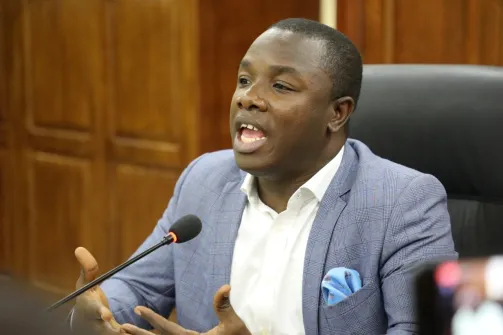
MONROVIA – A sharp escalation in Liberia’s political rhetoric has emerged as former lawmaker and Secretary General of the Congress for Democratic Change, Jefferson T. Koijee, launches a blistering public attack against Deputy Speaker Thomas Fallah, accusing him of betrayal and political opportunism following his expulsion from the party. Delivered through a direct message aired on the OK Morning Rush show, Koijee’s remarks extend beyond internal party tensions to include a broader warning to President Joseph Boakai and his administration. As THE ANALYST reports, the confrontation seems to signal deepening divisions within Liberia’s opposition landscape as political actors position themselves ahead of the 2029 electoral cycle.
A fierce and unrestrained political confrontation has erupted within Liberia’s opposition space, as former lord mayor of the City of Monrovia and Secretary General of the Congress for Democratic Change (CDC), Jefferson T. Koijee, launched a scathing public attack on Deputy Speaker Thomas Fallah, accusing him of betrayal, political opportunism, and alignment with forces opposed to the CDC’s ideological foundation.
The remarks, delivered in a pointed message directed at Fallah and broadcast on the OK Morning Rush show, mark one of the most direct and combative internal criticisms since Fallah’s expulsion from the CDC following the 2023 elections—a development the party characterized at the time as “political prostitution.”
A Direct Challenge to Loyalty and Identity
Koijee’s message was both personal and political, questioning Fallah’s ideological consistency and loyalty to the movement that once elevated him.
“You have been expelled, yet you now dance for the very forces that once oppressed the struggle you claimed to believe in,” Koijee declared, framing Fallah’s post-expulsion posture as a departure not merely from party affiliation but from the broader political struggle associated with the CDC.
The language reflects a deeper internal fracture within the party, where issues of loyalty, identity, and political alignment are increasingly being contested in public.
Message Extends to President Boakai
While directed at Fallah, the statement quickly expanded into a broader political warning aimed at President Joseph Boakai and the ruling establishment.
Koijee urged Fallah to “carry this word” to the President, asserting that no alliance—domestic or international—would be sufficient to override the will of the Liberian people.
In a striking rhetorical flourish, he suggested that even the mobilization of “every external master, every hidden hand” would not alter what he described as an inevitable political outcome determined by the electorate.
Invoking Global Political Lessons
Koijee reinforced his argument by invoking international political developments, referencing Hungary’s political transition from Viktor Orbán to Péter Magyar as an example of how entrenched political power can be overturned by popular will.
“The lesson is eternal,” he asserted, arguing that no elite alliance or external backing can withstand a determined electorate.
While the comparison may be politically illustrative, it underscores a broader attempt to frame Liberia’s political trajectory within a global narrative of democratic accountability and electoral change.
2029 Elections Framed As Defining Moment
Central to Koijee’s message is a forward-looking political projection, positioning the October 10, 2029 elections as a decisive moment of national judgment.
He expressed confidence that the outcome of that electoral cycle would be “clear, overwhelming, and final,” leaving no room for negotiation or manipulation.
“In that moment,” he declared, “Mr. Boakai will not spend one more minute in the office of the presidency.”
Such statements reflect an intensifying political atmosphere in which future electoral contests are already being framed in absolute and existential terms.
Defending the CDC’s Relevance
A significant portion of Koijee’s remarks was devoted to defending the continued relevance and vitality of the CDC, countering narratives that the party has weakened following its loss of state power.
He accused Fallah of attempting to portray the party as “finished, divided, and destined for irrelevance,” and rejected such characterizations as both inaccurate and politically motivated.
According to Koijee, the CDC remains deeply rooted in the consciousness of its supporters, describing it as a “living heartbeat” of what he termed the “Blue Revolution.”
Reaffirming George Weah’s Leadership
Koijee also reaffirmed the centrality of former President George M. Weah within the CDC’s political future, portraying him as a symbol of resilience and continued hope among the party’s base.
He went further, describing Weah’s leadership in spiritual and deterministic terms, asserting that he remains the “ordained and destined leader” to guide Liberia forward.
Such framing reflects the enduring personal and symbolic role Weah continues to play within the party’s identity, even outside of formal state power.
A Warning on Political Realignment
The message concluded with a broader warning to Fallah and other political actors perceived to be shifting allegiances.
Koijee cautioned that history would judge such decisions, emphasizing that the Liberian people are “watching, remembering, and preparing.”
“Choose your side carefully,” he warned, suggesting that the political consequences of present alignments would become evident in due course.
Deepening Political Fault Lines
The exchange highlights deepening fault lines within Liberia’s political landscape, particularly within opposition ranks where questions of loyalty, ideology, and future direction are increasingly contested.
It also underscores the intensity with which political actors are beginning to position themselves ahead of the 2029 elections, signaling that the next electoral cycle may be defined not only by policy debates but by narratives of identity, legitimacy, and historical continuity.
As rhetoric sharpens and alignments shift, the coming years are likely to test the resilience of Liberia’s political institutions and the maturity of its democratic discourse.
Comments are closed.