
Trial Testimonies Shake Prosecution Case -Pundits Say contradictions strengthen defense in Tweah trial
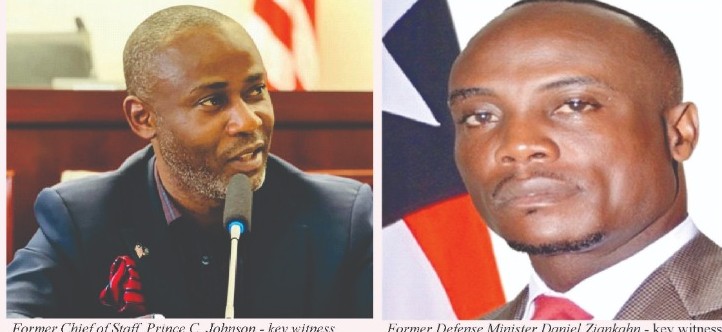
MONROVIA – A significant shift is emerging in the high-profile trial of former Finance Minister Samuel D. Tweah Jr. as key witness testimonies begin to challenge the foundation of the Government’s case. What was initially framed as a clear prosecution narrative is now being tested by contradictions touching on Liberia’s national security structure, legal procedures, and executive authority. As former Defense Minister Daniel Ziankahn and state witness Prince C. Johnson take the stand, their accounts are introducing uncertainty into critical elements of the indictment. The unfolding proceedings are raising broader questions about whether the case rests on firm legal ground or procedural misinterpretation. THE ANALYST reports.
Proceedings in the high-profile trial of former Finance Minister Samuel D. Tweah Jr. took a dramatic and potentially consequential turn Wednesday, as testimonies from two key witnesses—former Defense Minister Daniel Ziankahn and state witness Prince C. Johnson—introduced contradictions that legal analysts say could significantly weaken the Prosecution’s case.
The testimonies, delivered in open court in Monrovia, have not only raised doubts about the Government’s interpretation of Liberia’s national security architecture, but have also reinforced the Defense’s central argument that the matter hinges more on procedural interpretation than demonstrable criminal conduct.
FIA Membership Claim Challenged
One of the Prosecution’s key assertions—that the Financial Intelligence Agency (FIA) became part of the Joint Security framework only after a 2023 communication from National Security Advisor Jefferson Kanmoh—was directly contested during Ziankahn’s testimony.
When questioned about the alleged “admission” of the FIA into Joint Security, Ziankahn stated that he was unaware of any such formal process.
Legal experts observing the proceedings note that this response strikes at a critical element of the Prosecution’s case. Under the National Security Act of 2011, Liberia’s security architecture is clearly defined, with institutions such as the FIA established by statute and operating as integral components without the need for any formal “admission.”
Further clarification from observers suggests that the referenced 2023 communication merely assigned a communication code—“800”—to the FIA, rather than conferring any form of institutional membership.
This distinction, while technical, carries significant legal implications for the validity of the Prosecution’s claims.
Presidential Authority on Security Financing
Ziankahn’s testimony also shed light on the financing mechanisms of national security operations, describing what he characterized as a dual-channel system.
According to his account, funding for Joint Security operations may proceed either through established institutional channels—via the Joint Security framework to the Ministry of Finance—or directly from the President, acting in his capacity as Chair of the National Security Council.
This revelation lends weight to the Defense’s argument that certain financial transactions, which the Prosecution seeks to characterize as irregular, may in fact fall within legitimate executive authority, particularly under sensitive “need-to-know” operational protocols.
For legal observers, this introduces complexity into the Prosecution’s effort to establish wrongdoing, as it raises the possibility that the contested actions were not unauthorized, but rather executed within a recognized, albeit less transparent, framework.
Leadership of Joint Security: A Critical Contradiction
Perhaps the most consequential moment in the proceedings emerged during the testimony of Prince C. Johnson, who addressed the question of leadership within the National Joint Security structure.
“In the absence of the Minister of Justice, it is the Minister of Defense—not the Acting Minister of Justice—who chairs the National Joint Security,” Johnson testified.
This statement directly contradicts the Government’s indictment, which repeatedly identifies Nyanti Tuan as having served as Acting Chairman of Joint Security during the period in question.
Legal analysts warn that such a discrepancy could undermine a central pillar of the Prosecution’s case. If the court determines that the indictment is based on a flawed understanding of institutional authority, it could weaken the legal basis upon which the charges are constructed.
Procedural Misinterpretations Exposed
Johnson’s testimony also addressed procedural aspects of Joint Security operations, including claims that the National Security Advisor “swears in” institutions into the security framework.
However, legal experts have challenged this characterization, emphasizing that oaths administered within the security sector are designed to enforce confidentiality rather than confer institutional status.
Membership in Joint Security structures, they argue, is derived strictly from statutory provisions, not ceremonial practices.
This clarification further supports what many analysts are now describing as a broader pattern of procedural misinterpretation within the Prosecution’s case.
Case Hinges on Procedure, Not Intent?
Concerns about the strength of the Government’s case are no longer confined to external observers. A Government lawyer, speaking anonymously, acknowledged that the case appears to rely heavily on administrative and procedural questions rather than clear evidence of criminal intent.
“The case appears to rely heavily on administrative processes rather than demonstrable criminal conduct,” the lawyer stated. “Absent clear evidence of criminal intent or wrongdoing, procedural issues alone may not sustain a conviction.”
This assessment aligns closely with the Defense’s longstanding position that the charges stem from misinterpretations rather than illegal actions.
Defense Strategy Signals Confidence
The Defense team’s courtroom approach has also drawn attention. Counsel notably declined to cross-examine Ziankahn and limited questioning of Johnson to brief, confirmatory exchanges.
Legal observers interpret this restraint as a calculated strategy, suggesting that the Prosecution’s own witnesses are reinforcing the Defense’s narrative, thereby reducing the need for aggressive cross-examination.
Such an approach is often viewed as a signal of confidence that the case is shifting in the Defense’s favor.
Trial Continues Under Heightened Scrutiny
The trial is scheduled to resume Thursday, April 16, with expectations that the Prosecution may soon rest its case. The Defense is anticipated to begin presenting its arguments shortly thereafter.
As proceedings continue, the focus will remain on whether the contradictions exposed in court will materially alter the trajectory of the case.
Beyond the immediate legal contest, the trial is increasingly being viewed as a broader test of institutional competence—raising questions about the accuracy of legal interpretation, the robustness of prosecutorial preparation, and the standards by which high-profile cases are brought before the courts.
At stake is not only the outcome of one trial, but public confidence in the integrity of Liberia’s justice system.
Comments are closed.