
Grigsby Pushes Legal Reforms-Says witness protection gaps demand urgent action
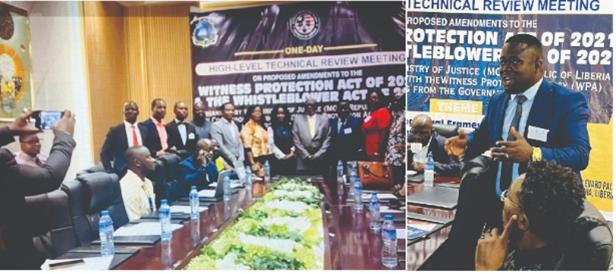
MONROVIA – Liberia’s justice reform momentum gathered renewed urgency as the Witness Protection Agency convened a high-level technical review targeting foundational weaknesses in the country’s witness and whistleblower protection laws. Speaking before a cross-section of judicial authorities, government officials, development partners, and civil society actors, WPA Director Atty. Teklo Maxwell Grigsby framed the exercise not as routine legislative housekeeping, but as a necessary intervention to restore credibility, close operational gaps, and strengthen Liberia’s anti-corruption architecture. At stake, he argued, is the confidence of citizens who must choose between silence and disclosure, often at great personal risk, within a system still struggling to guarantee their safety and dignity, as THE ANALYST reports.
A sweeping call for legal and institutional reform echoed through the halls of the Boulevard Hotel on Tuesday as Liberia’s Witness Protection Agency (WPA), under the leadership of Atty. Teklo Maxwell Grigsby, convened a high-level technical review meeting aimed at overhauling the country’s witness and whistleblower protection regime.
The gathering—bringing together an unusually broad coalition of actors spanning the judiciary, executive branch, anti-corruption institutions, civil society, and international partners—was not framed as a ceremonial dialogue. It was presented instead as a corrective moment, a point of reckoning for laws that, while historically significant, are now being tested by the realities of implementation.
Addressing the distinguished audience, Atty. Grigsby opened with a tone that blended institutional pride with sober realism. The Witness Protection Act of 2021 and the Whistleblower Act of 2021, he acknowledged, marked a turning point in Liberia’s legislative history—establishing, for the first time, a structured framework to protect individuals who step forward with critical information in criminal proceedings and anti-corruption efforts.
Yet, beneath that milestone achievement lies a more complicated truth.
“The law is a living instrument,” Grigsby declared, emphasizing that its relevance must be measured not by its existence, but by its effectiveness in real-world conditions. The WPA’s experience in administering the protection program, he noted, has exposed a series of structural gaps—gaps that now threaten to undermine the very objectives the laws were designed to achieve.
A System Under Strain
Central to Grigsby’s argument is a stark reality: justice systems do not function in the absence of protected witnesses.
Across Liberia—and indeed across much of Africa—weak or underdeveloped witness protection systems have long contributed to compromised prosecutions, abandoned cases, and a culture of silence where fear overrides civic duty.
Grigsby did not shy away from this reality. He pointed to comparative experiences from countries such as South Africa, Kenya, Rwanda, and Nigeria, where varying models of witness protection have evolved, offering lessons—both positive and cautionary—for Liberia’s reform path.
But the challenge at home is immediate.
The WPA’s internal review has identified critical deficiencies:
Ambiguities in the definition of who qualifies as a protected person;
Inadequate confidentiality provisions that leave witnesses exposed;
Weak inter-agency coordination mechanisms;
And gaps in alignment with international standards, particularly under the United Nations Convention Against Corruption (UNCAC).
These are not abstract legal concerns. They translate directly into operational risks—risks that can determine whether a witness comes forward or remains silent.
The Cost of Weak Protection
Grigsby’s remarks returned repeatedly to one central theme: confidence.
The credibility of Liberia’s anti-corruption framework, he argued, rests not on legislative texts alone, but on the lived experience of individuals navigating the system.
“If the State cannot guarantee protection,” he implied, “then disclosure becomes an act of self-endangerment.”
This is the paradox confronting Liberia’s justice sector.
On one hand, the country has taken bold steps to institutionalize anti-corruption mechanisms. On the other, those mechanisms remain vulnerable if the human element—the witness, the whistleblower, the informant—is not adequately protected.
The consequence is predictable: underreporting of corruption, weakened prosecutions, and erosion of public trust.
A Review Framed as Imperative
For the WPA, therefore, the ongoing review is not procedural. It is existential.
Grigsby described the exercise as a “legal imperative,” one that must yield outcomes that are not only technically sound but also operationally viable.
He called for deliberations that are frank, rigorous, and anchored in practical realities—moving beyond theoretical frameworks to address the everyday risks faced by those who engage with the justice system.
Among the priority areas identified:
Strengthening confidentiality protections to prevent unauthorized disclosure;
Clarifying institutional roles to eliminate duplication and fragmentation;
Establishing enforceable anti-retaliation mechanisms with clear penalties;
And ensuring alignment with Liberia’s international obligations.
The Emerging Threat Landscape
Perhaps most striking was the emphasis on emerging risks—particularly those tied to technology.
The existing laws, Grigsby noted, were crafted in a context that did not fully anticipate the rise of digital surveillance, cybersecurity vulnerabilities, and cross-border threats.
Today, these risks are no longer hypothetical.
Witnesses and whistleblowers can be tracked, exposed, or intimidated through digital means, often beyond the reach of traditional protection measures.
This evolving threat landscape demands a corresponding evolution in legal frameworks—one that integrates technological safeguards into the core architecture of witness protection.
A Collective Responsibility
While the WPA positions itself at the center of the reform process, Grigsby was careful to emphasize that responsibility is shared.
The Ministry of Justice, as co-convener, brings policy leadership. The Liberia Anti-Corruption Commission contributes enforcement perspective. The judiciary ensures legal integrity. Civil society provides advocacy and oversight. International partners offer technical support and comparative insight.
This multi-stakeholder approach, he suggested, is not optional—it is essential.
Effective witness protection cannot be achieved through isolated institutional efforts. It requires coordination, coherence, and sustained collaboration across the justice sector.
Beyond Law to Practice
A recurring undercurrent in the discussion was the gap between law and implementation.
Liberia’s statutes, while progressive on paper, must now be translated into systems that function reliably under pressure.
That means developing clear operational procedures, allocating adequate resources, training personnel, and establishing monitoring mechanisms that ensure compliance.
Without these elements, even the most well-crafted laws risk becoming symbolic rather than functional.
Toward Concrete Outcomes
The WPA’s expectations for the review process are deliberately ambitious.
Grigsby outlined a vision of tangible outputs:
Legislative amendments that close identified gaps;
Operational frameworks that enhance coordination;
And actionable recommendations that can be implemented without delay.
The ultimate goal is not incremental improvement, but systemic strengthening.
A Defining Moment
As the meeting progressed, the broader significance of the exercise became increasingly evident.
This is not merely about refining legal texts.
It is about redefining the relationship between the State and its citizens—particularly those who take the risk of speaking out against wrongdoing.
Will they be protected?
Will their identities remain secure?
Will retaliation be punished?
The answers to these questions will shape the future of Liberia’s anti-corruption efforts.
Commitment from the WPA
In closing, Grigsby reaffirmed the Witness Protection Agency’s full institutional commitment to the reform process.
The Agency, he said, stands ready to engage substantively with all stakeholders, contribute its operational experience, and support the development of a framework that is both robust and responsive.
There was a sense, as the session drew to a close, that Liberia stands at a crossroads.
The legal foundation has been laid.
What remains is the difficult but necessary work of strengthening that foundation—ensuring that the protections promised in law are delivered in practice, and that justice, in its fullest sense, is not only pursued but made possible.
Comments are closed.