
Safe Navigation-Nyberg Commends Liberia’s Maritime Progress, Calls for IHO Membership
MONROVIA – Liberia is a country whose shipping registry places it among the most consequential maritime actors in the world, with recognizable influence on global ocean governance that extends far beyond its coastline. Yet, despite this prominence, critical aspects of maritime safety—particularly hydrography and nautical charting—have long remained underdeveloped across much of West Africa. Against growing international concern over safe navigation, environmental protection, and the resilience of global supply chains, Liberia is once again being encouraged to align its maritime stature with deeper technical leadership. This was the central message delivered during a follow-up engagement between the International Hydrographic Organization (IHO)and the Liberia Maritime Authority (LiMA), where IHO Director John Nyberg commended Liberia’s progress while urging the country to assume a more active role within the global hydrographic community—an area increasingly vital to maritime safety, environmental stewardship, and international trade. The Analyst reports.
The Director of the International Hydrographic Organization, Dr. John Nyberg, has commended Liberia for its growing commitment to hydrography, nautical charting, and maritime safety, while strongly encouraging the country to deepen its engagement within the global hydrographic system.
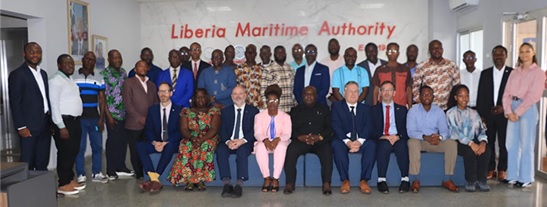
Dr. Nyberg made the remarks during the IHO delegation’s follow-up visit to the Liberia Maritime Authority, describing the engagement as both timely and encouraging. He expressed appreciation for the warm reception accorded to the delegation and noted that the strong turnout by Liberian stakeholders reflected genuine national interest in safe navigation and hydrographic development.
According to Dr. Nyberg, Liberia has demonstrated seriousness in following up on recommendations from earlier technical assessments, particularly those stemming from the IHO’s 2016 review.
Among the most significant recommendations, he emphasized, is Liberia’s membership in the International Hydrographic Organization—a step he described as essential for strengthening maritime governance and addressing findings raised during audits conducted by the International Maritime Organization (IMO).
“IHO membership is not symbolic,” Dr. Nyberg stressed. “It is a practical tool that allows countries to improve safety of navigation, comply with international obligations, and meaningfully participate in the global maritime domain.”
He noted that Liberia already plays an outsized role internationally through its shipping registry, one of the largest in the world, and argued that deeper engagement in hydrography would complement that leadership by enhancing coastal state responsibilities, data sharing, and maritime risk management.
Drawing on his professional background, Dr. Nyberg outlined more than 25 years of service with the United States National Oceanic and Atmospheric Administration (NOAA), where he led the U.S. Nautical Charting Program and later served as Deputy National Hydrographer before his election as an IHO Director. He explained that the IHO is governed by three elected Directors who collectively oversee global operations, and that he deliberately chose to focus much of his engagement on West Africa.
West Africa, he observed, remains significantly underrepresented within the IHO, with only a handful of coastal states holding membership. This underrepresentation, he said, limits the region’s ability to influence international hydrographic standards and decision-making processes that directly affect African waters.
“The potential of this region is enormous,” Dr. Nyberg said, noting that stronger participation from West African states would improve maritime safety, protect marine ecosystems, and unlock economic opportunities linked to ports, fisheries, offshore energy, and undersea infrastructure.
Addressing broader geopolitical trends, Dr. Nyberg acknowledged growing global skepticism about multilateralism but expressed confidence in the IHO’s resilience. He described the organization as a largely technical platform where countries cooperate regardless of political differences to solve practical challenges related to navigation safety and efficiency.
He thanked LiMA and national stakeholders for their hospitality and engagement, expressing optimism that the discussions would translate into stronger cooperation and concrete progress during and beyond the visit.
For his part, John F. Harvey, Deputy Commissioner for Domestic Vessels Registration and Safety at LiMA, welcomed the IHO delegation and partner institutions, describing the visit as a critical continuation of the 2016 assessment.
Mr. Harvey explained that the follow-up visit provides an opportunity to evaluate how far Liberia has come in implementing earlier recommendations. While acknowledging that several actions have been completed, he noted that others remain ongoing, reflecting the complexity of maritime governance and the involvement of multiple institutions.
“This engagement allows us to take stock of what has been achieved and to identify areas that still require attention,” Harvey said, adding that visible progress has been made in improving systems and practices within the maritime sector.
He recalled that Liberia also underwent an IMO audit in 2004, which identified several deficiencies related to coastal state obligations. Many of these responsibilities, he said, are shared across line ministries and agencies, and delays by some institutions contributed to adverse findings.
To address these challenges, inter-agency committees were established to implement corrective actions. According to Harvey, these committees have made notable progress, culminating in the submission of a corrective action report to the relevant Secretariat—an effort he said demonstrates Liberia’s commitment to transparency and continuous improvement.
Harvey expressed confidence that technical guidance from the IHO, the UK Hydrographic Office, and other partners would help Liberia address remaining gaps more effectively.
Also speaking to reporters, Debbie Cooper, Director of Policy Compliance and International Relations at LiMA, described the visit as a critical milestone linking accurate hydrographic services directly to safe navigation and marine environmental protection.
She emphasized that hydrography is inherently collaborative, requiring coordination across institutions despite LiMA’s central role. Hydrographic surveying and charting, Cooper explained, provide the data that allow mariners to avoid hazards such as wrecks, shallow waters, pipelines, and submarine cables.
“When hydrographic information is incomplete or inaccurate, the consequences can be severe,” Cooper warned, citing risks including vessel groundings, oil spills, environmental damage, and regional economic disruption.
She recalled incidents in which damaged submarine cables disrupted communications beyond national borders, underscoring the strategic importance of accurate charting.
As an IMO member state, Cooper said, Liberia is obligated to provide effective hydrographic services. She highlighted achievements since the 2016 assessment, including the establishment of a National Maritime Committee and the development of a National Maritime Strategy, which have strengthened coordination among agencies.
A major outstanding recommendation, she noted, is the creation of a National Hydrographic Committee, requiring participation from institutions such as the Department of Civil Aviation, Environmental Protection Agency, National Port Authority, and the Liberia Petroleum Refining Company.
The visit, which brought together stakeholders from the Ministry of Mines and Energy, Environmental Protection Agency, National Disaster Management Agency, National Port Authority, and other entities, underscored Liberia’s ongoing efforts to align with international maritime standards while strengthening safety, coordination, and compliance across its maritime domain.
Comments are closed.