
Boakai Champions Africa Peace Leadership-Wants Youth Agenda Take Center Stage
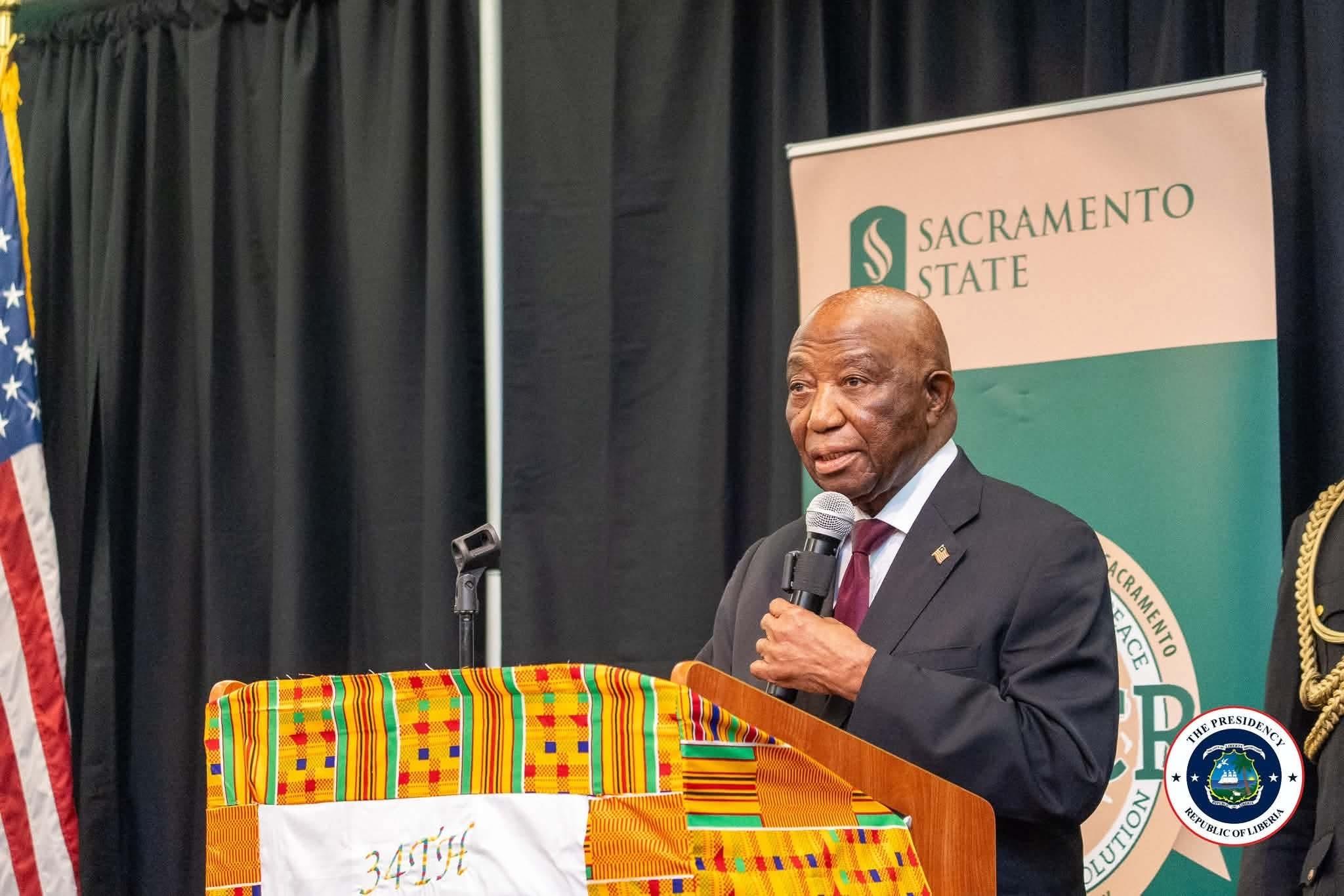
MONROVIA – President Joseph Nyuma Boakai’s acceptance of a prestigious continental peace award in the United States has elevated Liberia’s post-war recovery narrative onto a global stage, reinforcing the country’s image as a model of resilience and democratic renewal. Delivered in Sacramento, California, his keynote address went beyond ceremonial gratitude, offering a reflective and forward-looking vision of peace anchored in justice, youth empowerment, and institutional integrity. The speech arrives at a moment when global instability and regional pressures test the durability of peace across Africa, placing Liberia’s experience under renewed scrutiny. For Boakai, the message was clear: peace must be actively built, sustained, and defended, as THE ANALYST reports.
President Joseph Nyuma Boakai, Sr. has used an international platform in the United States to reaffirm Liberia’s commitment to peace, reconciliation, and democratic governance, while simultaneously positioning the country’s post-conflict recovery as a reference point for broader continental transformation.
Speaking at the 34th Africa Peace Awards hosted by the Center for Africa Peace and Conflict Resolution at California State University, Sacramento, President Boakai delivered a sweeping keynote address that combined personal reflection, national testimony, and a strategic vision for the future of peace leadership across Africa and its diaspora.
The occasion, marked by formal recognition of Boakai’s contributions to peace and governance, was framed not as a personal accolade, but as a collective tribute to the Liberian people. In a tone of humility and historical consciousness, the President emphasized that the honor belonged to citizens who endured years of civil conflict yet chose reconciliation over revenge.
“This honor is not mine alone,” Boakai declared, anchoring his remarks in the lived experiences of Liberians who, between 1989 and 2003, faced one of the most devastating civil wars in the region—one that claimed over 250,000 lives and left institutions fractured and trust eroded.
Yet, from that devastation, he argued, emerged a defining national choice: the deliberate pursuit of peace through dialogue, democratic renewal, and institutional rebuilding.
Boakai’s speech offered a layered understanding of peace, rejecting the notion that it is merely the absence of conflict. Instead, he framed peace as a dynamic condition rooted in justice, inclusion, opportunity, and dignity—elements that must be actively cultivated within societies.
For Liberia, he noted, peace is not theoretical. It is lived, tested daily, and sustained through deliberate policy choices and national commitment.
The President traced Liberia’s recovery trajectory from the signing of the Accra Comprehensive Peace Agreement in 2003, through successive democratic transitions, to its current efforts to confront historical injustices. These efforts include national apologies, dignified reburials, and ongoing steps toward establishing a War and Economic Crimes Court—an initiative he described as essential to ensuring that accountability and reconciliation move forward together.
In doing so, Boakai subtly reinforced the government’s current transitional justice agenda, situating it within a broader historical continuum rather than as an isolated policy initiative.
Equally significant was his emphasis on institutional resilience. Liberia’s ability to conduct peaceful democratic transitions, he noted, has strengthened its democratic credentials and positioned it as a credible voice in global peace discourse. This credibility is further underscored by Liberia’s current role as a non-permanent member of the United Nations Security Council for the 2026–2027 term.
Through this platform, Boakai pledged that Liberia would advocate for dialogue, diplomacy, and international cooperation, leveraging its experience to contribute to global peacebuilding efforts.
However, the President’s address was not limited to reflection. It was forward-looking, particularly in its focus on Africa’s youth—a demographic reality that he described as both an opportunity and a risk.
With approximately 70 percent of Sub-Saharan Africa’s population under the age of 30, Boakai warned that failure to integrate young people into governance and development processes could fuel instability, inequality, and conflict. Conversely, he argued, harnessing this demographic dividend could drive innovation, economic growth, and sustainable peace.
The speech outlined a series of policy-oriented recommendations aimed at building the next generation of peace leaders. Among these was a call for governments to invest in leadership development initiatives, including fellowships and mentorship programs supported by institutions such as the African Union and ECOWAS.
He also urged a rethinking of educational systems across the continent, advocating for curricula that integrate peace education, civic responsibility, and critical thinking from primary through tertiary levels. According to Boakai, such reforms are essential to equipping young people with the tools needed to navigate complex social and political environments.
Technology, too, featured prominently in his vision. The President highlighted the potential of digital platforms to mobilize youth, counter misinformation, and foster cross-border solidarity. In an era where information flows rapidly and narratives shape perceptions, he argued that technology must be harnessed as a force for positive engagement rather than division.
Traditional youth organizations were also identified as key vehicles for transformation. Boakai called for their restructuring to include peace mentorship programs, youth parliaments, and mediation initiatives, emphasizing the importance of intergenerational knowledge transfer.
“Our continent is blessed with diplomats, traditional leaders, elders, women, and civil society actors who cannot retire but must transfer wisdom,” he said, underscoring the need for continuity and mentorship in leadership development.
The President did not shy away from addressing the structural challenges facing African youth. He pointed to unemployment, inequality, limited access to education, and exposure to negative influences such as criminal networks and human trafficking as factors that undermine stability.
These realities, he warned, must be confronted through deliberate policy interventions that prioritize inclusion, opportunity, and empowerment.
Beyond Africa, Boakai extended his vision to the diaspora, describing it as an integral partner in the continent’s development and reconciliation processes. He invoked shared historical experiences, including slavery and colonialism, while urging a forward-looking partnership grounded in collaboration and mutual respect.
“Africa and her diaspora share a common destiny,” he stated, emphasizing the potential for diaspora engagement to contribute to peacebuilding, economic development, and cultural exchange.
The speech also carried a philosophical undertone, challenging prevailing notions of freedom and power. Boakai cautioned against the “vain accumulation of wealth and power” that marginalizes others, urging leaders to exercise responsibility and restraint.
In a particularly striking passage, he reminded his audience that political freedom, while significant, requires careful stewardship to avoid new forms of dependency or inequality.
At its core, the address was a call to action—directed not only at governments and institutions but at individuals. Boakai emphasized that peace leadership is not confined to presidents or diplomats. It is embodied by teachers, community leaders, entrepreneurs, and citizens who choose dialogue over division and justice over injustice.
“You, our youth, are the custodians of today’s and tomorrow’s peace,” he declared, urging young people to embrace their role in shaping the continent’s future.
The President’s closing remarks reinforced his commitment to building a Liberia that is just, inclusive, and prosperous, while also contributing to peace across Africa and the world. He framed the award as both recognition and responsibility—a reminder that the work of peacebuilding is ongoing and requires sustained dedication.
The significance of Boakai’s address extends beyond the ceremonial context of the award. It represents a strategic articulation of Liberia’s identity in the global arena—one rooted in resilience, guided by experience, and oriented toward the future.
At a time when many regions face renewed instability, Liberia’s narrative offers a counterpoint: a demonstration that recovery, reconciliation, and democratic consolidation are possible, even after profound conflict.
Yet, the speech also serves as a reminder that peace is not self-sustaining. It must be nurtured through inclusive policies, strong institutions, and active citizen engagement.
As Liberia continues its journey, the challenge will be to translate the vision articulated on the international stage into tangible outcomes at home—ensuring that the principles of justice, opportunity, and dignity are not only proclaimed but realized in the daily lives of its people.
In this sense, the Sacramento address is both a celebration of progress and a blueprint for the work that remains.
Comments are closed.