

Piah Releases More Performance Updates -Highlights 2025 Broad-Based Reforms, Achievements
MONROVIA – As 2025 draws to a close, the Government of Liberia has outlined a broad set of reported achievements and ongoing initiatives across key sectors of national development, including infrastructure, revenue mobilization, education, electricity, water supply, foreign engagement, and national security. The update, delivered at the Ministry of Information’s final press briefing of the year, presents a consolidated account of actions undertaken by line ministries, agencies, and commissions. According to the briefing, the report reflects a year marked by institutional reforms, expanded service delivery, and renewed international engagement. It details infrastructure projects, fiscal performance, sectoral investments, and policy measures intended to strengthen governance and economic activity. The presentation positions these efforts as part of a coordinated approach to national development, while providing a comprehensive summary of government activity during the year under review and setting out areas identified for continued focus going forward. THE ANALYST reports.
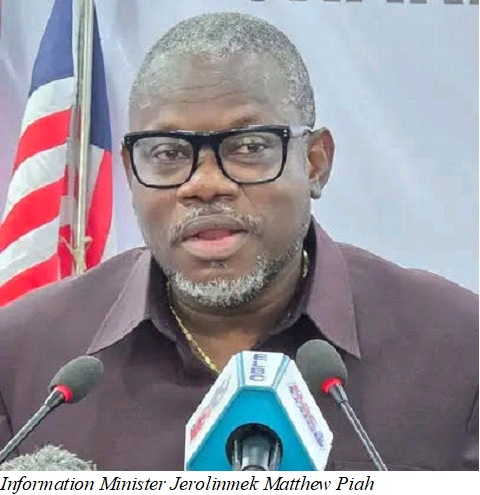
The Government of Liberia has reported progress across several key sectors of national development in 2025, including foreign policy, infrastructure, electricity, education, fiscal management, water supply, and national security, according to Information Minister Jerolinmek Matthew Piah.
Minister Piah made the disclosure during the Ministry of Information’s final press briefing for 2025, where he presented a consolidated performance update of line ministries, agencies, and commissions operating under the administration of President Joseph Nyuma Boakai, Sr.
Foreign Policy Reset and Global Re-engagement
According to the Minister, 2025 marked a strategic shift in Liberia’s foreign policy, with the Ministry of Foreign Affairs working to consolidate previously strained international relationships and reposition the country as a credible global partner.
Among the reported achievements were Liberia’s successful election to a non-permanent seat on the United Nations Security Council for the 2026–2027 term, the expansion of diplomatic relations with additional countries, and strengthened bilateral partnerships with the United States, France, Morocco, and Japan.
Minister Piah also disclosed that Liberia adopted a Gender-Responsive Feminist Foreign Policy, making it the first African country to formally institutionalize such a framework. The policy integrates gender equity, peace and security, climate governance, and women’s empowerment into Liberia’s foreign policy agenda.
Additional milestones cited include the extension of U.S. B1/B2 visa validity for Liberians to 36 months, the signing of a General Cooperation Agreement with France, strengthened engagement with the Liberian diaspora, decentralization of passport services to counties, and improvements in foreign aid transparency and inter-ministerial coordination.
Road Infrastructure Development
The Ministry of Public Works reported maintaining and rehabilitating 783 kilometers of roads nationwide, while paving more than 221 kilometers between January 2024 and December 2025.
Key projects cited include the Ganta–Saclepea Road, the Senequalie–Logatuo Road, the Zwedru–Greenville Corridor, the Capitol Bypass and urban road rehabilitation projects, as well as expanded road networks in coastal, southeastern, and rural areas.
Minister Piah stated that these interventions contributed to reduced transport costs, improved access, and greater price stability for commodities.
Electricity Expansion
The Liberia Electricity Corporation expanded national electricity access from 33 percent to 35 percent, connecting more than 63,000 new customers through urban, peri-urban, and rural electrification programs.
Reported achievements include tariff reductions for residential and social users, improved generation reliability, expansion of renewable energy projects, installation of solar streetlights, and the connection of rural communities through World Bank-supported initiatives.
Hydropower maintenance at Mount Coffee and new solar and battery energy storage projects are expected to significantly increase generation capacity between 2026 and 2027.
Education Sector Reforms
The Ministry of Education implemented reforms focused on learning outcomes, teacher stability, accountability, and inclusion.
Highlights include the launch of the US$88.7 million Excellence in Learning in Liberia Project, construction of 100 new primary schools, introduction of a national digital learning platform for Grades 1–3, regularization of 2,148 volunteer teachers onto the government payroll, removal of 1,053 ghost names, renovation of 40 public schools, and distribution of furniture under the One Child, One Chair initiative.
The Ministry also restored the national school census after a four-year lapse, launched a digital school permit platform, expanded school feeding programs, strengthened student welfare services, and scaled up scholarship programs domestically and internationally.
Fiscal Management and Revenue Mobilization
The Ministry of Finance and Development Planning submitted and secured legislative approval for a US$1.2 billion Fiscal Year 2026 National Budget, described as the largest in Liberia’s history.
The government mobilized US$883 million under the United Nations Cooperation Framework, secured US$12.8 million from Kuwait for road projects, and met eligibility requirements for a second Millennium Challenge Compact.
Fiscal reforms cited include improved transparency, timely publication of financial reports, full payroll migration to the Integrated Financial Management Information System (IFMIS), and strengthened audit compliance.
The Liberia Revenue Authority reported domestic revenue collections of approximately US$825 million in 2025, the highest recorded in Liberia’s history. Domestic revenue increased by US$213 million between 2023 and 2025, representing a 35 percent growth over two years, attributed to improved compliance, enforcement, and institutional strengthening.
Water Supply and National Security
The Liberia Water and Sewer Corporation operationalized the Brewerville Water System, expanded pipeline transmission, connected low-income households, and commenced water projects in Greenville and other areas.
In the security sector, the Ministry of National Defense strengthened civilian oversight of the Armed Forces of Liberia, approved 11 key policy directives, improved welfare and salaries of military personnel, renovated barracks, upgraded the 14 Military Hospital, and enhanced maritime security through the Coast Guard.
More than US$1 million was invested in barracks renovation, while new training programs, international exposure, and equipment upgrades were reported to have improved operational readiness.
Outlook
Minister Piah described 2025 as a year of recovery, reform, and repositioning, stating that the government’s performance reflects renewed fiscal discipline, growing international confidence, and a focus on delivering tangible outcomes for Liberians. He reaffirmed the administration’s commitment to sustaining reforms and development initiatives in 2026 and beyond.
Comments are closed.