
Boakai Launches New National Security Framework -Strategy targets threats beyond traditional security
MONROVIA – Liberia’s decision to unveil a new National Security Strategy arrives at a moment when traditional threats increasingly intersect with cyber risks, climate pressures, transnational crime, economic vulnerabilities, and public health emergencies. For a country that has spent decades consolidating peace after conflict, the significance of a modern security framework extends beyond military preparedness into governance, development, institutional trust, and citizen welfare. President Joseph Nyuma Boakai’s launch of the strategy signals an effort to align national security with democratic resilience while strengthening cooperation among state institutions, communities, and international partners confronting rapidly changing realities today with implications for and long term national stability and growth prospects ahead. THE ANALYST reports.
SECURITY AS THE FOUNDATION OF DEVELOPMENT
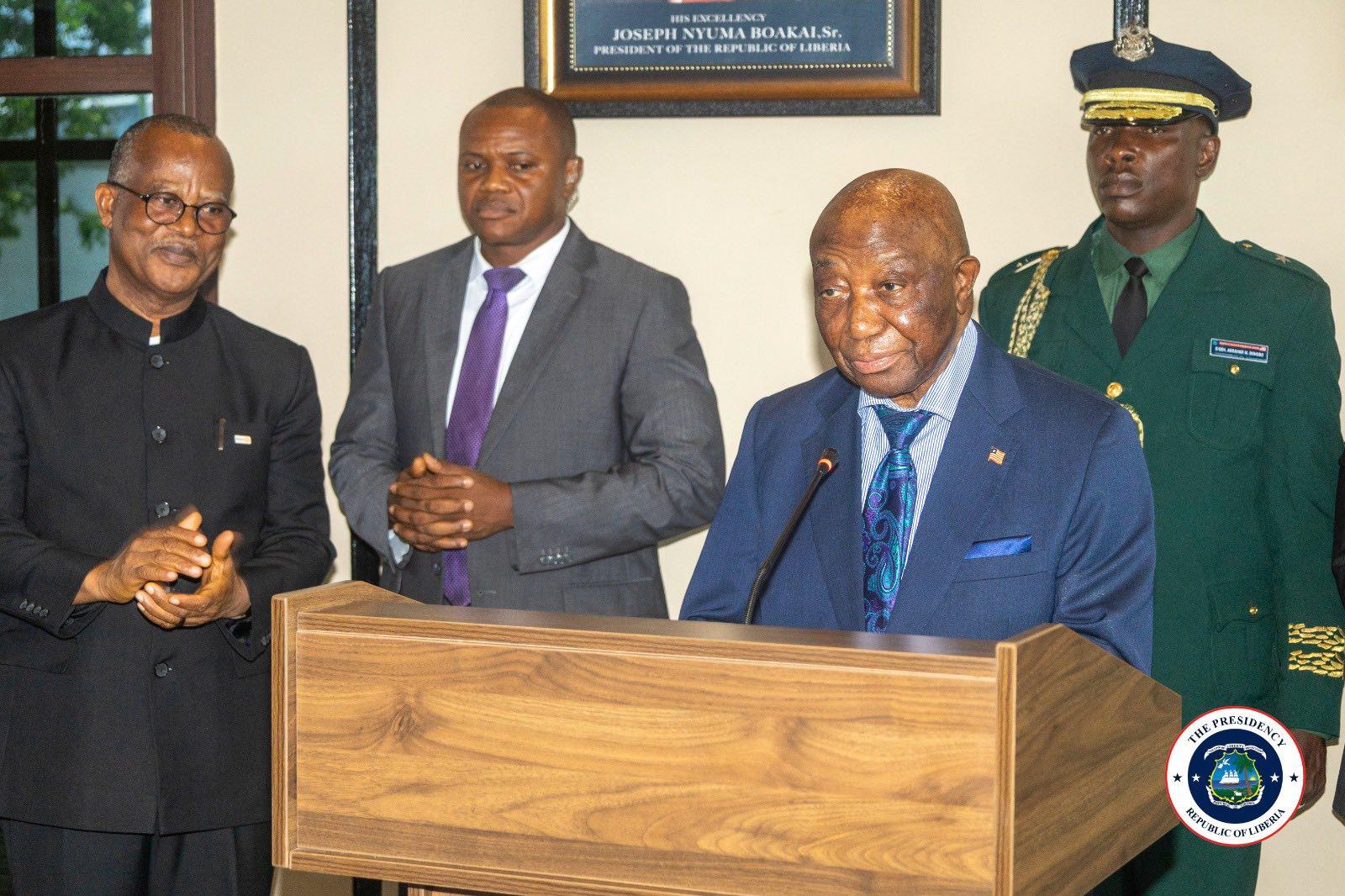
President Joseph Nyuma Boakai has formally launched the National Security Strategy of the Republic of Liberia (NSSRL), unveiling what he described as a comprehensive national blueprint intended to strengthen the country’s ability to confront evolving security threats while simultaneously deepening democratic governance, safeguarding national sovereignty, promoting economic stability, and advancing sustainable development.
The launch ceremony, held at the Executive Mansion in Monrovia, brought together senior government officials, members of the National Security Council, representatives of the Joint Security apparatus, development partners, diplomats, civil society actors, and other stakeholders involved in Liberia’s security and governance sectors.
Speaking in his capacity as Chair of the National Security Council, President Boakai characterized the new strategy as one of the most consequential policy frameworks introduced under his administration, emphasizing that security remains the foundation upon which all other national aspirations depend.
“The critical importance of security in a world fraught with global challenges cannot be overemphasized,” President Boakai declared. “Security is foundational; it is both a prerequisite and a catalyst for development.”
The Liberian leader stressed that the strategy should not be viewed merely as a policy document produced by government technocrats. Rather, he said, it embodies the aspirations of the Liberian people and establishes a national roadmap for protecting territorial integrity, preserving democratic gains, strengthening institutions, and ensuring that peace remains durable.
“Today marks a significant milestone in our collective journey toward building a peaceful, secure, and resilient nation,” he said.
RESPONDING TO EVOLVING THREATS
A central theme running throughout the President’s address was the recognition that the nature of security threats has changed dramatically since Liberia emerged from years of civil conflict.
President Boakai observed that modern security challenges are increasingly complex, interconnected, and transnational, making it necessary for governments to move beyond conventional security approaches.
He identified organized transnational crime, cyber threats, climate-induced vulnerabilities, economic shocks, and emerging public health crises as among the most pressing risks confronting nations today.
According to the President, the National Security Strategy was specifically designed to provide a forward-looking and coordinated framework capable of addressing these multifaceted threats before they evolve into larger national crises.
“In an increasingly complex and interconnected world, the nature of threats to national security continues to evolve,” he said. “From transnational organized crime and cyber threats to climate-related risks, economic vulnerabilities, and emerging public health challenges, our response must be proactive, coordinated, and forward-looking.”
The strategy emerged from a comprehensive assessment of Liberia’s current operating environment and prioritizes prevention, resilience, institutional effectiveness, citizen protection, and sustainable peacebuilding.
BEYOND GUNS, UNIFORMS AND BARRACKS
In one of the most significant policy messages contained in his address, President Boakai challenged the traditional perception that national security is solely the responsibility of soldiers, police officers, intelligence agencies, and other uniformed services.
Instead, he argued that security must be understood as a broader national undertaking involving governance, justice, economic opportunity, social inclusion, and public confidence in state institutions.
According to him, no nation can achieve lasting peace and security if large segments of its population remain excluded from development opportunities or lose faith in public institutions.
“National security is not the sole responsibility of the traditional security sector,” he stated. “It is a shared duty that encompasses good governance, justice, economic opportunity, and social cohesion.”
The President further connected security to the equitable management of national resources, noting that peace becomes more sustainable when citizens see tangible benefits from governance and development.
“Our true security rests upon how well we fulfill our democratic promise,” he declared.
ADMINISTRATION PLEDGES SECURITY REFORMS
President Boakai used the occasion to reaffirm his administration’s commitment to strengthening Liberia’s security institutions through reforms aimed at improving professionalism, operational effectiveness, accountability, and public trust.
He pledged continued investments in intelligence gathering, intelligence-sharing mechanisms, border management systems, and community-based security initiatives.
The President’s remarks indicate that the new strategy will place considerable emphasis on intelligence-led operations, interagency coordination, and preventive security measures rather than relying solely on reactive responses.
“As Chair of the National Security Council, I reaffirm this Administration’s unwavering commitment to strengthening the capacity, professionalism, and accountability of our security institutions,” he said.
Observers believe the strategy could reshape the manner in which security institutions coordinate operations and respond to emerging threats in the years ahead.
COMMUNITIES RECOGNIZED AS KEY PARTNERS
President Boakai also devoted considerable attention to the role of communities in maintaining peace and security.
Recognizing the importance of grassroots participation, he praised traditional authorities, local government officials, civil society organizations, community leaders, and religious institutions for their contribution to social stability and conflict prevention.
He specifically acknowledged chiefs, elders, superintendents, community leaders, and faith-based organizations as indispensable partners in Liberia’s broader security architecture.
“Deep in the heart of our nation are our chiefs, elders, local leaders, superintendents, community leaders, civil society, and our religious community, who must be commended for their indispensable role in supporting our national security architecture,” the President stated.
The acknowledgment reflects increasing recognition within government circles that security cannot be sustained without strong partnerships between state institutions and local communities.
REGIONAL COOPERATION TAKES CENTER STAGE
The President further highlighted the importance of regional and international partnerships in confronting contemporary security challenges.
He noted that many of today’s threats transcend national boundaries and therefore require collaborative responses involving neighboring countries and international organizations.
President Boakai reaffirmed Liberia’s commitment to deepening cooperation with ECOWAS, the Mano River Union, the African Union, the United Nations, and other partners.
According to him, these relationships remain essential for addressing shared threats and promoting collective regional stability.
“We will deepen collaboration with regional and international partners to address shared security challenges and promote collective stability,” he pledged.
Security experts have increasingly emphasized the importance of regional collaboration in addressing transnational crimes, terrorism, trafficking networks, cyber threats, and irregular migration.
PEOPLE-CENTERED SECURITY AT THE CORE
Throughout his address, President Boakai repeatedly returned to one central principle: the protection and well-being of Liberian citizens.
He assured the public that the strategy was designed to ensure that every Liberian enjoys safety, dignity, and confidence regardless of geographic location or socioeconomic status.
“Every citizen can be assured that their safety, security, and well-being remain at the heart of our national agenda,” he said.
“This Strategy is designed to ensure that every Liberian—regardless of location or circumstance—can live in dignity, free from fear, and with confidence in the future.”
The emphasis on citizen-centered security reflects a broader shift toward human security principles increasingly adopted by countries around the world.
INCLUSIVE CONSULTATIONS SHAPED DOCUMENT
President Boakai disclosed that the strategy emerged from extensive consultations involving security institutions, government ministries, civil society organizations, communities, and international partners.
He praised the participatory process and acknowledged stakeholders whose contributions helped shape the final framework.
Special recognition was given to National Security Advisor Samuel Kofi Woods II, Justice Minister N. Oswald Tweh, members of the Joint Security team, and other contributors who played significant roles in developing the strategy.
“I have been informed that a series of consultations preceded the final design and development of this Strategy,” the President said. “Your insights and commitment have been invaluable.”
Importantly, he also acknowledged that security planning must remain dynamic and adaptable to changing realities.
“Strategies change with time and conditions,” he noted.
CALL FOR NATIONAL OWNERSHIP
Concluding his remarks, President Boakai called for broad national ownership of the strategy and urged stakeholders across all sectors to support its implementation.
He stressed that successful execution would require cooperation among government institutions, the private sector, civil society organizations, development partners, and ordinary citizens.
“As we launch this National Security Strategy, I call upon all actors, public and private, to support its implementation,” he said.
“Let us work together, with unity of purpose and clarity of vision, to secure our nation for generations to come.”
With the formal unveiling of the National Security Strategy, the Boakai administration is seeking to institutionalize a governance model that links security, development, accountability, and citizen welfare into a single national framework.
The strategy represents one of the most comprehensive attempts in recent years to redefine security in Liberia, moving beyond traditional state protection toward a broader vision centered on resilience, human security, institutional strength, and sustainable development.
Whether its ambitious objectives are ultimately realized will depend not only on government commitment but also on the collective participation of communities, institutions, development partners, and citizens whose cooperation will ultimately determine the strategy’s success in safeguarding Liberia’s future.
country’s civil conflict.
Comments are closed.