
Sen. McGill Underscores Importance of Reconciliation -Speaks at CAI Forgiveness Education Training Forum
By H Matthew Turry
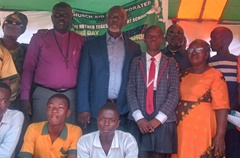
MONROVIA – In an effort to strengthen moral development process that helps individuals learn to overcome resentment, offer compassion, and foster reconciliation, the Church Aid Incorporated in collaboration with the Mother Tegeste Stewart School over the weekend held a one day groundbreaking Forgiveness Education training for over 100 high school students in Brewerville, district #17 Montserrado County at the Mother Tegeste Stewart Apostolic Pentecostal School
The one-day Forgiveness Education training and awareness session which brought together students, teachers, Bishops, Pastors, member of the Liberian Senate, and different facilitators was held under the theme, “The Place of Forgiveness Education in the Renewal of Local Communities and Reconciliation in Liberia.”
Delivering the keynote address, former Minister of State and Margibi County Senator Nathaniel F. McGill said Forgiveness Education is critically important in the reconciliation process of Liberia.
According to Senator McGill, Liberia, like many nations, has experienced periods of division, conflict, and hardship and the “scars of our past still affect communities, relationships, and institutions, and one of the most powerful tools we have for healing and progress is forgiveness—not as a sign of weakness, but as a courageous step toward reconciliation and renewal”.
Giving the importance of Forgiveness Education in healing of emotional and historical wounds, the Margibi lawmaker said forgiveness education helps individuals and communities confront the pain of Liberia’s past conflicts, including civil wars and social divisions.
“By teaching people how to process hurt, let’s go of resentment, and embrace healing; it paves the way for emotional recovery and collective national restoration,” he noted.
While speaking on the prevention of future conflicts through youth empowerment, the former CDC Chairman said by teaching young people about forgiveness, conflict resolution, and restorative justice, “we empower the next generation to break the cycles of hatred and retaliation”.
“On the promotion of peaceful coexistence and unity, Forgiveness Education encourages values like empathy, tolerance, and understanding, which are essential for rebuilding trust among citizens,” he noted.
Speaking on the role of the church in Forgiveness Education, Senator McGill said the church in Liberia has long been a pillar of strength, offering spiritual guidance and a place of refuge.
As the moral compass of society, he said further, the Church has a crucial role to play in forgiveness education.
“The Bible teaches us about the transformative power of forgiveness, and the church must continue to emphasize this message,” he said. “Matthew 18:21-22 urges Forgiveness as an ongoing practice, and it is within the church’s mission to teach this not only as a spiritual discipline but as a social necessity for national healing.”
The Margibi Senator said churches must offer spaces for people to come together in forgiveness, to reconcile past wrongs, and to heal from the emotional trauma that war and division have caused.
Defining the role of schools in Forgiveness Education, the Senate Committee Chair on Education narrated that school, as institution of learning are the future of Liberia; where youth of today shall have the power to shape the society of tomorrow, and it is therefore crucial that forgiveness education is integrated into their learning experiences.
“Schools should go beyond academic subjects and instill values of peace, unity, and forgiveness in their learning curriculum,” he asserted, quoting Biblical scriptures, Proverbs 22:6 which teaches, “Start children off on the way they should go, and even when they are old they will not turn from it.”
“By teaching forgiveness from an early age, the young people of Liberia can become ambassadors of peace who know how to address conflicts constructively rather than perpetuating the cycles of violence and hatred,” he added.
According to him, curriculum should be designed to include lessons on conflict resolution, restorative justice, and understanding historical trauma and that teachers should be trained to foster an environment where emotional intelligence and empathy are valued, where students are encouraged to process their emotions healthily and with an understanding of the broader social context.
On the role of the community in Forgiveness Education, McGill said the community, as the foundation of societal life, plays an integral role in the education of forgiveness.
He said communities must be spaces where individuals can engage in open conversations about the past, confront unresolved grievances, and work towards healing.
Providing Biblical references, the former Minister of State McGill quoted, “Hebrews 12:14 which says, “Make every effort to live in peace with everyone and to be holy; without holiness no one will see the Lord.”
According to him, this emphasizes the importance of peace and unity, which can be achieved through mutual understanding and forgiveness.
He also spoke of role of the media in Forgiveness Education, saying the media plays an important role in shaping public opinion and influencing societal norms through TV, radio, print, and social media,
“Philippians 4:8 encourages us to “think about whatever is true; whatever is noble, whatever is right, whatever is pure, whatever is lovely, whatever is admirable,” he emphasized. “The media can promote messages of peace, unity, and reconciliation by sharing stories of individuals and communities that have embraced forgiveness and healing.”
He further said the media should be responsible for countering hate speech, false narratives, and divisive rhetoric that can perpetuate conflict.
By reporting on reconciliation initiatives, educating the public about forgiveness, and showcasing positive role models, McGill said the media can foster a national dialogue about healing and progress.
Regarding the role of government in Forgiveness Education the Margibi Senator said: “The government is the ultimate enabler of national peace and unity, and in the context of forgiveness education, the government must create policies that encourage reconciliation, justice, and social healing.”
The lawmaker further quoted the Bible by saying, “Romans 13:1 reminds us that ‘Let everyone be subject to the governing authorities, for there is no authority except that which God has established.’ This implies that we as government leaders are tasked with ensuring justice and promoting peace.”
He noted that policies that prioritize forgiveness and reconciliation should be embedded into national programs, especially in post-conflict regions.
“The government must integrate forgiveness education into the formal curriculum and establish community peace and reconciliation centers to facilitate dialogue and healing across the country.
The CDC lawmaker told the students at the occasion: “You are the future of Liberia, and the choices you make now will determine whether Liberia continues on a path of peace or falls back into division. I want to encourage you to take responsibility for your role in reconciliation, in your schools, among your friends, and even in your families, you will face situations that test your ability to forgive. The Bible tells us in Colossians 3:13, ‘Bear with each other and forgive one another if any of you has a grievance against someone. Forgive as the Lord forgave you.’”
He concluded by saying, Liberia’s future depends on our ability to heal, reconcile, and rebuild together.
In special remarks, the Chairman and CEO of Church Aid Inc., Bishop Kortu K. Brown, said Liberia must do the right thing, and doing the right thing must include forgiveness to drive reconciliation in the country.
“Liberians will always struggle with doing the right things; Liberia is always challenged with doing the right thing, challenged with ensuring the rule of law, good governance, promoting reconciliation, fiscal accountability,” he said. “Too many people are afraid to do the right thing. But, why are you afraid to do the right thing? How can we have a crisis in the House of Representatives that is staying so long? It stayed so long because we didn’t want to do the right thing. And sometimes we think that we can bypass the right thing.”
Quoting from the Old Testament, the former Liberia Council of Churches President said, in 2nd King Chapter 22: 1-2, it says Josiah was eight years old when he began to reign, and he reigned for thirty and one years in Jerusalem. And he did that which was right in the sight of the Lord, and walked in all the way of David his father, and turned not aside to the right hand and to the left. We should not be afraid to do the right thing.”
According to the LCC President, “If we do the right thing it will lift our country up, but if we persist on doing the wrong thing, the wrong thing of the past.”
He added: “Don’t tell me it happened yesterday; yesterday we made a fuss for example with the CDC about the wrong thing they were doing and we don’t have to repeat them today because if we did then we are not promoting righteousness in Liberia.”
The clergyman cautioned citizens: “Liberians, our political leaders, our religious leaders, our academic leaders, whoever you are, if we want to make progress in Liberia, then we must promote righteousness in our governance, in the whole governance process. It is important for people like Senator Nathaniel McGill who are in the Senate Education Committee and the others to prioritize forgiveness education, because when we look on the faces of the young people we see hope in Liberia. You give us hope, when we see you don’t play football based on tribe, you don’t play football based on political party, you play football because you belong to the same school, the same family, the same community, the same nation, Liberia has hope.”
Continuing, he said: “I want to say to you the students, you are the generation of hope for Liberia and you should not hold back forgiving one another. The too many institutions are breaking down in Liberia because people don’t want to follow good examples. Religious institutions, political institutions, our political parties are in hand bags; our political parties are not factors for stability.”
Bishop Brown recounted: “Every time I think about the Catholic Church, I think about a good example of a factor for stability. I think about that Catholic Church that has been there over 1,000 years. Over 1,000 years, a religious institution is built and sustained to become part of the foundation of trying to maintain and drive morality in the world. It is important that we follow good examples of students.”
He stressed that anybody who wants to promote hate, envy, retribution in Liberia is holding the country back and wherever they are, they can be in the community, they can be in the church, they can be political parties, they can be in the government, they holding the country back, and they have to decide that they will do the right thing.
The Liberian cleric further noted: “If we are not consistent in upholding our values, if we are inconsistent in what we do, then it makes it difficult for us to make the kind of progress that we want. For we who are in the religious community, it was wrong yesterday, it is still wrong today, that is consistency. You went to school, you didn’t spy, why would you encourage your children to spy; you went to school you didn’t pay for grades; why do you encourage your children to pay for grades? A nation without values is an empty nation.”
For his part, the Coordinator of Liberia Forgiveness Education for CAI Program, Dr. Shalom M. S. Nimene, said there is a need now for the message of the peace of forgiveness education to be widely spread to all communities and schools.
“When I came to Liberia, I was privileged to serve for five years and something that surprised me; every time someone did something to another person they would say ‘I will pay my debt’. And this ‘pay my debt mentality’ drove us to where we were about 14 to 20 years ago where we slaughter one another,” he narrated.
“We are gathered today to see how we can carry on the teaching of forgiveness education, not only here but the length and breadth of Liberia,” he said. “Our wish is that, as we along the government of Liberia will see the need that indeed to embrace the teaching of forgiveness education in order to promote peace, because in the absence of forgiveness, peace is superficial, in the absence of forgiveness, reconciliation is just a mirage, in the absence of forgiveness, peaceful coexistence is not possible.”
Comments are closed.