
From Logan Town Roots To National Reckoning-Ngafuan’s Oddessy Shaped by Crisis, Courage, and Country
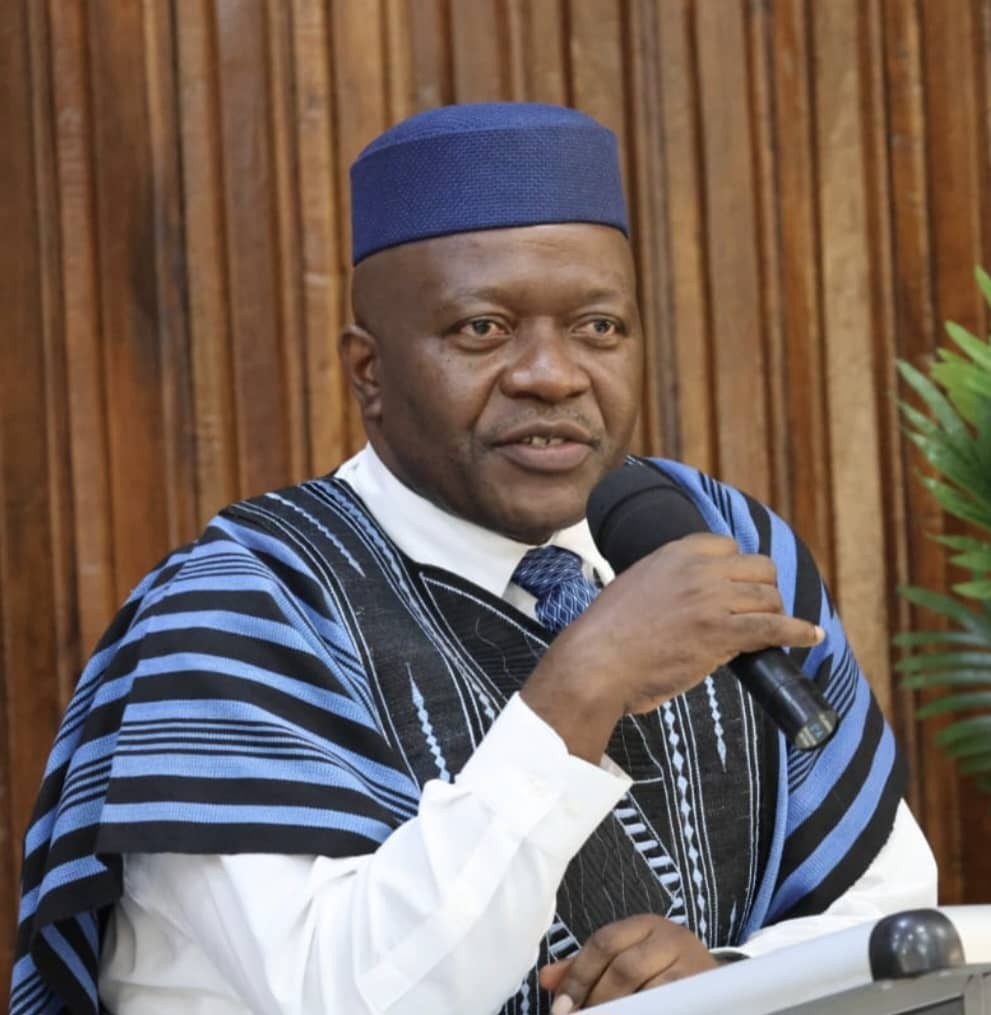
MONROVIA: In a country where leadership narratives are often shaped by privilege, proximity, or political inheritance, the story of Augustine Kpehe Ngafuan offers a different lens—one grounded in serial struggles, shaped by historical rupture, and refined through discipline and faith. Speaking in a rare, deeply reflective interview, the Finance Minister moves beyond policy language to reveal the personal foundations of public service, tracing a journey from Logan Town’s modest beginnings to the commanding heights of Liberia’s fiscal architecture. Yet beneath the story of ascent lies a deeper inquiry into resilience, national identity, and the burden of leadership in uncertain times. From excerpts of an exclusive interview on OK FM over the weekend, The Analyst reports on the Liberian fiscal maestro’s steps beyond policy briefings to offer something far more revealing—a layered account of a life forged in modest beginnings, tested by national upheaval, and sharpened through moments of personal and political risk.
FROM LOGAN TOWN TO NATIONAL STAGE
The Making of a Public Servant
The story of Augustine Kpehe Ngafuan does not begin in corridors of power, but in the dense, unvarnished realities of Logan Town—Gbandi Town to be precise—where survival, family cohesion, and modest aspiration formed the early grammar of life.
Born at the Old Maternity Center on Monrovia’s Bye-Pass, Ngafuan grew up in a household defined less by formal education and more by instinctive wisdom. His mother never had the opportunity to attend school. His father, though partially educated, navigated life through hustle, eventually working as a restaurant supervisor at the Ducor Palace Hotel. Yet both understood, with quiet conviction, that education was the only durable bridge out of limitation.
Books were purchased at great sacrifice. Priorities were reordered. And in those small but deliberate acts, the foundation of a future technocrat was laid.
But life’s fragility was never distant. The loss of a twin sister remains one of the most defining emotional markers in his life, reinforcing a worldview anchored in humility and reflection rather than celebration.
Birthdays, for him, are not festivities. They are audits.
A CHILD AWAKENED BY HISTORY
The Coup That Changed Everything
If family shaped his discipline, history awakened his consciousness.
The 1980 coup that led to the death of President William R. Tolbert Jr. was, for a young Ngafuan, both incomprehensible and transformative.
“I cried,” he recalled.
What began as confusion evolved into inquiry. Newspapers became daily ritual. Questions became habit. And a boy, once unaware of the mechanics of power, became deeply invested in understanding them.
It was, in many ways, an intellectual acceleration—one that pushed him beyond his years and into a lifelong engagement with national affairs.
BETWEEN FOOTBALL AND FATE
Paths Almost Taken
There were moments when the trajectory could have shifted.
Football was not a pastime; it was a serious ambition. Playing alongside future Lone Star players like Jonas Sarwiah and Fofie Kamara, Ngafuan was considered among the most promising talents of his cohort. At one point, the pull of the game nearly overshadowed his academic journey.
Yet intervention—parental, deliberate, and decisive—redirected him.
Equally formative were his years in Lofa County, where exposure to rural life introduced him to a different Liberia—one defined by labor, resilience, and what he calls “bush science.” These experiences grounded him, ensuring that his later policy perspectives would never be entirely detached from lived reality.
FAITH, DISCIPLINE, AND PERSONAL CHOICE
A Life of Restraint
At the age of twelve, a simple Bible study session produced a lifelong commitment: no alcohol, no smoking.
It was a decision made in innocence but sustained through conviction, even as later life revealed contradictions in those who had first taught him those values.
“Every one of us is weak,” he reflected. “Some of the things you achieve in life, just give them to the grace of God.”
That philosophy—part humility, part discipline—remains central to his identity.
THE RELUCTANT LEADER
From Shyness to Student Power
Ironically, the man now commanding national economic policy once avoided even answering questions in class.
“I was very shy,” he admitted.
Leadership did not come naturally. It was imposed—first by peers at the Booker Washington Institute, and later solidified at the University of Liberia. What began as reluctance evolved into responsibility.
And in time, responsibility demanded courage.
THE SPEECH THAT DEFIED POWER
Confronting Taylor in Real Time
At the height of Charles Taylor’s power, when dissent carried real danger, Ngafuan chose confrontation over caution.
At a national conference on Vision 2024, he delivered what he now calls his most “outrageous” speech—challenging the administration on reconciliation, human rights, and violations of the Abuja Accord.
The room fell silent. Fear was palpable.
“People were scared. You could drop a pin and hear it.”
But what followed was unexpected. Taylor did not silence him. He engaged him—publicly, persistently, and with visible irritation.
The exchange, broadcast live, became one of the most dramatic moments of student-led defiance in that era.
The consequences were immediate. Intelligence warnings forced Ngafuan into hiding for over a week. The threat was real. The fear, delayed.
Yet even in that moment, something else emerged: complexity.
TAYLOR: BETWEEN DEMON AND MAN
Reframing a Contested Legacy
Ngafuan resists the simplicity that has long defined public narratives about Taylor.
“There were two groups,” he explained. “Those who saw him as Jesus Christ, and those who saw him as Lucifer.”
His position was different.
“He was human—capable of both good and bad.”
This is not an absolution. It is a complication.
Ngafuan acknowledges the darker chapters of the Taylor era without hesitation. But he also points to overlooked dimensions: an ability to recognize talent, an openness—however limited—to dissent, and tangible institutional reforms, including the strengthening of Liberia’s financial architecture.
“He had a good eye for competence,” Ngafuan said.
It is an assessment grounded not in theory, but in experience.
FROM CRITIC TO TECHNOCAT
An Unlikely Transition
Perhaps the most revealing paradox is this: the same young man who openly challenged Taylor would later work within institutions shaped by his administration.
Recruited into the Central Bank after graduating with distinction, Ngafuan became part of a technocratic generation that benefited from opportunities within that system.
Even as an “anti-Taylor radical,” he was neither purged nor sidelined.
“Taylor knew about me,” he said. “But he did not remove me.”
This duality—criticism alongside inclusion—forms the core of Ngafuan’s argument: that leadership, even in its most controversial forms, is rarely one-dimensional.
STEERING AN ECONOMY UNDER PRESSURE
Growth, Shock, and Strategic Response
Today, the arena has shifted from student activism to economic management.
Ngafuan reports that Liberia recorded a 5.1 percent growth rate in 2025, alongside its highest-ever domestic revenue, exceeding US$840 million, and a national budget surpassing US$1 billion.
Yet progress has not been linear.
The sudden withdrawal of over US$300 million in USAID support created immediate strain across key sectors. The response, he argues, was not panic but recalibration.
“It was a shock,” he admitted, “but we restrategized.”
Looking ahead, projections for 2026 remain cautiously optimistic at 5.6 percent growth. But new external pressures—particularly geopolitical tensions affecting global oil markets—pose fresh risks.
Liberia, as an importer of petroleum products, is directly exposed.
Government responses include price adjustments, targeted interventions, and ongoing efforts to stabilize transport and essential services. While details remain guarded, the objective is clear: protect citizens without destabilizing fiscal policy.
LEADERSHIP WITHOUT ILLUSION
The Philosophy Beneath the Policy
Across the interview, a consistent theme emerges: realism without resignation.
Ngafuan does not promise ease. He does not deny hardship. Instead, he frames leadership as an exercise in navigation—managing uncertainty rather than eliminating it.
“We are hoping for the best,” he said, “but preparing for the worst.”
It is a statement that reflects both his personal journey and his public responsibility.
A LIFE THAT MIRRORS A NATION
From Logan Town to the Ministry of Finance, from shy student to national figure, from critic of power to steward of policy, Ngafuan’s journey is neither linear nor easily categorized.
It is, instead, deeply Liberian—marked by disruption, resilience, contradiction, and renewal.
And in telling it, he offers more than biography.
He offers a reminder: that nations, like individuals, are shaped not only by their triumphs, but by their willingness to confront complexity, to learn from contradiction, and to move forward without forgetting where they began.
Comments are closed.