

Zwedru Defies Skeptics, CDC Rises Triumphantly-22nd Anniversary Rewrites Liberian Opposition Playbook
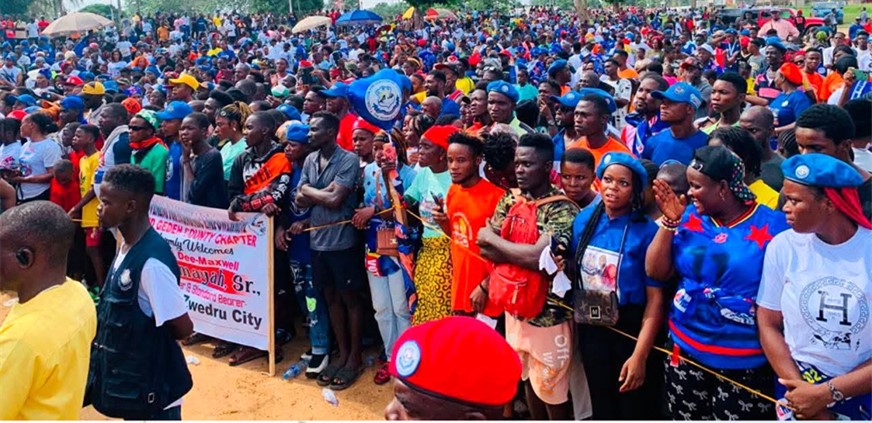
MONROVIA – When the Congress for Democratic Change announced plans to hold its 22nd anniversary in Zwedru, Grand Gedeh County, political analysts predicted a poorly attended gathering from a party in decline. They were wrong. Evidence abounds that what unfolded across five days last week was a commanding demonstration of organizational muscle, grassroots loyalty, and strategic coalition-building. Thousands converged from across southeastern Liberia and beyond. Opposition leaders who once fiercely criticized the CDC stood on the same platform. Former President George Weah addressed partisans via video from the United States. As THE ANALYST reports, the event delivered one unmistakable message: the CDC, let alone the opposition community against the ruling regime, is not finished.
When the opposition Congress for Democratic Change (CDC) announced that it would stage its 22nd Anniversary celebration in Zwedru City, Grand Gedeh County, many political observers were quick to dismiss the event. Skeptics predicted a poorly attended gathering, arguing that the celebration was merely an attempt to divert public attention from the party’s electoral defeat in 2023 and the steady departure of several influential figures from its ranks.
To them, the anniversary appeared destined to expose the party’s declining political fortunes rather than demonstrate its resilience. Yet, as preparations gathered momentum, that narrative gradually began to change.
Weeks before the celebration, the level of organization and coordination became increasingly evident. Despite encountering an early setback over access to the main venue, the organizers remained undeterred. Instead of allowing the challenge to derail the program, they regrouped and intensified preparations, gradually transforming Zwedru into the epicenter of Liberia’s political conversation.
Cynicism Meets the Southeast
The damp, thick air of southeastern Liberia had barely settled over the undulating landscape when the flyers went out. The opposition CDC was heading to Zwedru City, Grand Gedeh County, to observe its twenty-second anniversary and militant month celebration. In the climate-controlled offices of Monrovia, the political chattering classes smiled with practiced cynicism.
To the pundits, the announcement smelled of desperation — a loud, frantic distraction engineered by a political vanguard that had only recently watched the presidency slip through its fingers. With the corridors of state power now out of reach and a slow, agonizing trickle of high-profile defections chipping away at the party’s once-impenetrable armor, critics confidently prepared to write an obituary. They expected a ghost town; they expected the quiet, whimpering echo of a movement whose sunset had arrived.
But politics in the southeastern hinterlands rarely obeys the scripts written in the capital. As the calendar turned, a low, tectonic hum began to reverberate through the region, catching the entire Liberian political space completely off guard.
The Setback That Fueled the Fire
The road to this historic gathering was almost blocked before it began. In the eleventh hour, a sudden administrative roadblock denied the party its primary venue — a bureaucratic gut-punch that would have crippled a lesser organization. Yet, in the theater of Liberian grassroots politics, perceived persecution is often the ultimate fuel. Instead of fracturing the party’s resolve, the logistical setback supercharged the atmosphere. Zwedru did not panic; it pivoted.
The political temperature in Grand Gedeh took a sharp, electric upward swing as the vanguard began to roll into town to reclaim the narrative. Senator Thomas Yaya Nimley and former Senator Marshall Albert Dennis arrived first, their presence acting as a gravitational anchor.
They worked in flawless, midnight-oil harmony with a formidable local organizing triumvirate: former Superintendent Kai Farley, Sampson Bossoe, and Amos Quiah. Together, these local generals turned an administrative ambush into a masterclass in institutional defiance, preparing the city for an influx that would soon burst at the seams.
A Sea of Blue and Red

By mid-week, the grand defiance took physical form. The principal streets of Zwedru City dissolved into a roaring sea of blue and red as a massive parade kicked off the festivities. The vanguard had arrived, fueled by robust, dust-covered contingents that had journeyed across the rugged terrain of River Gee, Sinoe, and Maryland Counties. By Thursday afternoon, the local momentum collided with national gravity.
A high-profile executive convoy from Monrovia breached the city limits, bringing the party’s heaviest hitters into the fray. National Chairman Janga Kowo, former Finance and Development Planning Minister Samuel Tweah, and the fiery youth vanguard led by Alvan Wesseh, Mamensie Kaba, and Benedict Kolubah stepped onto the soil of Grand Gedeh.
Their arrival signaled that this was no mere regional commemoration — it was a national assembly of resistance. That evening, the raw, competitive energy of the youth league was channeled into a high-stakes football tournament. The matches drew an immense, cheering crowd that packed the perimeter, injecting a festive, communal joy into an atmosphere that had previously been thick with political tension.
By Friday, Zwedru had assumed the character of a bustling political capital. Convoys from various counties continued arriving throughout the day, swelling the already impressive crowd and reinforcing perceptions that the anniversary was evolving into a national opposition gathering rather than merely a party celebration.
As darkness fell, a colossal bonfire was lit at the main venue, its orange flames licking the night sky and casting long shadows over thousands of singing, chanting faces. Looking into the fire, the message was clear to anyone watching from Monrovia. What the skeptics had confidently predicted would be a somber post-election wake had instead evolved into a thunderous declaration of survival — a roaring testament to the CDC’s unshakeable southeastern fortress and the opening chapter of a brand-new political horizon.
The Day Zwedru Overflowed
The climax of the celebration unfolded on Saturday, June 27, 2026, the final day of the CDC’s 22nd Anniversary, as Zwedru City witnessed one of the largest political gatherings in its recent history.
Long before sunrise had fully broken, streams of enthusiastic partisans and supporters were already making their way toward the grounds in front of the historic Tubman Palace, the official venue of the celebration.
By 6:00 a.m., the area had begun filling steadily with men, women, and youth clad in the party’s blue and white colors, many arriving from distant towns and villages across Grand Gedeh County and neighboring southeastern counties. Their songs, chants, and spirited conversations created an atmosphere of anticipation that continued to build with each passing hour.
As the morning progressed, the crowd swelled beyond expectation. By noon, virtually every available space around the venue had been occupied, with latecomers scrambling to find vantage points from which to witness what had become the most anticipated political event in southeastern Liberia in recent years.
The sea of supporters stretching across the venue testified to the enormous public interest the anniversary celebration had generated.
Cummings Arrives to Thunderous Welcome
While thousands remained at the Tubman Palace grounds, another large contingent of jubilant supporters converged on the Goodin River Bridge to welcome the day’s principal guest, businessman and opposition statesman Alexander B. Cummings, whose keynote address had become one of the major attractions of the anniversary.
Travelling with Cummings were several leading figures from Liberia’s opposition community, including Musa Hassan Bility, Political Leader of the Citizens Movement for Change (CMC); Cllr. Lafayette Gould, National Chairman of the Alternative National Congress (ANC); Cllr. Moriah Yeakula, the ANC’s Vice Chairperson for Legal Affairs; together with other senior political personalities whose presence underscored the significance of the occasion.
At exactly noon, the long convoy appeared on the outskirts of Zwedru City, prompting loud cheers from hundreds of supporters who had patiently waited under the bright sunshine for several hours.
The distinguished guests were warmly received by CDC National Chairman Atty. Janga Augustus Kowo, accompanied by senior party officials and members of the local organizing committee. The brief reception ceremony quickly transformed into a jubilant street procession.
As the convoy proceeded toward the city center, supporters erupted into celebratory songs, chants, and rhythmic dancing. Many abandoned the roadside to follow the vehicles on foot, waving party flags and singing popular CDC anthems while others recorded the historic procession on their mobile phones.
The excitement reached another crescendo upon the arrival of the delegation at the Tubman Palace grounds. Thousands of supporters erupted in deafening applause, whistles, and chants, creating an electrifying atmosphere that reflected both admiration for the visiting opposition leaders and appreciation for the successful organization of the anniversary celebration.
Adding further excitement to the occasion was a rich blend of entertainment provided by some of Liberia’s most recognizable musical performers. Renowned recording artist Jonathan Koffa, popularly known by his stage name Takun J, thrilled the audience with energetic performances that kept supporters dancing and singing along.
He was joined by Christopher the Change and other local entertainers whose performances, featuring pro-CDC compositions alongside some of Liberia’s most popular contemporary hits, sustained the festive mood and energized the massive gathering throughout the afternoon.
The Official Program Begins
Nature itself appeared to cooperate with the organizers. The weather remained remarkably pleasant throughout the day, with bright sunshine and clear skies providing ideal conditions for the outdoor celebration.
As the afternoon gradually gave way to evening, the comfortable atmosphere encouraged thousands of supporters to remain at the venue, patiently awaiting the formal commencement of the official program.
Following several rounds of musical performances, cultural displays, and public entertainment, the stage was finally set for the official proceedings to begin.
With the enormous crowd settled in eager anticipation and the distinguished guests seated on the main platform, attention shifted from celebration to substance as the ceremonies formally got underway, ushering in what would become the defining moments of the CDC’s 22nd Anniversary observance.
The opening prayer was offered by a local clergyman, who invoked God’s presence over the proceedings and prayed for a peaceful and successful celebration.
He expressed gratitude for the journey mercies granted to the thousands of delegates and guests who had travelled from various parts of Liberia to participate in the anniversary, and asked for divine protection to accompany them safely back to their respective destinations at the conclusion of the event.
His prayer momentarily transformed the jubilant atmosphere into one of reverence, drawing loud affirmations of “Amen” from the crowd.
Following the invocation, the Local Chairman of the CDC in Grand Gedeh County, Dede McClain, delivered the official welcome remarks. Speaking with visible pride and enthusiasm, McClain extended heartfelt greetings to the party’s national leadership, invited dignitaries, and the thousands of supporters who had converged on Zwedru from across the country.
He described the decision to host the anniversary celebration in Grand Gedeh as both symbolic and historic, noting that the county considered it a great privilege to welcome the party faithful during such an important milestone in the CDC’s political journey.
McClain further declared that although the CDC was no longer the governing party, its political influence and grassroots support in Grand Gedeh remained unwavering.
To loud cheers from the audience, he emphasized that Grand Gedeh continued to stand firmly with the CDC, describing the county as one of the party’s enduring political strongholds.
His remarks resonated strongly with the enthusiastic crowd, whose repeated chants and applause reflected both party loyalty and confidence in the CDC’s future political prospects.
Chairman Kowo Sounds the Alarm
In his moving special statement delivered to partisans and supporters, National Chairman of the CDC, Atty. Augustine Janga Kowo, thanked them for their resilience over the years — especially since the defeat the party suffered in 2023 — and urged them to be ever vigilant in the midst of what he called the downward drift the country was experiencing under the Rescue government.
“Across the country, Liberians have witnessed dismissals of civil servants, attempts to remove tenured officials, political pressure on institutions, the weaponization of prosecution against former officials, and silence in the face of allegations involving officials of the current government,” Kowo stated.
“We have witnessed the controversial removal of Speaker Cllr. J. Fonati Koffa and the political crisis that followed in the National Legislature. We have witnessed interference, intimidation, and efforts to undermine opposition figures and institutions.”
Weah Speaks from America
The tempo of the program rose significantly when the Master of Ceremonies, Abu Sheriff, announced that the program would pause to accommodate a special remark from former President George Manneh Weah, who was in the United States witnessing the ongoing FIFA World Cup. Weah thanked supporters for remaining faithful to the party he had led for 22 years, stressing its grassroots credentials.
“My fellow partisans, twenty-two years ago, they laughed at us. They mocked us. They underestimated us. We proved them wrong. Together, we have built the most powerful grassroots political movement in Liberia. Together, we have changed our country’s political history. Together, we have achieved what many believed impossible. And yet, much remains to be done — and together, we can do it,” Weah declared.
He further warned that across Liberia, families were struggling, young people and entire communities had been forgotten, businesses were closing, and hardship had taken over the land. “The Liberian people deserve answers,” he added.
Cummings Delivers the Keynote
In his keynote address, the Political Leader of the Alternative National Congress (ANC), Alexander B. Cummings, said he was honored to be the keynote speaker for such a great occasion, praising the party for pioneering grassroots politics. “This moment speaks not only to the growing strength and maturity of our democracy, but to the perseverance and triumph of a people’s movement,” Cummings declared.
He praised the CDC for giving sons and daughters of low-income and neglected communities an opportunity to serve — out of West Point, New Kru Town, Clara Town, Logan Town, and across the nation — arguing that this represented the power and resilience of a people long overlooked and underestimated.
Wesseh Commands the Crowd
Earlier during the program, Alvin Wesseh, the CDC’s Deputy National Chairman for Education and one of the party’s most charismatic youth leaders, mounted the stage to introduce the invited guests. Displaying his trademark energy and mastery of crowd engagement, Wesseh transformed what might ordinarily have been a routine protocol exercise into one of the day’s most captivating moments. Employing a combination of party slogans, revolutionary chants, call-and-response exchanges, and spirited battle cries, he electrified the audience, drawing thunderous applause and enthusiastic responses from thousands of supporters. Each introduction was carefully crafted to celebrate the contributions of the invited dignitaries while simultaneously reinforcing the party’s message of resilience, solidarity, and political renewal.
The excitement generated by Wesseh’s presentation seamlessly paved the way for the Chairman of the 22nd Anniversary Committee, Cllr. Jlateh Siryon, who provided an overview of the significance of the celebration. Siryon explained that the anniversary represented far more than the commemoration of another year in the life of the CDC.
Rather, he described it as a moment of reflection on the party’s 22-year political journey — its struggles, sacrifices, achievements, setbacks, and enduring relevance within Liberia’s democratic landscape.
He further noted that the anniversary had been deliberately designed as a strategic political platform intended to stimulate national conversations about Liberia’s democratic future, strengthen opposition cooperation, and reaffirm the CDC’s commitment to remaining a formidable political force as the country begins its march toward the 2029 general elections.
Goodwill Messages and Market Women’s Tribute
As the official proceedings gathered momentum, the anniversary celebration evolved into a platform through which various segments of the CDC family and its supporters reaffirmed their loyalty to the party while expressing optimism about its political future.
The first round of goodwill messages came from representatives of youth organizations, traditional leaders, women groups, market women, and other affiliated bodies, each taking turns to congratulate the CDC on reaching its twenty-second anniversary.
Although each group conveyed its message from a unique perspective, a common thread ran through their presentations: gratitude for the party’s contribution to Liberia’s democratic development and unwavering confidence in its political resurgence.
One of the day’s most memorable presentations came from the market women, who affectionately described themselves as the “Mothers of the CDC.” Speaking with emotion and conviction, their spokesperson pledged the group’s continued loyalty to the party and vowed that they would mobilize their fellow citizens in support of the CDC’s quest to regain state power.
The women paid glowing tribute to former President George M. Weah, highlighting what they described as his efforts to empower Liberian women during his administration through appointments to public office, economic opportunities, and social intervention programs. As a symbolic demonstration of their appreciation and enduring support, they presented special gifts in his honor, drawing loud applause and chants from the enthusiastic audience.
Opposition Voices Raise the Political Temperature
The political discourse intensified when Atty. Garrison D. Yealue, a former Commissioner of the Governance Commission and a prominent CDC supporter from Nimba County, addressed the gathering. In a speech marked by sharp criticism of the current administration, Yealue argued that President Joseph Nyuma Boakai’s government had failed to introduce meaningful innovations capable of transforming the country’s fortunes.
Employing satire, he remarked that the administration had become known more for encouraging Liberians to “Think Boakai, Build Boakai and Love Boakai” than for implementing policies that would significantly improve the lives of ordinary citizens. Projecting confidence in his party’s prospects, Yealue predicted that the CDC would reclaim political power in the 2029 general elections — a declaration that was met with prolonged applause and chants from supporters.
The call for opposition solidarity grew even stronger when the Political Leader of the Movement for Progressive Change (MPC), Simeon Freeman, mounted the podium. Delivering one of the day’s more politically charged addresses, Freeman argued that the incumbent administration had, in his view, “lost the compass” needed to effectively govern Liberia.
He maintained that the country’s prevailing challenges demanded a united and coordinated response from opposition political parties rather than fragmented political competition. In what many observers interpreted as a direct appeal for the formation of a broad opposition alliance ahead of the 2029 elections, he urged political leaders to place national interest above personal ambition.
“We will have to bury our ego. We will have to unite to unseat the government democratically,” Freeman declared. The statement triggered thunderous applause, chants, and prolonged cheers from the crowd.
Bility Demands Principled Unity
The debate on opposition cooperation took on an even more nuanced dimension when Musa Hassan Bility, Political Leader of the Citizens Movement for Change (CMC), addressed the gathering.
Building upon Freeman’s earlier appeal for greater opposition unity, Bility acknowledged that collaboration among opposition political parties would be essential if they hoped to mount a formidable challenge in the 2029 general elections. However, he cautioned against pursuing unity merely for the sake of removing the incumbent administration from office.
According to Bility, the ultimate objective of any political alliance should be to provide Liberians with credible leadership capable of addressing the country’s social, economic, and governance challenges.
He argued that replacing one government with another, without offering a more competent and visionary alternative, would amount to little more than a change of faces rather than a meaningful transformation of the nation.
“We welcome the idea of opposition unity to galvanize mass support,” Bility declared. “But we will not do it blindly. We must ensure that we rally behind someone who has the competence to lead this country. It should not simply be about removing one government if there will be no meaningful change afterward.”
His remarks introduced a note of pragmatism into the broader conversation on opposition collaboration. While endorsing the principle of a united opposition, Bility made it clear that such unity must be anchored in merit, leadership capacity, and a shared national vision rather than political expediency alone.
Dennis, Nimley, and Ja’neh Weigh In
The parade of high-profile speakers continued with former Grand Gedeh County Senator Marshall A. Dennis, who is widely expected to seek a return to the Liberian Senate in the 2029 elections.
Dennis reaffirmed what he described as the unwavering loyalty of the people of Grand Gedeh to the CDC, arguing that the party’s philosophy and political message continued to resonate deeply with the county’s electorate, despite its transition from government to opposition. Senator Thomas Yaya Nimley, whose address combined encouragement for the CDC with a candid assessment of the challenges ahead, cautioned that returning to power would require more than nostalgia for past political successes.
He urged the CDC leadership to adopt new strategies, strengthen its organizational structures, and reconnect with the evolving aspirations of the Liberian people. He also criticized the Boakai administration, alleging that the country’s security institutions were no longer providing equal protection to all citizens.
One of the day’s most unexpected appearances came from former Associate Justice Kabineh M. Ja’neh, whose attendance attracted considerable public interest given the political history surrounding his removal from office during the CDC administration.
Speaking largely on constitutional and legal reforms, Ja’neh reflected on what he regarded as one of the most enduring legislative achievements associated with the former CDC-led government — the repeal of provisions in Liberia’s 1973 Aliens and Nationality Law that had restricted dual citizenship for Liberians who acquired foreign nationality.
According to Ja’neh, the enactment of the Dual Citizenship legislation in 2022 represented a landmark reform that restored citizenship rights to thousands of Liberians born in the country, as well as to their descendants.
Tweah Defends the CDC Record
Earlier in the program, Samuel D. Tweah Jr., former Minister of Finance and Development Planning, had delivered one of the most energetic and emotionally charged speeches of the anniversary.
Tracing the historical evolution of the CDC, Tweah recalled that the party was founded with the objective of deepening Liberia’s democratic culture, advancing popular participation in governance, empowering ordinary citizens, and promoting inclusive national development.
He went on to defend the record of the former CDC administration, highlighting what he described as major accomplishments in infrastructure financing, particularly the mobilization of resources for road construction, as well as efforts to stabilize and expand electricity access across the country.
Referring to the criminal proceedings previously brought against him by the state — from which he noted he had been acquitted — Tweah said the experience reflected what he viewed as a broader pattern of political persecution directed at former officials of the previous administration.
He concluded his address with a strongly worded critique of the current government, warning supporters against what he characterized as an erosion of democratic gains achieved over the years.
A Political Platform, Not Just a Party
Taken together, the addresses revealed a carefully woven political narrative. While individual speakers emphasized different themes — from organizational renewal and opposition unity to constitutional reform and economic stewardship — they collectively sought to reassure supporters that the CDC remained politically relevant and capable of mounting a serious bid to return to power in 2029.
The anniversary had, by this stage, clearly transcended celebration and had become a strategic platform for defining the contours of the country’s emerging opposition politics.
Comments are closed.