

Nyanti, Garcia Reaffirm U.S.-Liberia Ties amid DED Expiration -Diplomats Discuss Pushing Liberia’s Energy Compact Agenda
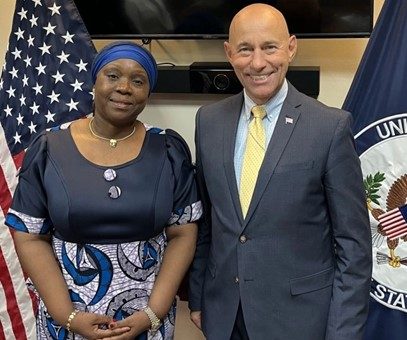
MONROVIA – Liberia’s Foreign Minister Sara Beysolow Nyanti has held a high-level bilateral meeting with U.S. Assistant Secretary of State for African Affairs Frank Garcia Jr. at the State Department in Washington, D.C., pressing the United States on three fronts that define the Boakai administration’s immediate external agenda: a transformative energy compact to address Liberia’s chronic electricity crisis, continued cooperation on regional security within the Mano River Union framework, and — most urgently — a durable immigration pathway for approximately four thousand Liberians currently shielded under Deferred Enforced Departure status set to expire on June 30, 2026. The meeting, which also featured Liberia’s Ambassador to the United States Dr. Al-Hassan Conteh, underscored the breadth and complexity of a bilateral relationship grounded in shared democratic values and more than a century of historical ties, even as it highlighted the gap between Liberia’s development aspirations and the concrete commitments required to meet them, as THE ANALYST reports.
Energy at the Center: Liberia Pursues a Transformative Compact
Electricity — or more precisely its absence — dominated the substantive development agenda at the State Department meeting. Minister Nyanti raised Liberia’s interest in pursuing what she described as a “transformative energy compact” that would systematically address longstanding deficits across generation, transmission, and distribution infrastructure. The pitch reflects the Boakai administration’s recognition that reliable and affordable power is the foundational prerequisite for the industrial development, foreign direct investment, and employment creation that the government has made central to its transformation agenda.
Liberia’s energy situation remains among the most constrained in West Africa. A significant majority of Liberians lack access to grid electricity, and businesses operating in Monrovia and secondary cities continue to bear the cost of private generation — a structural drag on competitiveness that no investment promotion campaign can fully offset. Minister Nyanti argued that improved energy infrastructure would reposition Liberia as a competitive destination for regional and international businesses, a case she pressed to a receptive though noncommittal interlocutor.
Assistant Secretary Garcia acknowledged the importance of Liberia’s energy goals and affirmed the United States’ continued interest in supporting sustainable development and energy security initiatives across the continent, though no specific commitments or compact timelines were announced. The Millennium Challenge Corporation, the U.S. government’s primary vehicle for major infrastructure compacts with eligible countries, has previously supported Liberia’s energy sector, and the framing of Nyanti’s pitch suggests Monrovia is positioning itself for a renewed or expanded engagement along those lines.
Regional Security and Democratic Governance on the Agenda
The meeting also covered regional security dynamics, with both sides acknowledging Liberia’s role within the Mano River Union as a stabilizing presence in a sub-region that continues to face transnational threats including illicit trafficking, cross-border criminality, and the spillover effects of political instability in neighboring states. Minister Nyanti and Assistant Secretary Garcia reaffirmed their respective governments’ commitment to supporting democratic institutions, strengthening governance systems, and advancing peacebuilding — language that reflects a shared rhetorical architecture but one whose practical content will depend on the specific programs and funding streams that follow from such high-level dialogue.
The bilateral also explored opportunities to expand commercial diplomacy and private-sector partnerships, with both sides acknowledging the private sector’s critical role in driving innovation, employment creation, and economic resilience. No specific commercial initiatives were announced, but the inclusion of this agenda item signals Monrovia’s interest in using diplomatic channels to complement its investment promotion efforts.
DED Expiration Looms: Nyanti Seeks a Path to Permanent Status
The most time-sensitive issue on the meeting’s agenda was the immigration status of approximately four thousand Liberians currently protected under Deferred Enforced Departure, a discretionary executive measure that has shielded eligible Liberian nationals from removal since 1991 in various forms, reflecting the United States’ acknowledgment of the extraordinary circumstances — civil war, the Ebola outbreak, and post-conflict fragility — that have historically made return untenable. The current DED designation is scheduled to expire on June 30, 2026, creating an imminent and acute legal vulnerability for affected individuals and their families.
Minister Nyanti used the meeting to make the case for Liberia’s DED community in terms that are both humanitarian and strategic. She highlighted the documented contributions of Liberians to American society across healthcare, education, business, and public service — a framing designed to shift the immigration conversation from legal status to civic value. She reaffirmed her government’s hope that “a pathway to permanent legal status can be identified for eligible beneficiaries,” a formulation that falls short of a demand but signals Monrovia’s position clearly.
Assistant Secretary Garcia welcomed the discussion and reiterated the importance of maintaining open communication on immigration matters affecting people-to-people ties between the two countries. The response reflects the structural limits of what the State Department can offer on an issue that ultimately rests with the Department of Homeland Security and, ultimately, with political decisions in the current U.S. administration. Whether the meeting produces any concrete movement on DED before the June 30 deadline — or whether a further extension will be announced — remains the central unanswered question for the Liberian diaspora community most directly affected.
Diplomatic Context: A Relationship Under Recalibration
The Nyanti-Garcia meeting takes place at a moment when U.S.-Africa policy is itself in flux, with the current U.S. administration undertaking a broad recalibration of foreign assistance and diplomatic priorities that has created uncertainty for African partners accustomed to predictable multilateral engagement. For Liberia, which has historically benefited from an unusually close relationship with Washington rooted in shared founding history, this recalibration presents both risk and opportunity — risk that established programs may be reconsidered, and opportunity to make targeted, high-value bilateral cases for continued engagement.
Minister Nyanti’s decision to lead the Washington engagement personally, rather than delegate it to Ambassador Conteh, signals the Boakai administration’s assessment of the stakes. The three-track agenda — energy, security, and immigration — reflects a disciplined prioritization of issues where U.S. partnership is either irreplaceable or can move the needle most significantly for the administration’s domestic legitimacy. How each of those tracks develops in the weeks ahead will be a measure both of Liberia’s diplomatic effectiveness and of how the United States chooses to calibrate its engagement with one of West Africa’s most historically significant bilateral relationships.
Comments are closed.