

Shoniyin Champions Character Over Credentials-Says Leadership Must Prioritize Character, Not Degrees Doctrine
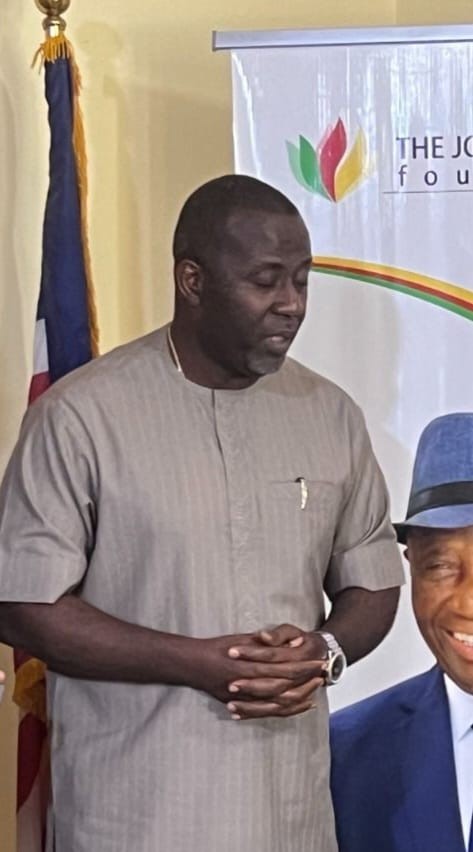
MONROVIA – In a country striving to rebuild institutions and restore public confidence, the question of what defines true leadership is becoming increasingly urgent. For years, credentials—degrees, titles, and professional status—have dominated the national conversation around success and authority. Yet, beneath this emphasis lies a growing recognition that qualifications alone have not guaranteed effective or ethical governance. At a time when public trust remains fragile, a new perspective is emerging—one that shifts attention from what leaders have achieved academically to who they are in character. As THE ANALYST reports, Ambassador B. Elias Shoniyin’s recent remarks has reflected a fundamental shift, challenging Liberia to rethink its leadership model and place integrity at the center of national development.
At a time when Liberia continues to grapple with questions of governance, accountability, and institutional credibility, a compelling call for a shift in leadership philosophy has emerged—one that places character above credentials as the defining standard for national progress.
Delivering a thought-provoking address at the 16th Global Leadership Summit, Ambassador B. Elias Shoniyin challenged long-held assumptions about success, education, and leadership, urging Liberians to fundamentally rethink what qualifies an individual to lead and to serve.
His message, simple yet profound, resonated across the audience and beyond: while education and professional achievement may open doors, it is character that determines whether those doors remain open.
“Your degree may get you a job, but your character determines how long you stay,” Shoniyin declared, drawing visible agreement from participants and setting the tone for a broader reflection on Liberia’s leadership culture.
In a society where academic credentials are often elevated as the primary pathway to opportunity and influence, Shoniyin’s intervention struck at the heart of a deeply ingrained national mindset. For decades, degrees, titles, and institutional affiliations have been seen not only as indicators of competence but also as the primary qualifiers for leadership positions.
However, according to Shoniyin, this emphasis has come at a cost.
He argued that Liberia’s most pressing challenge is not a shortage of educated individuals, but rather a deficit in integrity-driven leadership—leaders whose decisions are guided not merely by knowledge, but by values, accountability, and a commitment to the common good.
In framing his argument, Shoniyin drew attention to the disconnect that often exists between qualification and conduct, noting that the presence of credentials does not automatically translate into ethical leadership or effective governance.
To bring his message closer to lived reality, he shared a powerful and relatable story from Nimba County—a story that has since become a symbol of the very principle he sought to emphasize.
According to Shoniyin, a young motorcycle rider, operating within the constraints of daily economic hardship, found himself in possession of a significant sum of money accidentally left behind by a passenger. In a context where such an opportunity might have tempted many to act otherwise, the young man chose honesty.
He returned the money.
That single act of integrity, Shoniyin noted, did more than demonstrate moral uprightness—it changed the young man’s life. His honesty earned him national recognition, financial support, and access to opportunities that would otherwise have remained beyond his reach.
The story, while simple, carried a powerful implication: character is not merely an abstract virtue to be admired—it is a practical force that shapes outcomes, opens doors, and builds trust.
“The lesson is clear,” Shoniyin emphasized. “Character is not just a moral virtue; it is a strategic asset.”
In expanding on this idea, he suggested that nations, much like individuals, are judged not only by their achievements but by their values. A country that elevates character in its leadership structures is more likely to build resilient institutions, attract credible partnerships, and sustain long-term development.
Conversely, a system that prioritizes credentials without equal regard for integrity risks becoming fragile—susceptible to corruption, inefficiency, and public distrust.
Supporting this perspective, Madam Eyvonne Bright-Harding reinforced the call for value-based leadership, particularly among Liberia’s youth. She urged young people to align their ambitions not only with personal success but with principles that promote accountability, service, and national pride.
Her remarks underscored the idea that leadership is not confined to formal positions but is expressed through everyday decisions, attitudes, and responsibilities.
Together, the messages delivered at the summit painted a broader picture of a nation at a crossroads—one where the future of leadership depends not only on educational advancement but on the cultivation of ethical standards.
With over twenty-five years of distinguished service spanning diplomacy, governance, and academia, Ambassador Shoniyin’s voice carries both authority and lived experience. His career has exposed him to the inner workings of institutions and the complex interplay between policy, leadership, and public trust.
It is from this vantage point that his call for a new leadership doctrine gains both urgency and relevance.
As Liberia seeks to strengthen its institutions, improve service delivery, and position itself as a credible destination for sustainable investment, the demand for ethical leadership is becoming increasingly pronounced. Investors, development partners, and citizens alike are not only interested in policies and plans but in the integrity of those entrusted to implement them.
In this context, Shoniyin’s message can be seen as both a warning and a roadmap.
It warns that reliance on credentials alone will not address the deeper challenges facing the country. At the same time, it offers a pathway forward—one that begins with a deliberate and collective shift in values.
This shift, he suggested, must extend beyond rhetoric. It must be reflected in how leaders are selected, how institutions operate, and how accountability is enforced. It must also be nurtured at the grassroots level, where the next generation of leaders is being shaped.
Ultimately, Shoniyin’s doctrine presents a vision of a Liberia where character is not an afterthought but a foundation—a society in which integrity is rewarded, honesty is celebrated, and leadership is measured not only by achievement but by conduct.
As the country continues its journey toward rebuilding trust and strengthening governance, his message arrives at a critical moment.
For many observers, the question is no longer whether Liberia has enough educated individuals to lead, but whether it is ready to embrace a leadership culture grounded in integrity.
If it does, Shoniyin suggests, the nation stands a far better chance of building institutions that endure, governance systems that inspire confidence, and a future defined not by fragility, but by strength.
And in that vision, character is not just important—it is indispensable.
Comments are closed.