
Quaqua Laments Extractive Exploitation-Says Africa Faces Critical Minerals Reckoning
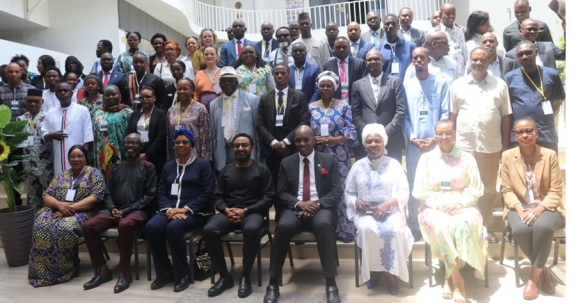
MONROVIA – As global powers intensify competition for critical minerals needed to fuel the green transition and digital economy, Africa is increasingly confronting difficult questions about whether the continent will finally benefit fairly from its vast natural resources or once again become trapped in exploitative extraction models benefiting external powers. Those tensions dominated discussions at the 5th Continental Forum on Extractive Industries, Business, Human Rights and Environment in Africa held recently in Dakar, Senegal, where African policymakers, legal experts, civil society organizations, and governance institutions warned that the global rush for lithium, cobalt, graphite, and rare earth minerals risks reproducing old injustices under a modern climate-transition narrative. Former Press Union of Liberia president, Peter Quaqua was present, and has reflected that the debate has now sparked renewed continental demands for sovereignty, accountability, and rights-based governance.
A major continental debate over Africa’s mineral future has emerged from Dakar, Senegal, where policymakers, governance experts, human rights advocates, legal scholars, and civil society actors gathered to confront mounting fears that the global race for critical minerals may reproduce the same exploitative extractive patterns that historically impoverished African communities while enriching external economic powers.
The growing concern was extensively outlined in an analytical intervention by Liberian journalist and governance advocate Peter Quaqua, whose reflections on the 5th Continental Forum on Extractive Industries, Business, Human Rights and Environment in Africa framed the gathering as a defining moment for Africa’s struggle over sovereignty, environmental justice, and equitable resource governance.
Held under the theme “Advancing Responsible Extractive Governance in Africa and in the Context of the Global Rush for Critical Minerals,” the Dakar forum brought together representatives from African governments, African Union institutions, human rights bodies, affected communities, academics, and environmental activists amid intensifying international demand for minerals considered essential to modern industrial transformation.
According to Quaqua’s analysis, the accelerating global transition toward renewable energy, electric mobility, artificial intelligence technologies, and advanced digital systems has sharply increased geopolitical competition for African mineral resources, particularly lithium, cobalt, graphite, and rare earth elements.
Yet despite Africa’s enormous mineral wealth, forum participants repeatedly warned that the continent continues facing the same structural contradictions that have long characterized extractive economies across Africa.
While mineral wealth theoretically offers opportunities for industrialization, infrastructure development, healthcare expansion, educational investment, and economic transformation, many African communities located near extractive projects continue experiencing displacement, pollution, environmental degradation, violent repression, weak accountability, and limited participation in the economic benefits generated from their resources.
Quaqua observed that beneath growing international excitement surrounding the so-called green transition lies deep continental anxiety that Africa may once again become trapped within externally driven extraction systems where raw materials leave the continent while wealth accumulation, manufacturing, and industrial transformation occur elsewhere.
Participants at the Dakar gathering argued that the global climate transition cannot become another justification for exploitative economic relationships disguised under environmental language.
That concern shaped many of the forum’s major debates.
One of the strongest recurring themes centered on African sovereignty over natural resources, particularly the principle embedded in Article 21 of the African Charter on Human and Peoples’ Rights affirming that African peoples possess the right to freely dispose of their wealth and natural resources.
Forum participants insisted that this principle must move beyond symbolic declarations and become a practical foundation for future extractive governance frameworks across the continent.
Speakers called for fairer licensing agreements, stronger local beneficiation policies, transparent governance mechanisms, industrial value addition, and more equitable utilization of revenues generated from Africa’s mineral wealth.
Many delegates warned that the current global demand for critical minerals risks reproducing colonial-style extraction structures in which Africa supplies raw materials while higher-value industrial activities remain concentrated in wealthier economies abroad.
Such concerns have intensified amid growing geopolitical rivalry among major international powers seeking strategic access to African minerals viewed as indispensable to future technological and industrial dominance.
Against that backdrop, participants urged African governments to strengthen collective continental bargaining power rather than negotiating fragmented bilateral arrangements that weaken Africa’s leverage internationally.
Among the proposals reportedly discussed during the Dakar forum was the possible establishment of an African Strategic Resources Authority capable of coordinating continental mineral governance policies and strengthening Africa’s negotiating position globally.
Human rights concerns also dominated major sections of the discussions.
Participants stressed repeatedly that development objectives and climate-transition goals cannot justify violations of human dignity, environmental sustainability, or community rights.
Communities living near extractive operations across Africa continue reporting widespread displacement, contamination of water systems, destruction of livelihoods, shrinking democratic participation, and environmental destruction linked to mining activities.
Environmental defenders, journalists, activists, and community advocates opposing or questioning extractive projects increasingly face intimidation, criminalization, and violence in multiple jurisdictions across the continent, participants warned.
The forum therefore reaffirmed the importance of procedural protections including access to information, freedom of expression, public participation, and the principle of free, prior, and informed consent.
Particular attention was reportedly given to women, Indigenous populations, youth, and marginalized rural communities, who frequently bear the heaviest environmental and social consequences of extraction while receiving little economic benefit.
Another major focus of the Dakar discussions involved corporate accountability.
For years, international discussions surrounding business and human rights have relied heavily on voluntary corporate social responsibility frameworks. But participants increasingly argued that voluntary standards alone are insufficient to address the scale of abuses associated with extractive industries.
The Dakar Declaration consequently called for stronger legal obligations on corporations operating across Africa, including mandatory environmental and human rights due diligence requirements throughout mineral supply chains.
Delegates also reportedly backed efforts to establish binding African legal instruments governing transnational corporations and multinational business enterprises operating within the continent’s extractive sector.
Supporters argued that such legal frameworks could significantly strengthen accountability regarding corruption, illicit financial flows, environmental destruction, labor exploitation, and unlawful extraction practices.
The forum additionally renewed support for ratification of the Malabo Protocol, which seeks to expand the jurisdiction of the future African Court of Justice and Human Rights to include corporations and legal entities, not merely individuals.
According to Quaqua’s analysis, many participants viewed this as an important evolution in African legal thinking, recognizing the immense influence multinational corporations increasingly exercise over governance, environmental outcomes, and human rights conditions throughout the continent.
The Dakar gathering also highlighted the growing importance of African regional institutions in shaping extractive governance standards.
Participants recognized the African Commission’s Working Group on Extractive Industries as an increasingly influential platform for developing continental accountability mechanisms and environmental protection standards.
Discussions further emphasized the need to integrate human rights protections into broader African Union policy frameworks including Agenda 2063, the Africa Mining Vision, and the African Continental Free Trade Area.
Perhaps the forum’s most significant conclusion was the growing recognition that environmental governance, democratic accountability, peace and security, climate justice, and economic transformation are inseparable challenges rather than isolated policy concerns.
By the conclusion of the Dakar meeting, participants appeared united around one central warning: Africa now stands at a defining historical crossroads regarding the governance of its natural resources.
The continent possesses a rare opportunity to redesign extractive governance systems in ways that prioritize people, environmental protection, democratic participation, and sustainable development rather than reproducing historical exploitation patterns.
Achieving that vision, however, participants acknowledged, will require stronger institutions, political courage, continental solidarity, and accountability mechanisms capable of resisting both external pressure and internal governance failures.
For many participants in Dakar, the issue ultimately extends far beyond minerals alone.
It concerns whether Africa’s future will continue being shaped primarily by external geopolitical competition and global market interests — or finally by the developmental aspirations, sovereignty, and rights of African people themselves.
Comments are closed.