

Liberia’s Environment Is Helplessly Crying Out -Flanzamaton urges nation beyond awareness to action
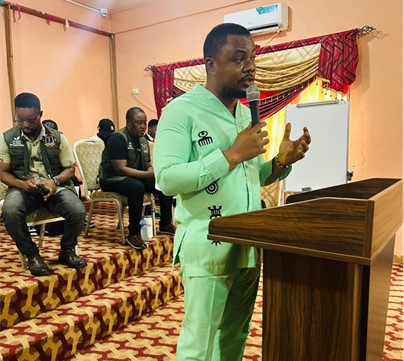
MONROVIA – Political and policy analyst Cephas MMD Flanzamaton has issued one of the most sweeping environmental calls to action heard in recent public discourse, warning that Liberia’s rainforests, coastline, rivers, and urban drainage systems are under mounting threat from human activity — and that without urgent, coordinated intervention reaching from government ministries down to student dormitories, future generations will inherit a degraded landscape that no amount of political will can restore. Speaking at APEX University during commemorations of World Environment Day, Flanzamaton challenged every layer of Liberian society to exchange passive environmental awareness for what he termed “environmental audacity.” THE ANALYST reports,
Delivering the keynote address under the theme “Environmental Stewardship in Liberia: From Awareness to Action,” Flanzamaton opened with a parable about an elder explaining to his grandson why rainfall patterns have changed, rivers have shrunk, and fruit trees yield smaller harvests.
“The old man sighed and said: ‘Son, the Earth is speaking, but we are not listening,'” Flanzamaton told the gathering of students, faculty, and government representatives. He added: “Today, I stand before you to remind us all that the Earth is speaking louder than ever — and it is our sacred duty to listen, to act, and to protect the only home we have.”
Injecting a moment of levity, Flanzamaton suggested that anyone who doubts climate change should simply walk from Broad Street to Red Light at noon without shade. “You will believe in global warming instantly,” he quipped, drawing laughter before returning to the gravity of his message.
A Nation Richly Endowed, Dangerously Threatened
Flanzamaton described Liberia as possessing extraordinary natural wealth — rainforests, wetlands, rivers, diverse wildlife, and fertile lands — but warned that this inheritance is being consumed by deforestation, unregulated urban expansion, coastal erosion, and poor waste management practices.
“The mesmerizing mangroves of Marshall, the dense canopy of Sapo National Park, and the life-giving Mesurado River are all crying out for sustainable management,” he said, warning that rising sea levels threaten vulnerable coastal communities, particularly West Point and Buchanan, while plastic waste clogs Monrovia’s drainage systems and contributes to seasonal flooding.
“These are not abstract problems; they are existential threats to our national survival,” Flanzamaton warned.
Calls on Government to Lead, Students to Follow
He called on the Liberian government to invest substantially in environmental education at all levels of the educational system, establish climate research laboratories and green academic curricula, and enforce environmental regulations with greater consistency across industrial sectors.
To students, he was equally direct, describing them as “custodians of the future” and challenging them to use social media platforms, campus environmental clubs, tree-planting campaigns, and waste segregation initiatives as tools of transformation.
“Imagine if every post, every tweet, every TikTok video carried a message of sustainability — the ripple effect would be monumental,” he said.
Alignment with Global Environmental Frameworks
Flanzamaton urged Liberian policymakers to anchor national environmental strategy within international frameworks including the Paris Climate Agreement, the United Nations Sustainable Development Goals, and the African Union’s Agenda 2063.
He revived an argument rarely heard in Liberian public discourse: that traditional indigenous values — which regarded rivers as sacred, forests as ancestral, and land as life — should be treated not as nostalgia but as a legitimate and underutilized component of contemporary environmental policy.
He closed with a challenge designed to outlast the day’s celebrations: “When future generations ask us what we did when the Earth was crying, we will not say we were silent. We will say: we listened, we acted, and we preserved the land of liberty.”
Comments are closed.