

Koijee writes for US Intervention -Casts Doubt on Police independent probe
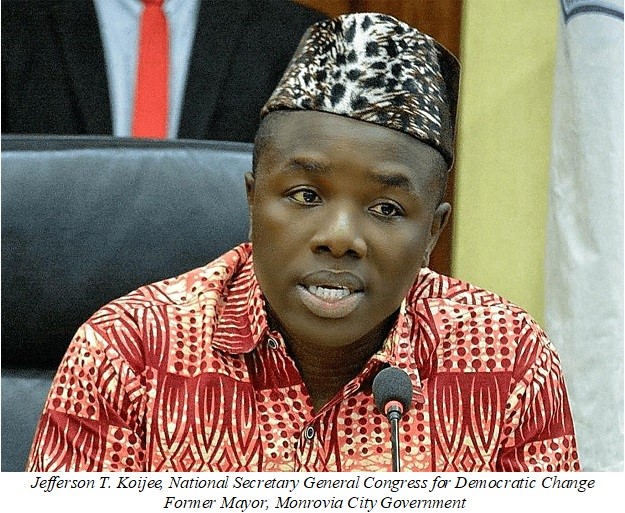
MONROVIA – Mounting allegations against Liberia’s security apparatus have escalated into a diplomatic concern, drawing the United States into an increasingly sensitive debate over accountability and external support. A formal communication from a senior opposition figure, CDC Secretary General Jefferson Koijee, now challenges not only the conduct of the Liberia National Police but also the implications of continued U.S. assistance amid claims of abuse, impunity, and institutional breakdown. At stake is more than bilateral cooperation—it is the credibility of Liberia’s rule-of-law architecture and the ethical framework guiding international partnerships. As accusations intensify and public trust wavers, the call for scrutiny signals a turning point in how security sector governance is contested. THE ANALYST reports.
A strongly worded communication addressed to the United States Embassy in Monrovia has brought Liberia’s security sector under intense scrutiny, raising serious allegations about the conduct of the Liberia National Police (LNP) and calling for an immediate review, suspension, and investigation into ongoing U.S. support to the institution.
The letter, authored by Jefferson T. Koijee, Secretary General of the Congress for Democratic Change (CDC), and directed to U.S. Chargé d’Affaires Joe Zadrozny, frames the issue as one of urgent national concern, arguing that the original intent of U.S. assistance—to strengthen democratic institutions and uphold human rights—may be at risk of being undermined by current realities within the police force.
At the core of the communication is a claim that the Liberia National Police, under the leadership of Inspector General Gregory Coleman, is increasingly perceived by the public not as a neutral enforcer of the law, but as an institution whose actions, in certain instances, contradict its foundational mandate.
Koijee asserts that there has been a troubling shift in how the police operate, citing what he describes as patterns of selective justice, institutional inaction, and alleged complicity in serious misconduct. These allegations, he warns, risk eroding public trust and weakening Liberia’s democratic framework.
Among the concerns raised are repeated reports of the police failing to effectively investigate and prosecute crimes related to drug trafficking, organized violence, and systemic corruption. Such failures, according to the letter, create an environment of impunity where criminal networks can operate with limited accountability.
The communication goes further, alleging direct involvement of some police actors in misconduct, including cases of abuse of power, sexual violence, and drug-related activities. These claims, if substantiated, would represent a significant breach of professional standards and raise serious questions about internal accountability mechanisms within the LNP.
Particularly alarming are references to recent incidents involving alleged human rights violations. Koijee cites reports of physical assaults on peaceful protesters, including students and activists who had taken to the streets of Monrovia to demand jobs and justice. According to the letter, some of these individuals were subjected to unlawful arrest and detention.
The communication further references a purported secret recording from police custody in which detainees were allegedly stripped and subjected to torture by masked individuals believed to be police officers. While such claims have not been independently verified within the context of the letter, their inclusion underscores the gravity of the concerns being raised.
In addition, the letter mentions what is described as an assassination attempt on Representative Saah Foko, allegedly involving state security actors. This claim, combined with other allegations, is presented as part of a broader pattern suggesting that elements within the security apparatus may be used to intimidate or suppress dissent.
Koijee characterizes the situation in stark terms, alleging that the police leadership has transformed the institution into what he describes as a “dangerous instrument” against citizens, with references to the existence of a “torture chamber” where individuals are subjected to severe abuse.
The letter also raises concerns about alleged links between police leadership and drug trafficking networks, suggesting that Liberia risks becoming a transit hub for regional and international narcotics operations. Such claims, if proven, would have far-reaching implications not only for national security but also for Liberia’s international standing.
Beyond these allegations, the communication provides a list of specific cases cited as evidence of a broader pattern of abuse and lack of accountability. These include instances of alleged police brutality, deaths in custody, and fatal shootings, many of which, according to the letter, have not resulted in prosecution or formal investigation.
The cumulative effect of these incidents, Koijee argues, has reinforced a growing perception among citizens that the police are operating as a “state-sanctioned malicious force,” rather than as protectors of public safety and order.
It is within this context that the letter questions the continued provision of U.S. assistance to the LNP. According to Koijee, there is a legitimate concern that resources intended to support democratic policing may inadvertently be enabling practices that contradict those objectives.
He warns that failure to address these concerns could undermine the credibility of the United States as a partner in Liberia’s democratic development, while also contributing to the erosion of governance standards within the country.
To address these issues, the letter outlines a series of recommendations directed at the U.S. government.
Foremost among these is the call for an independent, transparent, and comprehensive investigation into the use and impact of U.S. support to the Liberia National Police. Such an investigation, Koijee argues, should assess whether financial, logistical, and training assistance is being utilized in line with its intended objectives.
He also proposes a temporary suspension or restructuring of U.S. assistance, pending the outcome of such an investigation. Future support, he suggests, should be conditional upon measurable reforms, including improved accountability systems, adherence to human rights standards, and demonstrable improvements in professional conduct.
Additionally, the letter calls for enhanced transparency and public reporting mechanisms to allow Liberians to better understand how international assistance is being deployed within their national institutions.
Despite the critical tone of the communication, Koijee acknowledges the longstanding relationship between Liberia and the United States, emphasizing that the concerns are being raised precisely because of the importance of that partnership.
He stresses that international support must reinforce institutions that serve the public good, rather than those perceived to act against it.
The implications of this development extend beyond the immediate allegations. At a broader level, the issue touches on the intersection of security sector reform, human rights, and international cooperation—areas that are central to Liberia’s post-war recovery and democratic consolidation.
For the government, the challenge will be to respond in a manner that addresses public concerns while maintaining institutional stability. For international partners, the situation presents a complex dilemma: how to support reform without being seen as complicit in alleged abuses.
As the debate unfolds, one thing is clear—the credibility of Liberia’s security sector, and the trust of its citizens, will depend on the willingness of all stakeholders to confront these allegations with transparency, accountability, and decisive action.
Comments are closed.