
First Batch of Yellow Machines Arrive-Signals Major Infrastructure Push
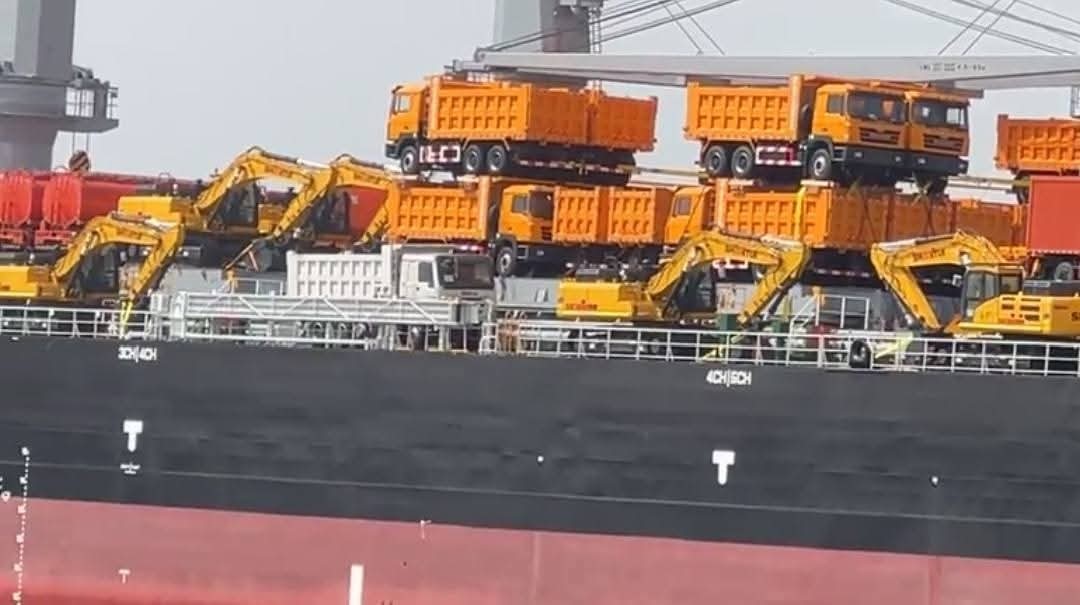
MONROVIA – The first consignment of most talk about heavy-duty earth-moving equipment procured by the Government of Liberia has arrived at the Freeport of Monrovia, marking a significant step in the administration’s drive to expand road connectivity and accelerate national development.
A total of 137 “yellow machines” docked at the port this week, representing the first batch of 285 pieces of equipment expected in the country. The remaining shipments are anticipated in the coming weeks.
Chairman of the Yellow Machine Coordinating Committee, Brownie J. Samukai, described the arrival as tangible evidence of the government’s commitment to infrastructure development under the ARREST Agenda.
“It is evidence of the government’s intentions,” Samukai said at the port. “Those who doubted that the machines were coming and claimed they were ‘paper machines’ can now see the evidence here. The yellow machines have begun to arrive in Liberia.”
According to Samukai, the equipment will be temporarily transported to Careysburg for storage, inspection, assembly, and testing before being deployed across Liberia’s 15 counties.
He said the initiative aims to improve road access to underserved communities, enhance farm-to-market routes, and strengthen links between towns and villages nationwide. Samukai emphasized that the machines will support efforts to connect remote areas to essential services, including hospitals and markets.

“If you want to go to Lofa, Gbapolu, Nimba, Grand Gedeh, Maryland, Grand Kru literally everywhere the President wants this country to be connected,” he said. “Eventually, when all counties are connected by tarmac roads, our towns and villages can also be connected by very good roads, ensuring year-round movement and economic activity.”
He added that improved infrastructure, combined with expanded electricity access, would create a foundation for sustained economic growth.
Beyond road construction, the initiative is expected to generate significant employment. Samukai announced that the government will soon advertise positions for equipment operators and support staff across the country.
Plans are underway to recruit at least 552 operators and an additional 552 support personnel, amounting to more than 1,000 direct jobs nationwide.
“If you multiply 1,000 persons earning, for example, $400 monthly, you are talking about $400,000 in disposable income circulating each month,” Samukai noted. “This is about growth. It is about employment so people can take care of their families and address poverty.”
He stressed that the machines are not only intended to clear roads but also to create livelihoods and stimulate local ec
The former Minister of National Defense outlined a structured deployment strategy to ensure effective and sustainable use of the equipment. Nineteen operational hubs will be established across the country, including fuel storage facilities, commonly referred to as tank farms, and maintenance centers.
Each county will receive one set of 19 machines, while four counties Nimba, Bong, Grand Bassa, and Lofa will receive double allocations of 38 machines each, reflecting higher operational demands in those areas.
Samukai emphasized that the government is committed to rigorous maintenance and operational efficiency.
“These are serial operational machines,” he said. “The government intends to invest in a maintenance program to ensure they are used efficiently and effectively. We have no intention of parking them.”
The equipment will remain stationed outside Monrovia during the assembly and testing phase, where lubrication, fueling, and readiness checks will be completed before full deployment.
Samukai said President Joseph Nyuma Boakai welcomed news of the machines’ arrival, describing him as pleased that Liberians can now see concrete evidence of the government’s plans.
“The President is very happy,” Samukai said. “He is proud that what he promised is being delivered and that his focus on development is taking shape.”
With additional shipments expected soon, the government says the initiative marks the beginning of a broader national effort to modernize infrastructure, improve accessibility, and drive inclusive growth across Liberia.
Comments are closed.