
Diasporic Liberian Urges Boakai to Reshuffle Cabinet -Warns to Tread Carefully on U.S. Relations
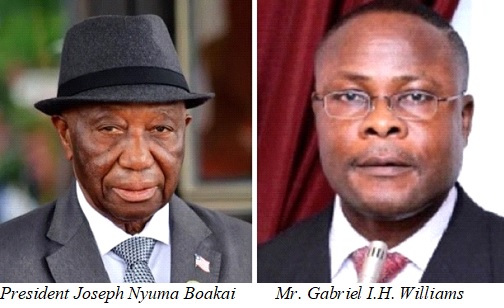
MONROVIA – As Liberia prepares for President Joseph Nyuma Boakai’s third Annual Message to the National Legislature, domestic political tensions and shifting global power dynamics are converging in ways that could significantly shape the trajectory of his administration. With controversies surrounding legislative leadership, rising public dissatisfaction over governance performance, and mounting international uncertainty following developments in U.S. foreign policy, political analysts warn that the margin for error is narrowing. In a detailed assessment of the current landscape, Liberian journalist and former diplomat Gabriel I.H. Williams argues that the President faces a defining moment—one that will require decisive internal reforms, careful diplomatic positioning, and strategic communication to avoid political fallout at home and abroad.
A Liberian political analyst has urged President Joseph Nyuma Boakai to consider an urgent reshuffle of his administration and to exercise caution in navigating both domestic political controversies and sensitive international relations, particularly with the United States, as the country enters a critical phase in 2026.
In an analysis released ahead of the President’s anticipated Annual Message, Gabriel I.H. Williams, a Liberian journalist, author, and former diplomat to the United States, warned that decisions taken in the coming weeks could have far-reaching consequences for the Boakai administration and Liberia’s overall stability.
Williams noted that Liberians and international partners are closely watching the President’s third State of the Nation Address (SONA), expected before the end of January, to assess progress on key national challenges, including poverty, economic performance, drug abuse, and governance reforms. According to the analyst, public expectations are high, and the stakes have been elevated by recent political and diplomatic developments.
Among the most sensitive domestic issues highlighted is the controversy surrounding the Speaker of the House of Representatives, Richard N. Koon, whose ascension to the speakership followed a contentious political struggle that led to the removal of Counsellor Fonati Koffa. Williams pointed to ongoing media reports describing a marital dispute involving Speaker Koon and the President’s Senior Political Advisor, MacDella Cooper, noting that the matter has reportedly become sub judice following the filing of a multi-million-dollar civil lawsuit in the United States.
According to the analyst, the controversy has the potential to deepen political polarization and expose the administration to reputational risk, particularly as allegations circulating in the public domain touch on sensitive legal and moral questions. He argued that the manner in which the government manages the issue will be closely scrutinized by both domestic and international observers.
Williams also questioned how the ongoing saga might affect the conduct of legislative business, including the delivery of the President’s Annual Message under Speaker Koon’s gavel, given the heightened political tensions surrounding his leadership.
On the international front, the analyst expressed concern over recent announcements by the United States placing Liberia among dozens of countries subject to a new visa suspension regime. He described the development as troubling, given Liberia’s historical and strategic relationship with Washington, and warned that further diplomatic missteps could expose the country to additional retaliatory measures.
Williams linked Liberia’s current diplomatic exposure to broader global shifts following the escalation of the U.S.–Venezuela crisis. He referenced widely reported accounts that U.S. authorities, acting under authorization from President Donald Trump, arrested Venezuelan President Nicolás Maduro and his wife in Caracas in early January 2026, a move that has sparked international controversy and condemnation from several world leaders and legal experts.
The analyst noted that the United Nations Security Council, where Liberia currently serves as a non-permanent member, convened an emergency session to address the fallout from the incident. During that session, Liberia joined the Democratic Republic of Congo and Somalia—collectively known as the “A3”—in issuing a statement warning that the developments posed serious risks to Venezuela’s internal stability and to regional and international peace and security.
The statement was delivered by Liberia’s Permanent Representative to the United Nations, Lewis G. Brown, and has since drawn attention to Liberia’s delicate position amid rising geopolitical tensions.
Williams cautioned that, as a small state operating in an increasingly multipolar world, Liberia must carefully calibrate its foreign policy to avoid alienating major powers. He warned that pronouncements perceived as unfriendly in Washington could prompt punitive responses, including sanctions or suspension of assistance, given the transactional nature often attributed to the current U.S. administration.
At the same time, he stressed the importance of maintaining balanced relations with other global powers, including China, arguing that Liberia’s diplomatic strategy must reflect the realities of a shifting international order.
To navigate these challenges, Williams proposed the establishment of a high-level foreign policy think tank composed of experienced diplomats, international relations experts, and senior government officials to guide Liberia’s engagement in global affairs.
Domestically, the analyst reiterated calls for a cabinet reshuffle, arguing that several officials who have served since 2024 are widely perceived as underperforming. With 2026 shaping up as a “make-or-break” year for the administration, he said decisive action could help reset public confidence.
While acknowledging progress in infrastructure development, including road construction, electricity expansion, and Liberia’s election to the UN Security Council, Williams said significant shortcomings remain in the fight against corruption, efficiency in public spending, and investment in health and education.
He also pointed to public controversy surrounding the national budget, allegations of misuse of public funds, and unresolved scandals as evidence of weak communication and expectation management by the government.
According to Williams, how President Boakai responds to these intertwined domestic and international challenges in the coming months may ultimately determine the legacy of his administration. See full text of Williams’ Message to President Boakai on page 7 of this edition.
Comments are closed.