

BFF, OWECC-L, VOTE-RL Unveil National Framework-Launches Dialogue Targeting Justice Deadlock
MONROVIA – Liberia’s long and politically sensitive debate over transitional justice is entering a potentially defining phase as a coalition of civil society institutions prepares to launch what organizers describe as an ambitious “Dialogue-to-Justice” national framework aimed at bridging the country’s lingering reconciliation divide. Coming amid renewed public tension over accountability for wartime atrocities and economic crimes, the initiative seeks to move national conversations beyond symbolic appeals for unity toward a structured, data-driven engagement process capable of shaping future legislative and policy action. Organizers insist the process is intended not merely as another ceremonial unification gathering, but as a sustained national mechanism designed to generate public consensus around reconciliation, justice, peacebuilding, and Liberia’s unresolved transitional governance questions facing the nation today. THE ANALYST reports.
Civil Society Coalition Announces Major Initiative
A broad coalition of Liberian civil society organizations is preparing to launch what organizers describe as a historic national framework intended to address Liberia’s longstanding transitional justice and reconciliation impasse through sustained public dialogue and citizen engagement.
The initiative, scheduled for official unveiling during National Unification Day observances on Tuesday, May 12, 2026, is being spearheaded by the Better Future Foundation (BFF) in collaboration with the Office of War and Economic Crimes Court in Liberia (OWECC-L), Voices of the Elders (VOTE-RL), Angie Brooks International Center (ABIC), and the Liberia Institute for Growing Patriotism.
According to organizers, the event will take place at the University of Liberia’s Capitol Hill Campus and is expected to convene senior government officials, international partners, civil society actors, diplomats, and justice advocates from across the country.
The broader initiative is reportedly being supported through the Partners for Democracy and Good Governance (PdG), which organizers describe as a strategic platform intended to connect reconciliation dialogue with practical transitional justice policy development.
Organizers Seek National Ownership
At the center of the initiative is an effort to move Liberia’s transitional justice conversation beyond political polarization and symbolic public rhetoric toward what organizers characterize as a more structured national consensus-building process.
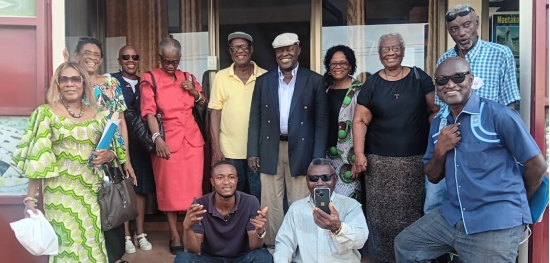
Speaking during a pre-conference briefing ahead of the National Unification Day dialogue, veteran educator and event co-presider Sister Mary Laurene Browne reportedly emphasized the need for sustained civic participation and long-term national engagement.
“Unification is not a static event; it is an active, persistent dialogue,” Sister Browne declared, while urging Liberians across all sectors of society to actively participate in shaping the country’s future reconciliation and justice agenda.
She additionally called on private sector institutions and corporate actors to recognize that lasting peace and national stability remain essential foundations for sustainable economic growth and investment security.
Massive National Survey Planned
One of the initiative’s most ambitious components involves what organizers describe as a nationwide “Snap Survey” targeting approximately 15,000 respondents across Liberia.
According to organizers, the survey is intended to generate empirical national data regarding public attitudes toward reconciliation, transitional justice, and the establishment of war and economic crimes accountability mechanisms.
The coalition argues that transitional justice discussions in Liberia have historically been dominated by elite political narratives, while ordinary citizens’ perspectives have often remained underrepresented in national policymaking processes.
By introducing a large-scale quantitative assessment, organizers believe the process can provide policymakers, legislators, and justice institutions with measurable national sentiment capable of informing future decisions surrounding accountability and reconciliation frameworks.
Quarterly Dialogue Process Proposed
Beyond the survey itself, organizers say the initiative will establish what they are calling a “Dialogue Loop,” consisting of quarterly postmortem stakeholder sessions extending through 2027.
Under the proposed framework, data generated through the nationwide survey would not merely be archived or publicly released, but instead continuously revisited during recurring national dialogue sessions involving stakeholders from government, civil society, academia, religious communities, youth groups, and international partners.
According to the coalition, these recurring consultations are intended to gradually build public consensus around transitional justice while reducing the intense political polarization that has historically surrounded discussions involving war crimes accountability.
Transitional Justice Debate Intensifies
The launch comes at a particularly sensitive moment for Liberia’s transitional justice process, which has remained politically contentious for years despite repeated calls for accountability following recommendations made by the Truth and Reconciliation Commission.
Organizers argue that mainstreaming public sentiment through the proposed survey process could provide the Office of War and Economic Crimes Court in Liberia and the National Legislature with stronger political and empirical foundations for future action.
The coalition specifically hopes to transform transitional justice from what it describes as a divisive political issue into a broader national development and peacebuilding priority capable of attracting wider public consensus.
For years, Liberia’s transitional justice debate has remained trapped between demands for accountability from victims and human rights advocates on one side, and fears of political instability, retaliation, and renewed division from opponents of war crimes prosecutions on the other.
Organizers now appear determined to reposition the conversation around national ownership, dialogue, and participatory consensus-building rather than purely adversarial political confrontation.
High-Level Attendance Expected
The National Unification Day conference is expected to feature a keynote address followed by a major high-level panel discussion involving senior national and international stakeholders.
Expected participants reportedly include the Speaker of the Liberian Legislature, the Executive Director of OWECC-L, representatives of the United Nations system, members of the diplomatic community, and leaders associated with the National Unification Hero/Heroine Awards Committee.
The Secretariat of the Mary N. Brownell National Unification Hero/Heroine Awards has additionally confirmed receipt of nominations recognizing individuals considered to have demonstrated exceptional commitment to national unity and reconciliation efforts.
According to organizers, award recipients will be officially announced and honored during the ceremony.
Liberia’s Reconciliation Journey Faces Critical Test
The initiative arrives at a time when Liberia continues grappling with unresolved historical trauma decades after the end of its brutal civil conflicts.
While the country has maintained relative political stability in recent years, debates surrounding justice, accountability, reconciliation, and institutional healing remain deeply sensitive and politically divisive.
Advocates for war crimes accountability argue that lasting peace cannot be sustained without confronting impunity and acknowledging the suffering of victims. Opponents, however, continue warning that aggressive prosecutions could reopen old wounds and destabilize fragile national cohesion.
Against that backdrop, the coalition’s “Dialogue-to-Justice” framework appears to represent an attempt to navigate a difficult middle ground—one seeking to combine reconciliation dialogue with gradual movement toward accountability through sustained public participation and consensus-building mechanisms.
Whether the initiative succeeds in breaking Liberia’s long-standing transitional justice deadlock remains uncertain. But what is already clear is that the national conversation surrounding war crimes accountability, reconciliation, and democratic healing is once again moving forcefully back to the center of Liberia’s political and civic landscape.
Comments are closed.