

Judge Ordered: ‘Open Jury Probe’ -Kaba reverses Feika’s closed-door investigation
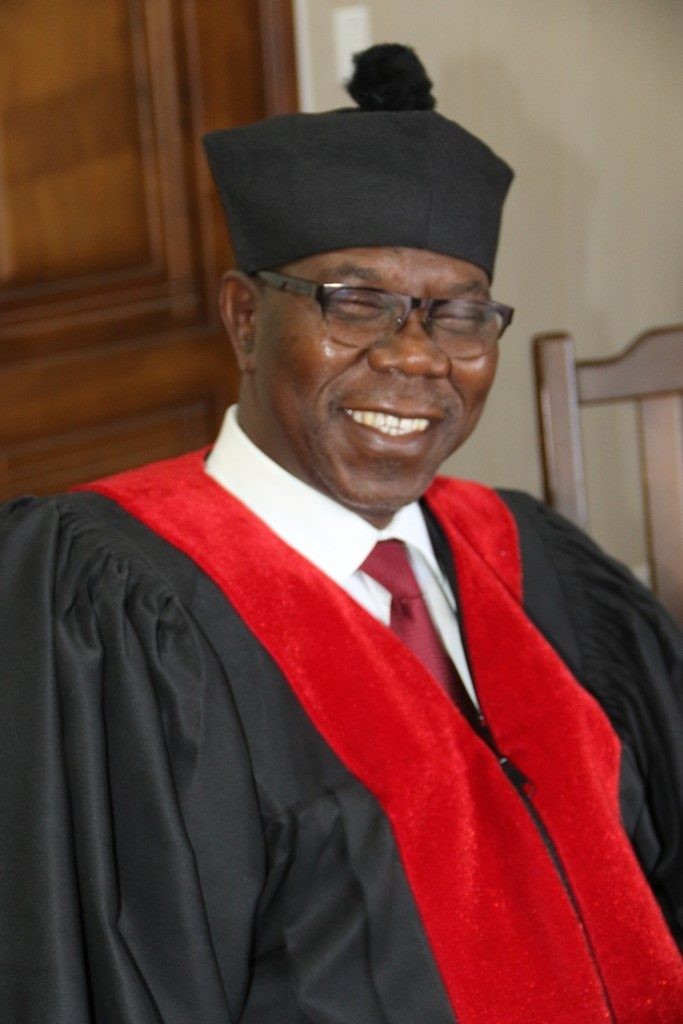
MONROVIA – A courtroom confrontation over the boundaries of judicial transparency and post-verdict conduct has thrown fresh scrutiny onto the Liberian government’s handling of the aftermath of the acquittal of former Finance Minister Samuel Tweah. Justice in Chambers Yusuf D. Kaba on Wednesday ordered Criminal Court ‘C’ Judge Ousman Feika to conduct any investigation into alleged jury misconduct or tampering in open court, in the full presence of all parties and their legal representatives — effectively reversing an earlier decision by Judge Feika to privately question jurors outside the presence of both the prosecution and defence. The ruling has reignited debate over whether the government is pursuing justice or engineering a political reversal. THE ANALYST reports.
The legal battle surrounding the trial of former Finance Minister Samuel Tweah has entered a new and constitutionally charged phase following an intervention by Justice in Chambers Yusuf D. Kaba, who on Wednesday issued a directive that cuts directly to the question of whether post-verdict judicial proceedings in Liberia can be conducted in secrecy — and whose interests such secrecy ultimately serves.
Justice Kaba ordered Criminal Court ‘C’ Judge Ousman Feika to conduct any investigation into allegations of jury misconduct or tampering strictly in open court and in the full presence of all parties and their legal representatives. The ruling followed a conference convened with all parties present, at which Justice Kaba required the parties to sign a stipulation recording the outcome of the discussions. The central finding of that stipulation was that while Judge Feika retains the authority to examine post-verdict complaints relating to alleged jury misconduct, any such inquiry must be conducted openly, transparently, and with full participation by all concerned parties.
The decision effectively reverses Judge Feika’s earlier approach: a private, closed-door questioning of jurors that excluded both the prosecution and the defence — a procedure that drew an immediate legal challenge from members of the defence team in the Tweah et al. case, who filed a writ of prohibition challenging the propriety and legality of conducting such an inquiry outside of open court.
The specifics of what triggered the jury investigation remain officially undisclosed. Neither the defence nor the public has been formally informed of the contents of the jurors’ filing with the court. However, persistent speculation in legal and media circles suggests that three jurors who voted to convict former Minister Tweah may be alleging that mobile phones were present among jurors during the period of their sequestration.
Unconfirmed reports emerging from the investigation further suggest that the nine jurors who voted to acquit Tweah reportedly informed investigators that they had no knowledge of phones being present during the jury’s sequestration period.
The government’s apparent pursuit of a jury tampering narrative following the acquittal verdict has attracted sharp and growing criticism from legal analysts, veteran practitioners, and public commentators who question both its legal foundation and its political motivation.
Among the most prominent voices is veteran journalist Phillipbert Browne, who argued in a widely circulated published article that a verdict of acquittal is legally final and that no post-verdict jury investigation can lawfully overturn such a verdict under Liberian law.
Browne further contended that there is no known precedent in Liberia’s legal history where a post-verdict jury inquiry has been successfully used to invalidate an acquittal — making the current exercise, in his assessment, both legally unprecedented and constitutionally questionable.
Browne pressed further into territory that is likely to prove uncomfortable for the government, noting that jurors in sequestration are held under state supervision and are accessible through court personnel and security arrangements that fall directly under government control.
The implication — that any alleged misconduct during sequestration would necessarily raise questions about the oversight failures of the very institutions now investigating the verdict — has not been addressed by official government spokespersons.
Perhaps the most politically significant context in which the investigation now sits is the earlier public position taken by Justice Minister Counsellor N. Oswald Tweh, who, in the immediate aftermath of the verdict, publicly accepted the court’s decision and described both the acquittals and the convictions in the case as evidence that Liberia’s anti-corruption process was functioning credibly.
The Minister had pledged to strengthen the government’s prosecutorial capacity in future corruption cases rather than challenge the verdict already rendered.
That concession now sits in uneasy tension with the government’s apparent support for a jury investigation that, by its nature, implies that the verdict may have been compromised. As one senior legal analyst summarised the contradiction bluntly: ‘How the same Government is now ghost-chasing Samuel Tweah through allegedly influenced jurors is beyond me.
If jurors had concerns, they should have raised them before they were discharged by the court. Waiting ten days later to suddenly come forward raises serious questions about prompting and outside influence. Whatever comes from this investigation cannot legally overturn the verdict. This entire exercise appears more political than legal and seems aimed at slowing the CDC’s post-verdict momentum.’
Judge Feika is expected to commence the open-court investigation sometime next week. The proceedings are now expected to occur under full public scrutiny — a condition that may test the coherence of both the narrative being pursued and the legal architecture available to sustain it.
Comments are closed.