

Dillon Challenges Weedor’s Partisan Past -Lawmakers put elections law compliance at center of confirmation
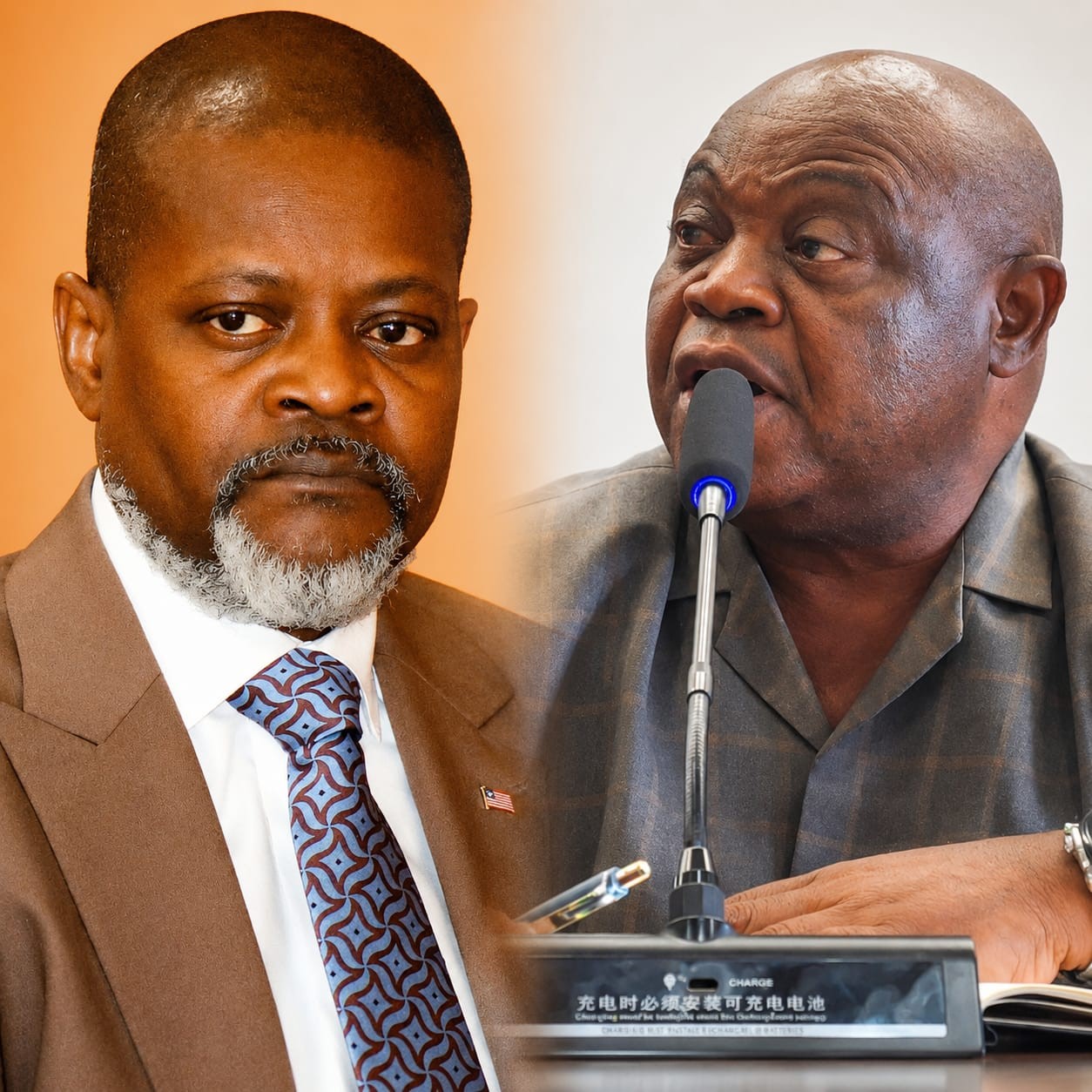
MONROVIA – The confirmation hearing of National Elections Commission Chairman-Designate Jonathan K. Weedor before the Liberian Senate on Thursday produced some of its most pointed questioning from Montserrado County Senator Abraham Darius Dillon, who demanded documented proof that Weedor had formally resigned from his former political party before the Senate could proceed to a final determination on his appointment. Senator Dillon, known for his tenacious interrogation of nominees on matters of principle and procedure, anchored his demand in Section 2.5 of Liberia’s New Elections Law, which explicitly prohibits NEC commissioners and staff from maintaining membership or affiliation with any political party. The stakes of the confirmation — and the credibility of the NEC itself — were laid bare, as THE ANALYST reports.
The confirmation hearing of National Elections Commission Chairman-Designate Jonathan K. Weedor before the Liberian Senate took a sharply focused turn on Thursday, May 28, when Senator Abraham Darius Dillon of Montserrado County demanded documented evidence of the nominee’s formal departure from partisan politics before the chamber proceeds to vote on his appointment to lead the country’s electoral management body.
Senator Dillon’s intervention was rooted in Section 2.5 of Liberia’s New Elections Law, a provision that unambiguously prohibits commissioners, election officers, and employees of the National Elections Commission from maintaining membership or affiliation with any political party, or from participating in political campaigning for elective office.
The Senator argued that for the nominee to credibly assume leadership of an institution whose core mandate is the impartial administration of elections, the Senate and the Liberian public must be satisfied that his departure from partisan politics is a matter of verifiable institutional record — not simply an assertion of intent.
Appearing before the Senate, Weedor disclosed that he previously served as Organizing Chairman of the Liberia National Union, known as LINU. He stated that he resigned from the party in 2004 following his nomination and appointment by the Interim Government to serve at the NEC. Senator Dillon acknowledged the disclosure but maintained that the Senate required formal documentary evidence — a resignation letter or equivalent instrument — to appropriately satisfy the legal standard and to inform his own final vote on the nomination.
Dillon’s insistence on evidence-based confirmation proceedings reflects a broader Senate Judiciary Committee standard that he has championed consistently, and one that has become a hallmark of his legislative conduct on matters of institutional credibility and constitutional compliance.
The Senator emphasized that the independence, neutrality, and public trustworthiness of the NEC are not abstract values but operational prerequisites for an electoral body charged with managing contests that determine the composition of Liberia’s government.
Beyond the question of party resignation, Senator Dillon raised substantive constitutional and electoral law concerns that probed the nominee’s readiness to navigate complex governance terrain. He questioned Weedor on electoral threshold-setting and constituency apportionment, specifically referencing Articles 80(d) and 80(e) of Liberia’s 1986 Constitution — provisions that govern the Legislature’s authority in establishing electoral thresholds and the NEC’s corresponding responsibility in seat distribution and constituency apportionment.
Dillon further asked whether Weedor, as acting NEC Chairman, would demonstrate the independence and institutional courage required to ensure that the Legislature itself complies with constitutional and electoral mandates — a question that cuts to the heart of the NEC’s relationship with the very body responsible for confirming its leadership, and one that Weedor must answer with sufficient clarity to satisfy a Senate that is simultaneously his confirming authority and a regulated stakeholder in the electoral process.
The Senator also renewed his longstanding call for Liberians living abroad to be granted the right to participate in national elections, arguing that citizens in the diaspora — many of whom contribute significantly to the country’s economic life through remittances — deserve the franchise. In response, Weedor acknowledged the significance and political sensitivity of the matter and assured the Senate that the NEC would give the issue careful and serious consideration under his leadership.
On enforcement of the provision under Section 5(a) of the New Elections Law — which stipulates that any political party or independent candidate receiving less than one percent of valid votes cast in a general election may lose eligibility to contest the subsequent election — Dillon asked pointedly whether a Weedor-led NEC would strictly enforce this provision regardless of the political consequences. Weedor pledged his commitment to implementing the Elections Law in full accordance with its legal requirements.
The hearing continues, with the Senate expected to reach a final determination on the nomination in due course. The scrutiny applied by Senator Dillon has ensured that the standard of evidence demanded of the NEC’s incoming leadership will be a matter of public record before any confirmation vote is cast.
Comments are closed.