

Tweah Testimony Shakes Prosecution Case -Defense momentum rattles courtroom dynamics
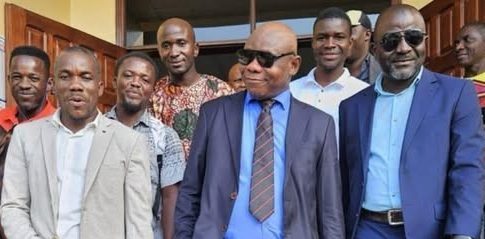
MONROVIA – After weeks of legal maneuvering, the trial involving former Finance Minister Samuel D. Tweah, Jr. appears to have reached a decisive and potentially transformative phase. What began as a high-profile prosecution has increasingly evolved into a courtroom contest dominated by the defense’s aggressive strategy and the former minister’s own commanding testimony. Legal observers, including students and analysts closely tracking proceedings, now suggest the case may be tilting in unexpected ways, raising broader questions about evidence, prosecutorial strength, and the political undertones surrounding the trial. As the prosecution scrambles to regain footing through a proposed rebuttal, the implications extend beyond the courtroom into Liberia’s wider governance discourse. THE ANALYST reports.
The ongoing trial involving former Finance Minister Samuel D. Tweah, Jr. and several members of the former administration’s National Security Council (NSC) and National Joint Security (NJS) apparatus has entered a critical phase, one that many legal observers now describe as a defining moment in the proceedings.
After nearly six weeks of courtroom exchanges, punctuated by intense scrutiny, legal argumentation, and heightened public interest, the trajectory of the case appears to be shifting—largely due to the former minister’s own testimony and the strategic posture adopted by his defense team.
From the outset, Tweah had framed the case against him as politically motivated, frequently describing it as a “witch-hunt” in public commentary prior to his court appearance. At the time, critics dismissed such claims as a familiar rhetorical defense employed by accused public officials seeking sympathy. However, as the trial has progressed, and particularly following several days of sustained testimony from the former minister, that narrative is gaining renewed attention.
Legal analysts, including both trained practitioners and keen observers who have followed proceedings closely, are increasingly pointing to what they describe as significant weaknesses in the prosecution’s case. Central to this evolving assessment is the perception that the prosecution has struggled to present compelling evidence directly linking the accused to the alleged crimes. Beyond evidentiary gaps, critics also highlight what they consider deficiencies in the coherence and persuasiveness of the prosecution’s arguments before the jury.
A Defense Built on Authority
At the heart of the prosecution’s case lies the assertion that Samuel Tweah lacked the legal authority to approve and facilitate the disbursement of more than LRD$1.05 billion and US$500,000 in funds associated with national security operations. According to prosecutors, this alleged absence of authority underpins a broader claim of conspiracy, theft, money laundering, and economic sabotage involving multiple actors within the security architecture.
The defense, however, has methodically sought to dismantle this foundation. Led by Cllr. Arthur Tamba Johnson, the legal team has focused on establishing the former minister’s statutory authority under Liberia’s Public Financial Management (PFM) framework.
During his testimony, Tweah articulated a detailed interpretation of the legal mechanisms governing public expenditure. He emphasized that the passage of the national budget by the Legislature constitutes the primary “legal trigger” for the movement of funds within government systems.
According to his argument, once appropriations are approved, the Minister of Finance is vested with broad discretionary powers to allocate, reallocate, delay, or prioritize payments based on prevailing national needs.
This interpretation, if accepted by the jury, significantly undermines the prosecution’s claim that the absence of formal request letters invalidates the transactions in question. Tweah argued that such letters, while administratively common, are not determinative of legality. Instead, he maintained that ministerial authority—particularly in emergency or national security contexts—remains the decisive factor.
Emergency Context and Executive Discretion
A key pillar of the defense strategy has been the contextualization of the transactions within emergency and exigent circumstances. Tweah explained that in situations involving national security or public emergencies, financial decisions often require rapid execution, sometimes without the formalities associated with routine disbursements.
He further argued that the PFM law explicitly allows for flexibility in such scenarios, including the possibility of exceeding budget allocations under defined conditions, provided that such actions are subsequently reported to the Legislature.
In this regard, Tweah pointed to the inclusion of the disputed expenditures in the government’s 2023 financial reports as evidence of transparency and compliance. This argument seeks to counter the prosecution’s portrayal of the transactions as clandestine or unlawful.
Direct Debits and Legal Interpretation
Another contentious issue in the trial has been the use of direct debit mechanisms to transfer funds. The prosecution has suggested that such transactions fall outside the standard budgetary process and are therefore suspect.
The defense has vigorously contested this interpretation. Tweah provided multiple examples, including transfers to institutions such as the National Elections Commission (NEC), the World Food Programme (WFP), and the United Nations Population Fund (UNFPA), to illustrate that direct debits are not only permissible but have been routinely employed in circumstances requiring expedited financial action.
He argued that such mechanisms are consistent with both domestic legal frameworks and international best practices, particularly in contexts where delays could jeopardize critical national objectives, such as election preparedness.
Dissecting Alleged Contradictions
Perhaps the most striking aspect of the defense’s approach has been its focus on exposing what it describes as inconsistencies and contradictions within the prosecution’s case. Tweah, leveraging both his professional experience and rhetorical skill, has sought to guide the jury through perceived discrepancies between investigative reports, the indictment, and witness testimony.
One notable point of contention involves the status of the Financial Intelligence Agency (FIA) within the National Joint Security framework. The prosecution has argued that the FIA was not a recognized member of the NJS at the time of the transactions, thereby questioning the legitimacy of funds directed to the agency.
The defense countered this claim by referencing provisions of the 2011 National Security Reform Law, which, according to their interpretation, automatically integrates all law enforcement entities established after its enactment into the national security architecture. Given that the Financial Intelligence Unit (FIU), the predecessor to the FIA, was established in 2012, the defense argues that its membership status is legally unquestionable.
The Evidence Question
A recurring theme throughout the trial has been the question of evidence—or, as critics of the prosecution suggest, the lack thereof. Tweah and his legal team have repeatedly emphasized that the prosecution has failed to present tangible proof linking the accused to personal enrichment or misuse of funds.
In criminal proceedings of this nature, the burden of proof rests squarely on the prosecution, which must establish guilt beyond a reasonable doubt. The defense has argued that mere allegations, unsupported by concrete evidence such as asset acquisition, bank records, or financial trails, are insufficient to meet this threshold.
This line of argument has resonated with some observers, who note that the prosecution’s reliance on testimonial evidence and interpretative claims may not be enough to secure a conviction.
Emotional Undercurrents in the Courtroom
Beyond legal arguments, the trial has also been marked by moments of emotional intensity. Tweah’s testimony included personal accounts of his experiences during the investigation period, including what he described as attempts to arrest him and the impact of the situation on his family.
At one point, his emotional breakdown in court reportedly left a visible impression on members of the jury, adding a human dimension to a case otherwise dominated by technical legal discourse.
Such moments, while not determinative of legal outcomes, can influence perceptions, particularly in jury trials where credibility and relatability play important roles.
Prosecution Seeks Rebuttal
In what many interpret as a sign of mounting pressure, the prosecution has moved to introduce a rebuttal witness to counter the former minister’s testimony. This development suggests an acknowledgment that the defense has effectively challenged key aspects of the case.
The effectiveness of this rebuttal, however, remains uncertain. Legal analysts caution that introducing a witness at this stage carries risks, particularly if the testimony fails to directly address the issues raised by the defense or appears speculative in comparison to the firsthand experience presented by Tweah.
A Trial with Broader Implications
While the immediate focus remains on the courtroom, the implications of the trial extend far beyond the individuals involved. The case has become a focal point for broader debates about governance, accountability, and the use of state power.
For some, it represents a test of Liberia’s commitment to combating corruption and ensuring that public officials are held accountable. For others, it raises concerns about the potential politicization of the justice system and the dangers of pursuing high-profile cases without sufficiently robust evidence.
The Road Ahead
As proceedings continue, attention will remain fixed on how the jury interprets the competing narratives presented before it. The prosecution faces the challenge of reinforcing its case with credible evidence and coherent argumentation, while the defense will seek to consolidate the gains it believes it has made.
The outcome of the trial, whatever it may be, is likely to have lasting repercussions—not only for the accused but for Liberia’s legal and political landscape as a whole.
For now, one thing is clear: what began as a straightforward prosecution has evolved into a complex legal battle, one that continues to captivate public attention and redefine expectations about the administration of justice in Liberia.
Comments are closed.