
The Legislature Must Return To The People
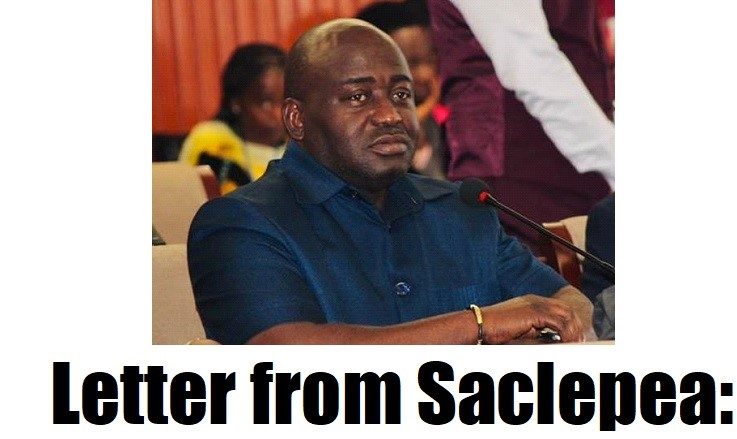
By Musa Hasssan Bility
There are moments in public service when one must pause, reflect, and ask difficult questions, not of others first, but of oneself and one’s own institution.
This is one of those moments.
In recent days, I have spent time reflecting on the Legislature, on the Constitution, and on the many things we do in the course of our work. And the more I reflect, the more convinced I become that if we approached our duties differently, we would be in a far better place as an institution and as a country. More importantly, I believe we still have the chance to turn things around. We still have the opportunity to restore the dignity of the Legislature, strengthen confidence in government, and prove to the Liberian people that public office can still be a place of service and not merely a place of privilege.
As I sit in the chamber and watch the conduct of our national affairs, I often see in the faces and arguments of some of my colleagues a troubling misunderstanding of what separation of powers truly means. Too often, when the issue arises, it is treated as though it gives the Legislature the authority to act as if the Constitution no longer matters, as if the laws we make automatically place us above the very framework that created us.
That is not true.
Yes, the Legislature has the power to make its own rules. Yes, we have oversight authority over the other branches of government. Yes, we play a central role in the governance of the Republic. But every one of those powers is guided by something greater than individual will, partisan convenience, or institutional pride. That guide is the Constitution. That guide is the rule of law. That guide is the solemn understanding that no branch of government is above the system that gives it legitimacy.
The moment we begin to act as though oversight is the same as supremacy, we begin to damage the Republic. The moment we confuse constitutional authority with unlimited power, we begin to lose our way. There is no such thing as supreme power in a constitutional democracy. There are only defined powers, limited powers, and powers that must be exercised with humility, discipline, and respect for the people.
And that is where our greatest responsibility lies.
The Legislature was designed to be the closest branch of government to the people. We are the ones elected directly from communities, towns, districts, and counties. We hear the pain of the people firsthand. We see the struggling mother, the unemployed youth, the abandoned elderly, the broken clinics, the poor roads, the schools without hope, and the communities that feel forgotten. No branch of government should better understand the aspirations, frustrations, and daily realities of the Liberian people than the Legislature.
But at this point in our national life, I do not believe our actions consistently reflect that sacred duty.
Too often, we are distracted by power struggles, internal conflicts, procedural battles, and the pursuit of influence. Too often, we behave in ways that suggest that the institution exists for us rather than for the people who sent us there. Too often, we place our pride above principle, our convenience above country, and our temporary victories above the long-term integrity of the Legislature.
We can do better.
We can create a Legislature that truly works for everybody. We can build an institution that listens more carefully, acts more wisely, and governs more responsibly. We can make the Legislature an honorable place again, one defined not by noise and confusion, but by seriousness, service, and respect.
That begins with a change of mindset.
We must stop thinking that our power is proven by how loudly we defy limits. Real strength in a democracy is shown by discipline. Real leadership is shown by restraint. Real patriotism is shown by submitting ourselves to the same constitutional order we ask others to obey.
We must remember that the Constitution is not an inconvenience. It is not an obstacle. It is not something to be cited only when convenient and ignored when uncomfortable. It is the people’s covenant with their government. It is the yardstick by which all our actions must be measured. And if we in the Legislature, who are sworn to uphold it, treat it as optional, then we weaken not only our own credibility but the foundation of the Republic itself.
The Legislature must become a place where the people’s voice is elevated, not drowned. It must become a place where national interest takes precedence over factional interest. It must become a place where debates are guided by principle, where decisions are shaped by conscience, and where service is measured by impact on ordinary lives.
We can go beyond the budget. We can go beyond allowances. We can go beyond the narrow politics of the moment. We can take time to think deeply about the people who sent us into that building and ask ourselves, every day, whether our conduct honors their trust. We can ask whether our decisions make their lives better, whether our actions strengthen democracy, and whether history will say we served with wisdom or merely occupied office.
For me, this is not about shouting at colleagues every day. It is not about disagreement for the sake of disagreement. It is not about personal battles. My desire is simple: that we can have a Legislature that truly speaks for the people, protects the people, and earns the respect of the people.
We are not helpless. We are not trapped. We are not beyond redemption as an institution. We can turn this around. We can restore credibility. We can build a Legislature that commands moral authority because it acts lawfully, responsibly, and with humility. We can make the institution more prosperous in reputation, more respected in conduct, and more faithful to the Liberian people.
That is the Legislature our country deserves.
And that is the Legislature we must strive to become. Have a pleasant week.
Comments are closed.