

Paye Rejects Erasure of Ministerial Record -Goes to the Rescue of his Legacy at Mines & Energy Ministry
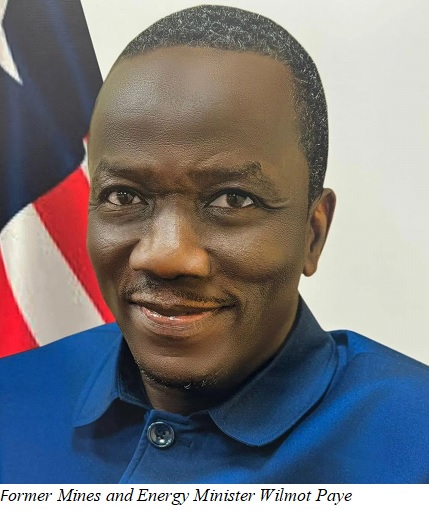
MONROVIA – Transitions in government often test not only policy continuity but also the integrity of institutional memory. In Liberia, where administrative change is frequently accompanied by political realignment, the question of how legacies are acknowledged—or quietly rewritten—has become a recurring source of tension. Former officials have increasingly warned that professional achievements risk being obscured in the rush to rebrand governance agendas. It is against this backdrop that former Mines and Energy Minister Wilmot Paye broke his silence, not to contest authority or reclaim office, but to defend what he describes as honesty in professionalism. His intervention, expressed in a commentary, raises broader questions about respect, continuity, and ethical standards in public service. THE ANALYST reports.
Former Minister of Mines and Energy Wilmot Paye has rejected what he described as attempts to downplay or erase the contributions made during his tenure at the Ministry, warning that such practices undermine professionalism, good governance, and institutional continuity.
In a written statement released over the weekend, Paye said that since leaving office, he has deliberately avoided public confrontation, including with his successor, in keeping with what he described as a disciplined upbringing and long experience in leadership and public service.
He reiterated a view he previously expressed that presidential appointments are temporary in nature, likening them to “a borrowed coat which does not belong to the person bearing the title.” According to Paye, this understanding guided his conduct during the transition period, including extending full cooperation to his successor despite long-standing political differences.
Paye noted that disagreements are a natural part of public life and should serve to sharpen ideas rather than erase history. However, he said recent developments at the Ministry of Mines and Energy suggest a troubling pattern of misrepresentation that now requires clarification.
“This is not about attention or recognition,” Paye stressed. “It is about the principles of good governance and respect for the contributions of others.”
He argued that efforts to obscure the record of the Ministry’s recent past amount to an attempt to rewrite history, an exercise he described as futile while those who shaped that history remain alive and present.
According to Paye, the narrative of the Ministry before and after 2024 was shaped by identifiable individuals and documented processes, not by anonymous or abstract forces. He said that achievements recorded during that period cannot be erased through omission or selective storytelling.
While acknowledging that officials in the Executive Branch serve at the pleasure of the President, Paye emphasized that accomplishments realized during his tenure were executed on behalf of the President and the Republic of Liberia. He said it is therefore unfair for those benefiting from the same executive privilege to attempt to diminish or conceal the work of their predecessors.
Paye pointed to two specific instances that he said illustrate the emerging pattern.
The first relates to the recent launch of the Ministry of Mines and Energy’s Five-Year Strategic Plan. Paye expressed surprise that the launch reportedly made no reference to the individuals and processes responsible for developing the document. He clarified that the plan was the product of deliberate and coordinated work facilitated by Cooper Mykers under the supervision of the Deputy Minister for Planning, Research and Development, with further refinement by the Ministry’s procurement director.
He added that the Strategic Plan was formally referenced during his November 21, 2025 handover speech, underscoring that its origins are neither unclear nor undocumented.
The second issue concerns renewed discussions around the establishment of a National Minerals Company for Liberia. Paye said the proposal was a central priority during his tenure and was widely communicated within government circles, including the Economic Management Team and the Inter-Ministerial Concession Committee.
According to him, the Ministry went as far as drafting an Executive Order for the President’s consideration. He said recent reports suggesting that the idea is newly conceived misrepresent the historical record and disregard prior work.
Paye insisted that his intervention is not motivated by personal acclaim but by respect for intellectual labor. “Thinking is hard work,” he noted, adding that ideas which result in measurable outcomes deserve acknowledgment, even when administrations change.
He concluded by calling on public officials to build upon existing achievements rather than seeking to rebrand them as original breakthroughs. He urged those in public service to acknowledge the efforts of others, regardless of personal or political differences, arguing that such humility is essential to national development.
“To build Liberia,” Paye said, “there should never be a time to downplay the contributions of others. Progress is cumulative, not selective.”
Comments are closed.