

Nation Bids ‘Zico’Zelee Goodbye-Wake Keeping Friday, Funeral & Burial Saturday
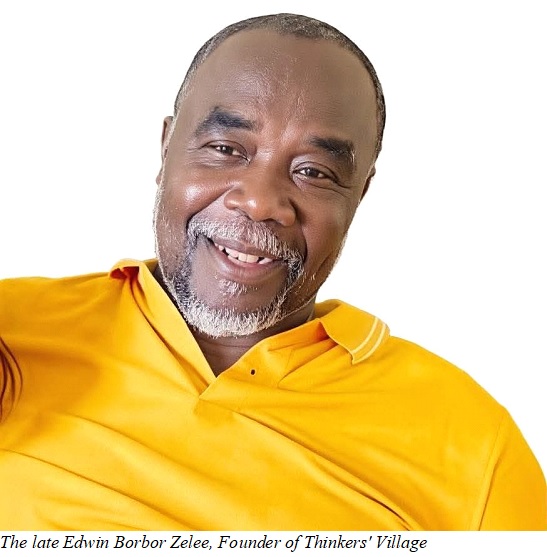
MONROVIA – In the quiet gravity that accompanies the passing of a life well lived, the nation, specifically relatives, this week reflect on the death of Edwin Borbor Zelee, founder of Thinkers’ Village, businessman, public servant, mentor, and above all, a man whose humanity outpaced his success.
To family, friends, colleagues, and countless beneficiaries of his generosity, he was simply “Zico.” To Liberia, he was one of those rare souls whose presence made life lighter and whose absence leaves a silence that lingers.
Funeral arrangements announced by the family indicate that removal will take place at St. Moses Funeral Parlours at 1:00 p.m. A wake-keeping ceremony will follow on Friday, January 23, 2026, at Harvest Intercontinental Cathedral, Congo Town, from 5:00 p.m. to 9:00 p.m.
Funeral services will be held on Saturday, January 24, 2026, from 10:00 a.m. to 1:00 p.m. at the same venue, with interment later that day at Shiata Flowers and Vaults, Careysburg City, Montserrado County.
Born on November 24, 1954, in Sinoe County, Edwin Borbor Zelee was the son of Farley Zelee Sr. and Lucy Dahwone Zelee. From the very beginning, those who knew him sensed something uncommon in his spirit. Even as a boy, he possessed a warmth that drew people close and a generosity that seemed instinctive rather than learned.
Zico often believed his father saw that promise early. Determined that his son would be prepared for life, Farley Zelee Sr. ensured Edwin attended some of the best schools available.
He began at Demonstration School, then proceeded to St. Patrick’s and St. John’s, before graduating from Our Lady of Fatima High School in Maryland County. Along the way, friendships multiplied, nicknames accumulated, and stories began—many of which would be retold with laughter decades later.
At St. John’s, younger boys fondly called him their “play pa,” a title earned not through authority, but generosity. After school, Edwin would routinely give them his large plate of rice, never asking for thanks. That simple habit revealed a truth that would define his life: his generosity began early—and never stopped.
Zico was outgoing, humorous, and effortlessly charming. He laughed with people, sometimes at them, but never in cruelty. His laughter filled rooms; his stories animated gatherings. In his youth, he was also impeccably stylish—at times resembling a French gentleman, on other days a classic Italian. Style came naturally to him, as did people. Kindness, humor, and presence combined to make him unforgettable.
In 1974, Edwin met Sieh Giple, then a student at Saint Theresa’s Convent. What followed was a four-year pursuit marked by persistence, sweet talk, and patience.
Eventually, Sieh said yes, and in 1981, Zico crowned her his queen. Their union produced six children and anchored his life in family.
True to his expansive nature, Zico’s family extended beyond convention; additional children joined his lineage, and he embraced them all with equal affection and responsibility. He loved his children deeply and remained present in their lives across time and circumstance.
Zico’s charisma transitioned seamlessly into his professional life. While studying Business Management at the University of Liberia, he worked part-time with the Liberia National Police, later rising to Acting Chief of Planning and Research.
In 1979, he moved to Public Works as Payroll Superintendent for the OAU project. After the coup, he joined the Liberia Petroleum Refining Company (LPRC) in 1981 as a Marketing Manager—a decision that would shape both his life and the institution.
At LPRC, Edwin Zelee thrived. He held multiple leadership positions and was selected for a six-month management seminar at Arthur D. Little in Boston, an opportunity reserved for those considered exceptional.
Yet, even as his success grew, Zico’s instinct was always to lift others. He brought people into the organization, opened doors, and shared opportunity generously. That, colleagues recall, was simply “Zico’s way.”
He founded the LPRC Sports Association, and the company’s football team—the LPRC Oilers—became a source of pride and laughter. When told the footballers were waiting outside his office, he would joke, “You mean those brokers have come again?” sending waves of laughter through the corridors. Employees remember not just his humor, but his heart—how he gave freely, supported willingly, and treated everyone with dignity.
War disrupted that chapter. As conflict engulfed Liberia, Zico’s path shifted. He spent time in Sierra Leone and the United States, working with the Red Cross during periods of instability. But Liberia was always home.
In 2004, he returned, and in 2005, during President Ellen Johnson Sirleaf’s first term, he was appointed Chairman of the Forestry Development Authority. After public service, he turned fully to private enterprise.
Real estate became his canvas. He built relentlessly—so much so that people joked he had cement running through his veins. But his most enduring creation was Thinkers’ Village.
What began as seven modest hotel rooms evolved into a sprawling complex of more than 30 rooms, a restaurant, conference hall, and nightclub. The surrounding area took on the name Thinkers’ Village, a testament to the scale of his vision and labor.
In its prime, it was the place—a gathering ground for friends, thinkers, artists, workers, and dreamers. Despite owning land across the country, the beach at Thinkers’ Village became his true home.
Every Sunday, friends gathered there. Zico talked football and politics, told endless stories, cracked jokes, and sometimes—just sometimes—opened the club so his workers could enjoy themselves while he and Sieh shared a few dances.
Thinkers’ Village was built with his blood, sweat, and tears, and he remained devoted to it until his final days. In 2024, he returned to LPRC as a board member, serving with the same loyalty that had defined his earlier career.
Despite achievement, Zico never lost humility. He never thought himself above anyone. He could speak to anyone—rich or poor, powerful or struggling. If he entered a place alone, he left with friends. He stood beside people in grief and in joy, never pretending, never posturing.
In many ways, Edwin Borbor Zelee was Liberia in spirit and soul. His life reflected the country’s warmth, resilience, humor, and generosity. He wanted nothing more than to see Liberia succeed and Liberians flourish. He encouraged many to return home, to build, to give back. His legacy is visible across communities at home and abroad.
It may not be etched in monuments or recorded in textbooks, but it lives on in meals shared, advice given, jobs created, dignity restored. Many reading this will remember a moment when Zico helped—quietly, without expectation. That is how he lived.
He is survived by his wife Sieh Giple Zelee; his children Joydine Zelee (Harmon), Treyah Zelee, Nora Zelee, Farlita Zelee, Tilnise Zelee Connor, Patricia Zelee, Whitney Zelee, Charlynne Zelee, David Zelee, Austin Zelee, Vanessa Zelee, Ophelia Zelee, and Hjordis Zelee Kaine; his grandchildren; siblings; and a wide circle of relatives and friends.
In death, he reunites with his parents and siblings who predeceased him.
Liberia mourns—but also gives thanks. For a life that laughed easily, loved deeply, and gave freely.
Comments are closed.