

IG Coleman Rebuked -Senate exchange sparks growing public outrage
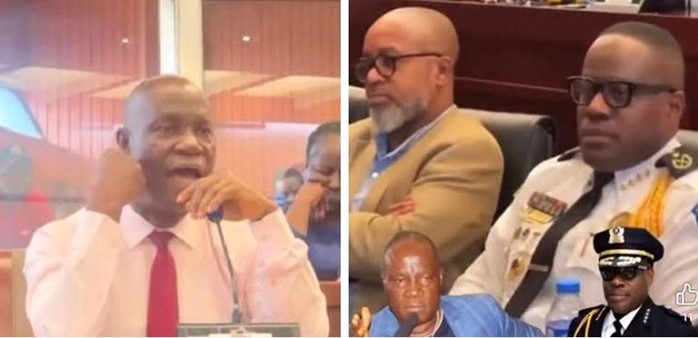
MONROVIA – Public confidence in democratic institutions often depends as much on official conduct as on policy decisions. That principle has come under renewed scrutiny following a heated exchange between Inspector General of Police Gregory Coleman and Senator Samuel Kogar during a Senate hearing on the ongoing US$19 million cocaine investigation. Although the Police Chief apologized after lawmakers demanded a retraction, criticism has continued to mount beyond the Capitol. Citizens, civil society organizations, political commentators, and governance advocates argue the incident transcends a personal disagreement, raising broader questions about institutional respect, accountability, and relations between Liberia’s co-equal branches of government. THE ANALYST reports.
Public criticism of Inspector General of Police Gregory O.W. Coleman continues to intensify following his controversial remark telling Nimba County Senator Samuel Kogar that he “talks loosely” during a Senate hearing on the ongoing investigation into the reported US$19 million cocaine seizure at Roberts International Airport (RIA).
Although Coleman immediately apologized after senators demanded that he withdraw the statement, many Liberians contend that the incident represented a troubling display of disrespect toward a sitting senator and, by extension, the Liberian Senate. Citizens, civil society organizations, and political commentators have since condemned the Police Chief’s conduct while questioning what they describe as the Legislature’s unusually lenient response.
The controversy erupted during a joint security briefing before the Senate, where members of the Joint Security appeared to update lawmakers on the high-profile drug trafficking investigation.
During the hearing, Senator Samuel Kogar sharply questioned the pace and credibility of the investigation, expressing concern that little progress had been made since the massive drug seizure.
Kogar argued that if President Joseph Nyuma Boakai was genuinely committed to uncovering those responsible for the trafficking operation, the leadership of the Joint Security should be replaced.
“Madam Pro Tempore and Mr. Co-Presiding, let us become serious about this investigation because of the damaging impact this drug issue is having on the image of our country. We are not getting anywhere with this investigation. The best way to obtain results is to remove the heads of the Joint Security Team and replace them with more competent individuals capable of getting to the bottom of this matter,” Senator Kogar stated.
Remark Sparks Public Reaction
The recommendation visibly unsettled Coleman, who interrupted the senator by responding, “You just talk loosely.”
The remark immediately provoked outrage inside the Senate chamber, with lawmakers demanding that the Inspector General retract the statement. Coleman subsequently apologized before the hearing continued.
Despite the apology, public condemnation has continued to grow, with many Liberians describing the Inspector General’s remarks as unbecoming of the country’s highest-ranking police officer and inconsistent with the respect expected between co-equal branches of government.
Several citizens interviewed by THE ANALYST argued that the exchange reflected what they described as a growing culture of intolerance toward public scrutiny among some senior government officials.
They maintained that regardless of disagreements during legislative hearings, public officials appearing before lawmakers have a constitutional obligation to conduct themselves with professionalism, restraint, and respect.
Civil Society Joins Criticism
Adding its voice to the debate, Transparent Leadership International described Coleman’s conduct as an embarrassment to government and an affront to the dignity of the Senate.
In a statement made available to THE ANALYST, the organization argued that the Inspector General’s conduct was unacceptable for someone entrusted with leading the country’s principal law enforcement institution.
“This is a complete embarrassment to the government to see a senior officer within the country’s security architecture publicly disrespect Senator Samuel Kogar in such a manner. There is no justification for allowing such conduct to be directed at a senior government official by another high-ranking public servant,” the organization stated.
Public commentator Paul Zaizay Thompson also criticized the exchange, saying the Inspector General’s comments undermined the professionalism expected of Liberia’s chief law enforcement officer.
Questions Over Senate Response
Beyond criticizing Coleman’s conduct, many citizens also questioned the Senate’s decision to accept the apology and proceed with the hearing.
Several observers argued that the Legislature’s response contrasted sharply with previous actions against opposition politicians and outspoken government critics.
Some cited the expulsion of Representative Yekeh Kolubah from the House of Representatives as an example of what they considered inconsistent standards in addressing controversial conduct by public officials.
Political analyst Kelvin Solo Teh similarly expressed disappointment with how the matter concluded, arguing that the Senate should have demonstrated greater institutional resolve in defending its dignity.
According to Teh, anyone who watched the hearing could observe increasing tension before the controversial remark was made.
The controversy has since expanded into a broader national discussion about civility, institutional respect, constitutional accountability, and the standards expected of senior public officials.
Many observers maintain that the episode has become about more than a single exchange between a senator and the Inspector General, arguing that it has highlighted the importance of safeguarding the dignity of Liberia’s democratic institutions while national attention remains fixed on the government’s handling of the US$19 million drug investigation.
Comments are closed.