

Sirleaf Champions Women’s Inclusion -Says financial access drives sustainable economic transformation
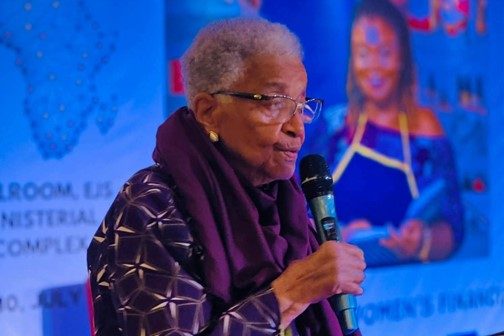
MONROVIA – Liberia’s economic transformation will depend not only on macroeconomic policies but also on whether millions of women gain meaningful access to financial opportunities. Former President Ellen Johnson Sirleaf’s renewed call for women’s financial inclusion places economic participation at the center of national development rather than treating it solely as a gender issue. Her message reflects a growing global consensus that inclusive financial systems stimulate entrepreneurship, expand productivity, reduce poverty, and strengthen economic resilience. The conference also highlighted the need for coordinated action among government, financial institutions, legislators, and development partners to remove barriers limiting women’s access to capital and financial services. As THE ANALYST reports, the former Liberian leader opines that sustained implementation, however, will determine whether these commitments produce measurable economic change.
By Lincoln H. Dalieh
Former President Ellen Johnson Sirleaf has called for renewed national commitment to advancing women’s financial inclusion, describing the economic empowerment of women as one of the most effective strategies for accelerating Liberia’s development and building a more resilient economy.
Speaking at the National Conference on Women’s Financial Inclusion, held under the theme, “Women’s Financial Inclusion as a National Economic Growth Strategy,” Sirleaf urged policymakers, financial institutions, legislators, development partners, and the private sector to move beyond rhetoric and implement practical measures that eliminate barriers preventing women from fully participating in the country’s economy.
Addressing government officials, banking executives, entrepreneurs, development organizations, and women’s groups, Sirleaf stressed that empowering women economically is no longer simply a matter of promoting gender equality but a national development priority with far-reaching economic benefits.
Economic Imperative
Drawing on decades of leadership experience in governance and economic policy, Sirleaf argued that countries that deliberately invest in women’s economic participation consistently experience stronger economic performance, greater business innovation, and more inclusive growth.
“When women have equal opportunities to access finance, own businesses, save, invest and participate in economic decision-making, entire communities benefit,” she emphasized, noting that women’s financial empowerment directly contributes to poverty reduction, job creation, improved household welfare, and national productivity.
Sirleaf observed that despite progress in expanding access to financial services across Liberia, many women—particularly those operating small businesses in rural communities and the informal sector—continue to face significant obstacles in obtaining affordable credit, opening bank accounts, accessing insurance, and utilizing modern digital financial services.
She challenged financial institutions to rethink traditional lending models that often disadvantage women because of collateral requirements and other restrictive conditions.
According to Sirleaf, financial inclusion should not be viewed merely as increasing the number of bank accounts but as creating an enabling environment where women have meaningful access to affordable financial products, business development opportunities, investment capital, financial education, and digital technology.
Building Partnerships
The former Liberian leader underscored the importance of strengthening partnerships among government agencies, commercial banks, development institutions, civil society organizations, and international partners to develop innovative solutions capable of reaching underserved women throughout the country.
She maintained that inclusive financial systems are critical for unlocking women’s entrepreneurial potential, especially as women continue to play an increasingly significant role in agriculture, trade, small business development, and community-based enterprises.
As Global Patron of the African Women Leaders Network (AWLN), Sirleaf reaffirmed the organization’s commitment to promoting women’s leadership and economic empowerment across Africa. She encouraged young women entrepreneurs to take advantage of emerging opportunities in digital finance, innovation, agribusiness, and technology while urging policymakers to ensure that financial systems become more responsive to women’s needs.
Sirleaf further noted that Liberia cannot achieve its long-term development ambitions if nearly half of its population remains excluded from meaningful financial opportunities. She emphasized that empowering women economically strengthens not only families but also national institutions and economic resilience, adding that financial inclusion should become a central component of Liberia’s national development agenda.
Stakeholders Seek Action
The conference, organized by the African Women Leaders Network (AWLN) Liberia Chapter, brought together key stakeholders to explore practical strategies aimed at expanding women’s access to financial services and increasing their participation in the formal economy.
Earlier, Lilian L. Best, Co-Lead of AWLN Liberia’s Financial Inclusion Pillar, welcomed participants and described financial inclusion as a foundation for sustainable development rather than simply access to banking services.
She emphasized that meaningful inclusion requires deliberate investments in financial literacy, affordable financing, entrepreneurship development, digital financial services, and supportive public policies that create opportunities for women across all sectors of society. According to Best, improving women’s access to financial resources strengthens household incomes, stimulates business growth, and contributes significantly to national economic transformation.
Also addressing the conference, Representative Moima Briggs Mensah, Chairperson of the House Committee on Gender Equality, Children Development and Social Services, reaffirmed the Legislature’s support for policies that promote gender equality and women’s economic empowerment. She stressed that increasing women’s participation in economic activities contributes directly to stronger families, improved livelihoods, and sustainable national development.
Senator Amara M. Konneh, Chairman of the Senate Committee on Banking and Currency, highlighted the importance of creating an inclusive financial ecosystem capable of supporting women entrepreneurs and small businesses. He observed that expanding women’s access to finance would strengthen small and medium-sized enterprises, broaden Liberia’s revenue base, stimulate investment, and create additional employment opportunities.
The keynote address was delivered by the Executive Governor of the Central Bank of Liberia, who reaffirmed the Bank’s commitment to promoting financial inclusion through supportive regulatory policies, digital financial innovation, and stronger collaboration with commercial banks and development institutions.
A panel discussion featuring entrepreneur Justina Shepherd, International Bank (Liberia) Limited Deputy Credit Manager Were Browne-Sieh, Liberia Bank for Development and Investment Head of Business Othello Sherman, and BRAC Liberia Head of Program Jenneh M. Gbao examined practical solutions to overcoming barriers to women’s financial inclusion.
Panelists identified limited access to affordable credit, inadequate financial literacy, collateral requirements, and unequal access to business financing among the principal challenges confronting women entrepreneurs. They also emphasized the growing importance of digital financial services, targeted financial education, and innovative lending products in expanding economic opportunities, particularly for women in rural communities.
By the close of the conference, participants expressed optimism that the deliberations and recommendations would contribute to stronger policies and coordinated actions placing women’s financial inclusion at the center of Liberia’s economic transformation agenda. The conference concluded with a consensus that empowering women financially is both a matter of social justice and a strategic investment capable of driving inclusive growth, reducing poverty, strengthening businesses, and building a more prosperous Liberia.
Comments are closed.