

Fallah’s Political Shenanigans Exposed -Nyumalin questions Deputy Speaker’s true intentions for Boakai
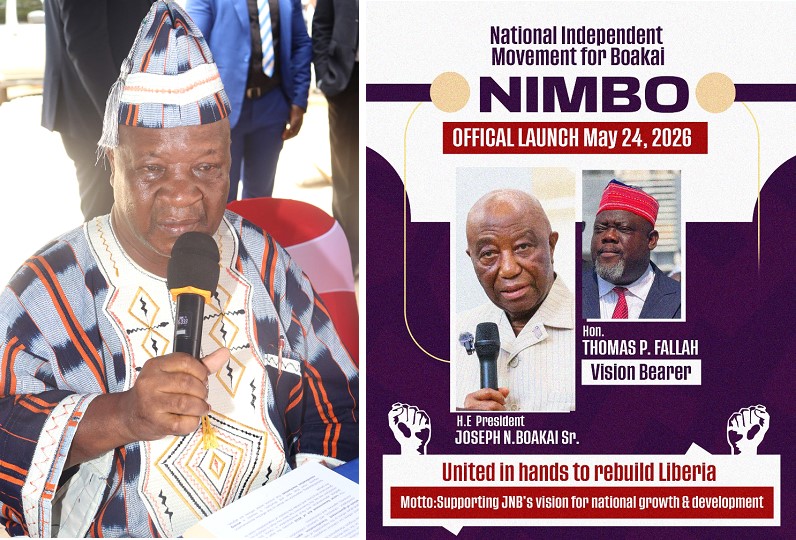
MONROVIA – What initially appeared to be an ordinary political disagreement inside Liberia’s ruling establishment has rapidly evolved into a revealing confrontation over loyalty, power, and the future direction of President Joseph Nyuma Boakai’s governing coalition. The sharp public exchange between Local Government Minister Francis Sakila Nyumalin and Deputy Speaker Thomas P. Fallah exposes growing anxiety within the Unity Party over parallel political structures emerging outside traditional party control. Beneath the fiery rhetoric lies a deeper struggle over political legitimacy, succession calculations, grassroots influence, and unresolved tensions from the bruising 2023 elections. As rival camps reposition themselves ahead of future contests, the controversy surrounding the newly formed NIMBO movement is already reshaping national political conversations, with the deputy speaker fiercely called out by his archrival Nyumalin. THE ANALYST reports.
Liberia’s already fragile political equilibrium inside the ruling establishment has suffered a fresh jolt following an unusually sharp and public confrontation between Local Government Minister Francis Sakila Nyumalin, Sr. and Deputy Speaker Thomas P. Fallah over the latter’s newly established political structure known as the National Movement for Boakai Organization (NIMBO).
What began as a seemingly routine political mobilization effort has now exploded into a national controversy carrying significant implications for the Unity Party-led administration, legislative-executive relations, and the broader struggle for political influence ahead of Liberia’s next electoral cycle.
At the center of the unfolding political storm is Minister Nyumalin’s blistering condemnation of what he described as “Dog-Cat politics” — a vivid Liberian expression he deployed to accuse Deputy Speaker Fallah of attempting to simultaneously occupy conflicting political positions for strategic convenience.
Speaking during a live interview on OK FM in Monrovia, the Local Government Minister openly questioned the sincerity and motives behind NIMBO, arguing that it is politically dishonest for an individual to publicly claim support for President Joseph Nyuma Boakai while continuously criticizing the ruling Unity Party administration that brought the President to power.
“I’m not going to be a part of any political Dog-Cat,” Nyumalin declared during the interview in remarks that have since generated intense national discussion across radio stations, social media platforms, political circles, and community gatherings.
“What do I mean? In the political world, when you want to be a dog, be a dog; when you want to be a cat, be a cat. You cannot be both at the same time,” the Minister asserted.
The comments were widely interpreted as a direct rebuke of Deputy Speaker Fallah’s recent political maneuvering and growing attempts to carve out an independent support structure around President Boakai outside the formal architecture of the Unity Party.
Political observers say the controversy surrounding NIMBO goes far beyond a mere war of words between two powerful politicians. Instead, it reveals deeper tensions within Liberia’s governing arrangement and growing unease over emerging political ambitions, shifting loyalties, and the possible fragmentation of support structures around the presidency.
At issue is Deputy Speaker Fallah’s increasingly delicate balancing act.
While Fallah has publicly launched NIMBO as a movement intended to rally support for President Boakai and his development agenda, he has simultaneously maintained public criticism of aspects of the Unity Party government, repeatedly suggesting that the administration must become more responsive to ordinary Liberians and more effective in addressing bread-and-butter concerns.
That dual posture has now become the focal point of suspicion within sections of the ruling establishment.
Minister Nyumalin, who fiercely defended President Boakai throughout the 2023 electoral struggle, openly challenged the Deputy Speaker to formally align himself with the Unity Party if his support for the President is genuine rather than politically expedient.
According to Nyumalin, no political actor can credibly claim allegiance to the President while simultaneously weakening the institutional and political structures sustaining his government.
The Minister’s comments reflected what insiders describe as growing concern within influential circles of the Unity Party that auxiliary political formations like NIMBO could eventually evolve into rival political power centers capable of diluting party authority and undermining future political cohesion.
Some ruling party insiders reportedly view the emergence of parallel organizations around the presidency as dangerous Trojan horses capable of destabilizing the Unity Party from within, especially as conversations surrounding succession politics, coalition arrangements, and future legislative contests quietly intensify behind the scenes.
Nyumalin’s intervention therefore appears to have gone beyond personal disagreement and entered the realm of political signaling — a message to ambitious actors attempting to position themselves near the presidency without fully embracing the governing party’s structures and political discipline.
Yet the confrontation cannot be fully understood without revisiting the bitter political history between the two men.
The roots of the hostility stretch back to the fiercely contested 2023 Legislative and Presidential Elections, particularly in Lofa County District #1, where Nyumalin and Fallah found themselves on opposite sides of one of the country’s most politically charged electoral battlegrounds.
At the time, Francis Sakila Nyumalin was the incumbent Representative of Lofa County District #1 and a key northern lieutenant for then-opposition standard bearer Joseph Nyuma Boakai of the Unity Party.
Conversely, Thomas Fallah — despite being politically associated for years with Montserrado County — strategically shifted political attention to his ancestral roots in Lofa County, where he emerged as one of the Coalition for Democratic Change’s most aggressive regional operatives during former President George Manneh Weah’s re-election campaign.
The political contest in Foya rapidly transformed into a symbolic proxy war between the CDC and the Unity Party.
The campaign atmosphere became highly polarized, emotionally charged, and deeply confrontational as both camps fought fiercely for political supremacy in one of Liberia’s most strategic electoral terrains.
Fallah ultimately inflicted a devastating defeat on Nyumalin, unseating the incumbent lawmaker in what many analysts viewed as one of the most consequential legislative upsets of the 2023 elections.
That victory significantly elevated Fallah’s national political profile.
Leveraging his growing influence inside the House of Representatives, he subsequently secured the powerful position of Deputy Speaker, placing him at the heart of Liberia’s legislative leadership structure under the new Boakai administration.
Meanwhile, President Boakai moved to politically rehabilitate his defeated ally by appointing Nyumalin as Minister of Local Government, thereby preserving his relevance and influence inside the administration.
The result is that two former political rivals who once battled intensely in Lofa’s electoral trenches now occupy major national positions within the same governing framework — a situation that continues to produce visible friction.
Political analysts believe the bitterness from the 2023 campaign has never fully disappeared and now heavily colors perceptions surrounding NIMBO and Fallah’s broader political intentions.
To many within the Unity Party establishment, the Deputy Speaker’s latest political moves are being interpreted not merely as support for President Boakai but as strategic groundwork for future political bargaining power.
Nyumalin’s repeated insistence that he would examine such political movements with a “microscopic eye” reflected precisely that suspicion.
Even while referring to Fallah as his “traditional big brother,” the Minister made clear that he does not trust independent political structures operating outside standard party channels.
His language suggested that he views NIMBO less as a support vehicle for President Boakai and more as a sophisticated political survival mechanism designed to preserve influence regardless of how future political alignments evolve.
The controversy also exposes broader structural tensions inside Liberia’s fragile coalition-style governance culture, where political actors often maintain multiple loyalties simultaneously — to personalities, parties, regional blocs, and shifting alliances.
Liberian politics has historically been characterized by fluid allegiances and strategic repositioning, especially during transitional political periods.
Against that backdrop, auxiliary political organizations frequently emerge around sitting presidents, often claiming loyalty while quietly pursuing independent ambitions.
That history partly explains the nervousness now visible within sections of the Unity Party.
Some observers argue that the party fears losing ideological cohesion and grassroots control if too many unofficial political structures begin competing for influence around President Boakai.
Others believe the controversy reveals unresolved insecurities inside the ruling establishment itself — particularly fears that the Unity Party remains vulnerable to internal fragmentation despite controlling the Executive Mansion.
Supporters of Deputy Speaker Fallah, however, have reportedly reacted angrily to Nyumalin’s comments.
Several of his allies allegedly view the Minister’s public attack as vindictive and politically motivated, accusing him of using his cabinet position to revisit old electoral wounds from the 2023 defeat.
To them, NIMBO represents a legitimate grassroots effort intended to consolidate support for President Boakai’s governance agenda rather than undermine the Unity Party.
They argue that political support for the President should not be monopolized exclusively by one party structure, especially in a coalition-driven democratic environment where multiple actors contributed to national political change.
Some pro-Fallah voices have further insisted that constructive criticism of government performance should not automatically be interpreted as disloyalty to the President.
According to that argument, highlighting governance shortcomings may actually strengthen public accountability and improve policy responsiveness rather than weaken the administration.
Nevertheless, the optics of the confrontation remain politically damaging.
At a time when the Boakai administration faces mounting public pressure over economic hardship, infrastructure deficiencies, unemployment, and governance expectations, open warfare between senior political figures inside the broader ruling establishment risks projecting division and instability.
The public clash has therefore intensified conversations about the coherence of the government’s political machinery and the emerging contest for influence around the presidency.
Analysts warn that if not carefully managed, such tensions could gradually deepen factionalism inside the ruling coalition and complicate legislative-executive cooperation moving forward.
The timing of the dispute is equally significant.
Liberia may still be years away from another presidential election, but political positioning has already quietly begun across the national landscape.
Movements like NIMBO are therefore being interpreted by many observers not merely as support organizations, but as early instruments for political realignment, influence-building, and future electoral leverage.
That reality explains why Minister Nyumalin appeared particularly alarmed by what he perceives as political ambiguity.
For him, the issue is not simply whether Fallah supports President Boakai. Rather, it is whether such support exists within a framework of institutional loyalty to the Unity Party or within an independent structure capable of becoming politically autonomous later.
The debate also raises broader questions about the future of party politics in Liberia.
Can ruling parties maintain discipline and cohesion in an environment increasingly dominated by personality-driven political networks? Can presidents effectively govern while multiple competing actors attempt to build independent influence around their leadership? And how should governments balance coalition inclusiveness with party loyalty?
Those questions now hover heavily over the Nyumalin-Fallah confrontation.
For now, what is certain is that the controversy has exposed deep undercurrents of mistrust beneath the surface of Liberia’s ruling establishment.
The rivalry between Francis Sakila Nyumalin and Thomas P. Fallah — once rooted in a brutal electoral contest in Lofa County — has now evolved into a larger national political confrontation carrying implications far beyond the personal ambitions of two powerful men.
As rhetoric intensifies and competing political camps harden their positions, the battle over NIMBO may ultimately become an early test of how stable, united, and politically disciplined the Boakai governing alliance truly is.
Comments are closed.