

Dr. Pailey Challenges Negro Citizenship Clause -As House Debates Liberia’s 178-Year Citizenship Law
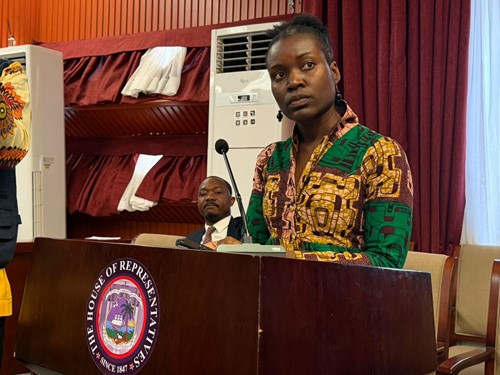
MONROVIA – A 178-year-old constitutional clause restricting citizenship to persons of Negro descent has returned to center stage. Dr. Robtel Neajai Pailey, an LSE scholar, brought a decade of research on the clause to the House of Representatives Tuesday. Her comparative study covers Liberia and Sierra Leone, the only two African nations with such a provision. The central question she posed: is the clause racist, protectionist, neither, or both? The debate is not merely academic. It implicates land ownership, foreign investment, and Liberia’s democratic future. Pailey’s 250-plus interviews across four countries reveal that citizens fear non-black land acquisition above all else. Any reform that sidesteps that anxiety, she warned, is dead on arrival. THE ANALYST reports.
Members of the 55th Legislature’s House of Representatives on Tuesday participated in a legislative dialogue led by Dr. Robtel Neajai Pailey, Assistant Professor in International Social and Public Policy at the London School of Economics and Political Science (LSE).
Pailey presented findings from her ongoing book-length research project titled “Africa’s Negro Republics: How Race, Citizenship and Migration Impact Development in Liberia and Sierra Leone.” The dialogue gave lawmakers an opportunity to examine the historical roots and contemporary consequences of constitutional provisions commonly known as the “Negro clauses,” and their implications for governance, migration, citizenship, land ownership, and national development.
Liberia’s Negro clause: a history
Pailey explained that her research focuses on the two countries in Africa that have codified racial identity into their citizenship frameworks. Liberia’s provision traces to the 1847 Constitution, which restricted citizenship to persons of Negro descent. That restriction was subsequently reinforced in the 1973 Aliens and Nationality Law, preserved in the 1986 Constitution, and retained under the 2022 Dual Citizenship Law. Sierra Leone adopted a parallel provision in the 1962 Nationality and Citizenship Act, which was challenged in the Akar vs. Supreme Court case of 1967 to 1969 and later amended under the 2006 Dual Citizenship Law.
The research, which has been in development since 2018, pursues four central questions: why were the clauses adopted in Liberia and Sierra Leone; why have they endured despite changing political contexts; whether they should be understood as racist, protectionist, neither, or both; and how they have shaped socio-economic development in both countries.
Pailey told legislators that these questions are not merely historical. They continue to define who belongs in each country and on what terms.
250 interviews across four countries
To answer those questions, Pailey employed a multi-sited, mixed-methods research design drawing on archival data, more than 250 semi-structured interviews conducted in Monrovia, Freetown, Beirut, and New Delhi, legislative dialogues, and surveys. Archival research was conducted in the United States, Sierra Leone, and Barbados.
The breadth of the fieldwork, she explained, was deliberate: understanding the clauses required hearing not only from citizens of Liberia and Sierra Leone but also from members of immigrant communities whose status and rights are directly affected by the provisions.
According to Pailey’s preliminary findings, the adoption and maintenance of both clauses were shaped by historical inequalities rooted in slavery, colonialism, capitalism, and neoliberal economic structures. The clauses did not emerge in a vacuum but as deliberate responses to those histories, she argued, in contexts where newly independent states sought to define who would control their territory and resources.
Fear of land loss drives support
Her research further found that contemporary anxieties about removing the clauses are driven significantly by the growth of Middle Eastern and Asian immigrant communities in both countries from the mid-20th century onward.
She noted that Liberian and Sierra Leonean citizens express distinct but related concerns: Sierra Leoneans focus primarily on the extension of political rights to non-Africans, while Liberians center their anxieties on land ownership and economic control.
To illustrate the depth of those concerns, Pailey cited interviews from her fieldwork. An Indian national, male, aged 32, told her: “I don’t think Liberians are racist; it’s for protection, they believe non-black foreigners will buy the entire country.”
A Lebanese national, male, aged 67, stated: “Citizenship does not matter to me, it’s land that matters.”
A Liberian national, male, aged 31, quoted in Pailey’s 2021 book, expressed the sentiment more bluntly, arguing that without the clause, Liberia would cease to be Liberian:
“If we move this clause, they will buy up every lick of the private sector. There’s a whole bunch of landowners in Monrovia who will be eager to sell because they will see six zeros and their eyeballs will start turning and Liberia won’t be Liberian anymore. It won’t. That’s why I’m in favour of it, and if that makes me a bigot or a pseudo racist or prejudice then, yeah, I am. This is my damn country and I got more right to it than you!”
Pailey drew on the political economist Karen Brodkin’s framework, which views race as a relationship to the capitalist means of production, to argue that in Liberia, citizenship and land ownership are inextricably linked. To lose one, in the view of many Liberian citizens, is to lose the other.
Pailey poses hard questions to lawmakers
In closing her presentation, Pailey posed four questions directly to members of the Legislature: whether the Negro clause is a priority for their legislative agenda and why; whether they believe the clause is racist, protectionist, or neither; whether the clause has any implications for Liberia’s contemporary development; and whether non-black residents, including Lebanese, Indian, and Chinese nationals, should be entitled to Liberian citizenship.
She emphasized that any proposed amendments to the Negro clauses in either country must explicitly address the land ownership and economic anxieties that her research has documented. Without doing so, she warned, any referendum on such changes is unlikely to succeed.
House commends scholar’s contribution
Following the presentation, Speaker Richard Nagbe Koon commended Pailey for her scholarly contribution and her continued commitment to national discourse on issues affecting Liberia’s development. Koon requested the Chairperson of the House Committee on Gender, Representative Moima Briggs-Mensah, to formally thank Pailey on behalf of the House for consistently making herself available to contribute her expertise toward national development.
Briggs-Mensah applauded Pailey for her dedication to research and public service, describing the dialogue as timely and informative.
She encouraged continued collaboration between academia and the Legislature in addressing complex national policy issues through evidence-based research.
Members of the House also expressed appreciation for the presentation, noting that the dialogue provided valuable historical context and research findings that will contribute to informed legislative discussions on citizenship, constitutional reform, governance, and national development.
Tuesday’s dialogue is part of the House of Representatives’ ongoing efforts to engage scholars, researchers, and policy experts in promoting evidence-based legislation in the Republic of Liberia.
Comments are closed.