

CSA Defends Payroll Reforms as Key to Credibility -Says It Aims at Cleaning up Liberia’s Civil Service
MONROVIA – After years of payroll irregularities, ghost names, and weak oversight that eroded confidence in Liberia’s public service, the government says it is beginning to regain control of its civil administration systems. At the center of this effort is the Civil Service Agency (CSA), which is spearheading biometric verification, payroll standardization, and digital governance reforms under the administration of President Joseph N. Boakai. According to the agency, these measures are not only eliminating long-standing abuses but also improving employee welfare and institutional accountability. As THE ANALYST reports, officials argue that while challenges remain, the shift toward data-driven management and transparency marks a decisive break from past administrative distortions.
The Civil Service Agency (CSA) says sustained payroll cleanup, biometric verification, and digital governance reforms are gradually restoring credibility and efficiency to Liberia’s civil service, following years of payroll abuse and administrative distortions.
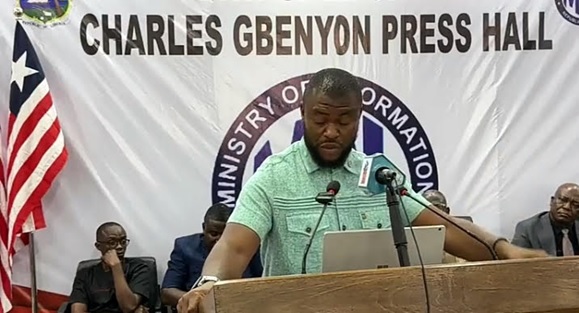
Speaking Thursday at the Ministry of Information, Cultural Affairs and Tourism (MICAT) regular press briefing, CSA Director-General Josiah F. Joekai Jr. said the agency’s reform agenda under the Boakai administration is focused on correcting historical injustices, strengthening accountability, and ensuring that only verified and productive workers remain on the government payroll.
Dr. Joekai told journalists that when the current administration took office, it inherited a public payroll riddled with inconsistencies, including thousands of unverified names, unpaid volunteers, and weak oversight mechanisms that undermined service delivery and public trust.
“For years, the payroll system was not only inefficient but deeply unfair,” he said. “You had people rendering service without compensation, while others whose identities could not be verified continued to draw salaries.”
According to him, the CSA has since relied on biometric verification, inter-agency collaboration, and data-driven decision-making to stabilize the system and gradually align Liberia’s civil service with international best practices.
He also said the reforms are being implemented in coordination with the Ministry of Finance and Development Planning and the Office of the Comptroller and Accountant General.
One of the agency’s most consequential actions, Dr. Joekai explained, was the full discontinuation of paper-based Legal Power of Attorney (LPA) transactions. For decades, the system allowed salaries to be accessed through manual authorization processes that were vulnerable to fraud, delays, and abuse.
“With the biometric LPA system now in place, government workers can securely access credit using fingerprint authentication,” he said. “At the same time, the CSA, banks, and the Ministry of Finance manage backend settlements transparently.”
He noted that the shift to digital platforms has significantly reduced bureaucracy and improved confidence among public employees, particularly those who previously struggled to access formal financial services because of documentation challenges.
Beyond payroll verification, Dr. Joekai said reforms have extended to civil servant welfare, with the CSA negotiating longer-term loan facilities with partner commercial banks. Repayment periods, he disclosed, have been extended to as much as five years, enabling workers to invest in housing, education, agriculture, and small businesses.
“These reforms are about dignity and empowerment,” he said. “Public service should not condemn workers to perpetual financial hardship.”
The CSA Director-General also referenced the introduction of salary-advance schemes by commercial banks, offering short-term financial relief to government employees at relatively low interest rates. He said additional banks are expected to join the initiative in 2026, expanding options available to civil servants.
Addressing concerns over unpaid volunteers, particularly in the education and health sectors, Dr. Joekai acknowledged that thousands of Liberians had served the government for years without being formally placed on payroll.
He boasted that the CSA, working with sector ministries, has made significant progress in integrating verified volunteers.
“No one who has been duly verified and rendered service to this country should remain unpaid indefinitely,” he emphasized, describing the process as both a moral and administrative obligation.
On accountability, Dr. Joekai pointed to the CSA’s role in enforcing presidential actions against suspended officials earlier in the year. He disclosed that salaries blocked from those cases were redirected to support public education initiatives under the government’s social intervention programs.
“This is not punishment for punishment’s sake,” he said. “It is about accountability and redirecting public resources to where they matter most.”
He further highlighted the reactivation of the Civil Service Board of Appeal as a critical mechanism for protecting workers’ rights while maintaining discipline. According to him, the board has already handled dozens of grievances, leading to reinstatements where wrongful dismissals were established.
Internationally, Dr. Joekai said Liberia’s payroll and workforce reforms are beginning to attract regional attention, with the country increasingly participating in public service reform discussions and knowledge-sharing platforms.
“We are not claiming perfection,” he concluded, “but Liberia’s civil service is moving away from opacity and toward systems that reward verification, merit, and accountability.”
Comments are closed.