

Weala Citizens Demand Justice Court Fast-Tracked -Reject continued culture of national impunity
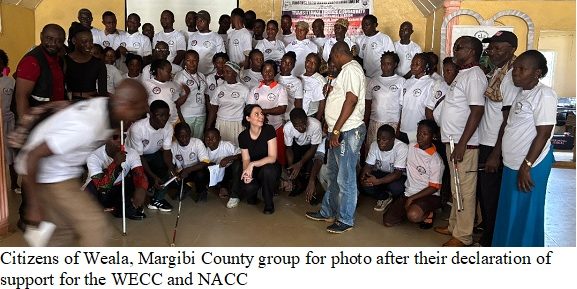
MONROVIA – Growing national pressure for justice and accountability in postwar Liberia intensified over the weekend as citizens of Weala, Margibi County openly renewed demands for the urgent establishment of the War and Economic Crimes Court, arguing that decades of impunity have continued undermining national healing, democratic credibility, and public trust in the rule of law. The call, made during a transitional justice awareness forum attended by civil society actors, students, international partners, and officials associated with Liberia’s transitional justice process, reflects mounting grassroots impatience over the country’s long-delayed confrontation with wartime atrocities and large-scale corruption. As THE ANALYST reports, this also places renewed political attention on the Boakai administration’s handling of one of Liberia’s most emotionally and politically sensitive national questions.
Citizens of Weala in Margibi County have intensified public calls for the immediate establishment of Liberia’s long-debated War and Economic Crimes Court (WECC), declaring that justice, accountability, and national healing can no longer remain trapped in endless delays while victims of war atrocities and corruption continue waiting for closure decades after the country’s violent conflict.
The renewed demand emerged during a one-day Transitional Justice Awareness Program held Friday, May 15, 2026, under the theme, “Healing the Nation Through Justice and Accountability — The Liberian Perspective.”
The event was organized by the Transitional Justice Working Group of Liberia (TJWG) in collaboration with key stakeholders involved in Liberia’s transitional justice process and attracted broad participation from community residents, students, civil society organizations, human rights actors, and international representatives.
Also attending the gathering were officials from the Office for the Establishment of the War and Economic Crimes Court for Liberia (OWECC-L), headed by Executive Director Dr. Cllr. Jallah A. Barbu, alongside representatives from the Office of the United Nations High Commissioner for Human Rights (OHCHR).
The Weala forum now joins a growing nationwide chorus demanding concrete action toward establishing accountability mechanisms for atrocities committed during Liberia’s years of conflict and for major corruption offenses affecting the country’s governance system.
For many participants at the event, the issue has moved beyond legal or political debate and entered the realm of national moral urgency.
Residents openly expressed frustration over what they described as decades of impunity, warning that Liberia cannot claim genuine reconciliation or sustainable peace while individuals accused of serious wartime crimes and large-scale corruption continue escaping accountability.
“Justice is essential for lasting peace,” several citizens repeatedly emphasized during the open discussions.
One resident, speaking emotionally during the forum, captured the frustrations shared by many participants.
“We need justice for the innocent people who died,” the resident declared. “The War and Economic Crimes Court must come so that the truth can be told and those responsible can face the law.”
That sentiment reflects a broader national tension that has persisted in Liberia since the end of the civil war.
Although Liberia’s Truth and Reconciliation Commission (TRC) completed extensive hearings and issued recommendations years ago, implementation of key accountability measures — particularly the establishment of a war crimes court — has remained politically sensitive and repeatedly delayed across successive administrations.
Supporters of the court argue that Liberia’s failure to prosecute major atrocities has entrenched a dangerous culture of impunity while undermining public confidence in justice and democratic accountability.
Critics and skeptics, however, have historically warned that aggressively pursuing wartime prosecutions could reopen old wounds, destabilize political relationships, or trigger fresh divisions within a country still managing the legacy of conflict.
Yet among many ordinary Liberians, especially victims and survivors, patience appears increasingly exhausted.
At the Weala gathering, participants repeatedly insisted that genuine national healing cannot occur without confronting unresolved questions surrounding accountability for both wartime atrocities and systemic corruption.
Speaking during the event, Transitional Justice Working Group head Martin Nlonjae Toe Sr. aligned strongly with those concerns, arguing that the proposed War and Economic Crimes Court and National Anti-Corruption Court (NACC) represent essential mechanisms for ending Liberia’s longstanding culture of impunity.
“The courts will bring lasting healing to victims and help end the culture of impunity that has permeated Liberia,” Toe declared.
His remarks highlighted the growing effort among transitional justice advocates to frame accountability not as revenge or political persecution, but as a necessary foundation for democratic credibility, reconciliation, and institutional reform.
Toe further stressed that citizens themselves must remain informed and actively engaged if Liberia’s transitional justice process is to succeed meaningfully.
According to him, accountability cannot depend solely on government institutions or international actors. Public pressure and citizen participation remain essential components in sustaining momentum behind the process.
He argued that achieving sustainable peace in Liberia requires a combination of criminal prosecutions, truth-telling initiatives, reparations programs, and institutional reforms designed to address both historical grievances and systemic governance failures.
That broader transitional justice framework reflects lessons drawn from post-conflict societies worldwide, where experts increasingly emphasize that reconciliation efforts must combine accountability with institutional transformation if long-term peace is to endure.
For Liberia, however, implementing such mechanisms remains politically delicate.
The country’s civil conflicts, spanning from the late 1980s into the early 2000s, involved multiple armed factions, political actors, foreign interventions, and widespread atrocities that devastated communities across the nation. Hundreds of thousands of people died, while many more experienced displacement, sexual violence, torture, forced recruitment, and other severe abuses.
Despite those realities, Liberia has never established a domestic war crimes court to prosecute major atrocities committed during the conflict years.
Internationally, Liberia has faced repeated criticism from human rights organizations for failing to advance accountability despite recommendations emerging from the Truth and Reconciliation Commission.
Pressure has periodically intensified whenever foreign courts prosecuted former Liberian warlords or factional commanders under international jurisdiction while domestic accountability remained stalled.
At the Weala program, Dr. Cllr. Jallah A. Barbu provided participants with an overview of draft legislation recently submitted to President Joseph Nyuma Boakai concerning both the WECC and the National Anti-Corruption Court.
According to Barbu, the proposed WECC would specifically focus on crimes committed during Liberia’s conflict period between 1979 and 2003, while the NACC would address major corruption-related offenses.
Importantly, Barbu disclosed that the draft law establishing the National Anti-Corruption Court includes provisions imposing lifetime bans from public office on individuals convicted of corruption-related crimes.
That aspect of the proposal is likely to generate significant national discussion given growing public frustration surrounding corruption, governance failures, and weak accountability within state institutions.
Corruption remains one of Liberia’s most politically sensitive issues, with repeated allegations involving misuse of public resources, procurement irregularities, abuse of office, and weak enforcement mechanisms continuing to dominate national discourse.
By linking anti-corruption accountability with transitional justice mechanisms, advocates appear increasingly determined to frame impunity not merely as a wartime issue, but as a broader governance problem affecting Liberia’s democratic future.
Barbu also encouraged citizens to directly engage lawmakers and maintain pressure for passage of the proposed legislation.
He emphasized that transitional justice cannot advance successfully without strong public backing and sustained national commitment.
Speakers at the gathering reminded participants that President Boakai had already renewed Executive Order 164, thereby extending the mandate of the Office for the Establishment of the War and Economic Crimes Court for Liberia.
Advocates now argue that the next critical phase requires legislative action capable of transforming preparatory frameworks into operational accountability institutions.
“Now it is left with all Liberians to support this process so that the long-awaited justice can be achieved timely,” Toe stressed.
Political analysts say the Weala forum reflects a broader shift occurring within Liberia’s transitional justice debate.
For years, conversations surrounding the War and Economic Crimes Court were often concentrated within elite political circles, international advocacy spaces, and human rights organizations. Increasingly, however, grassroots communities themselves are becoming more vocal and organized around demands for accountability.
That development may carry important political implications.
As ordinary citizens openly engage the issue, pressure on lawmakers and national leaders could intensify significantly, especially if community-level awareness programs continue expanding across the country.
At the same time, the issue remains politically explosive.
Some individuals and groups continue expressing fears that the court could become politicized or selectively applied. Others worry about the practical complexities involved in prosecuting decades-old crimes within a fragile institutional environment.
Still, for many Liberians, the larger fear now appears to be continued silence and unresolved injustice.
The Weala gathering repeatedly returned to one central message: that peace built without accountability remains incomplete.
Participants argued that national reconciliation cannot rest solely on forgetting the past while victims continue carrying unresolved pain and perpetrators remain unpunished.
For the citizens of Weala, the conclusion appeared unmistakable. The time for endless discussion has passed. The time for justice, they insisted, is now.
Their voices now add growing momentum to a national conversation likely to become increasingly unavoidable as Liberia continues wrestling with the unfinished business of war, corruption, accountability, and democratic legitimacy.
Comments are closed.