

Lofa Border Tension Sparks National Alarm-Youths Confront Guinean Troops amid Diplomacy
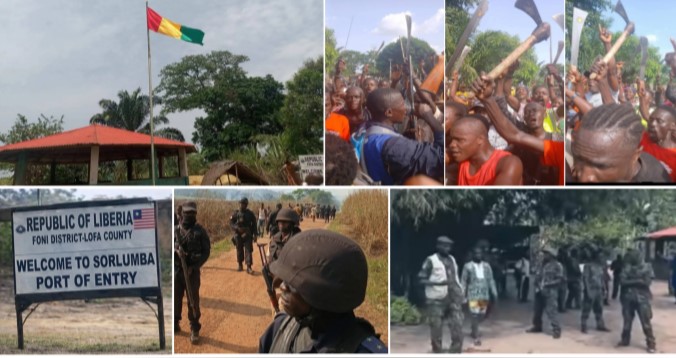
MONROVIA – A tense confrontation unfolding along Liberia’s northern frontier is raising serious national concern about the fragility of peace in the Mano River basin. Reports from Lofa County suggest that what began as a dispute over border demarcation and road construction activities has rapidly evolved into a sensitive security situation involving Guinean troops and mobilized Liberian youths. Border communities, historically vulnerable due to weak state presence and unresolved territorial issues, often become flashpoints when tensions arise between neighboring states. While residents describe their actions as patriotic defense of Liberian sovereignty, security analysts warn that civilian mobilization against foreign troops carries significant risks. Meanwhile, as THE ANALYST reports, the Government of Liberia has stepped in diplomatically, urging calm while pursuing engagement with Guinean authorities.
A tense and potentially dangerous confrontation is unfolding along Liberia’s northern frontier, where patriotic youths in Lofa County have emerged as the unexpected frontline defenders in what residents describe as a Guinean military incursion into Liberian territory.
What began as a dispute over territorial demarcation and economic activities in border communities has rapidly escalated into a situation with serious national security implications, raising fears of possible military escalation, diplomatic strain between Liberia and Guinea, and the reawakening of painful memories from Liberia’s turbulent past.
Reports from the ground indicate that the tension is centered around Sorlumba and surrounding communities in Foya District, an area located along the porous Liberia–Guinea frontier.
Over the past twenty-four hours, dramatic scenes have reportedly unfolded as young men and women mobilized in large numbers to assert Liberia’s sovereignty in the contested zone.
Images circulating on social media platforms show youths hoisting Liberian flags at strategic points, organizing patrols, chanting patriotic slogans, and blocking what they believe to be advances by Guinean security forces.
For many of the youths involved, the confrontation is not simply about territory—it is about national pride and the defense of their homeland.
“We are not soldiers, but this is our country. If we don’t stand here, who will?” a local youth leader in Foya reportedly said while addressing fellow residents gathered near the disputed area.
Grassroots Patriotism In Border Communities
Community elders say the mobilization reflects deep-seated frustration among border residents who often feel neglected by the central government until crises emerge.
For decades, many communities in Lofa County have complained of limited infrastructure, inadequate security presence, and slow responses to border concerns.
“Border people always feel forgotten until trouble comes,” said Kolubah Zezay, a traditional leader in Lofa County.
“Now the young people feel they must defend their own land.”
Observers say such mobilization reflects a growing pattern of grassroots nationalism in fragile border zones, particularly where citizens perceive that the state is slow to assert its authority.
Political observers note that in communities where the government’s security presence is limited, local residents often take symbolic actions to demonstrate national sovereignty.
What Triggered The Crisis
Reports emerging from residents indicate that the crisis began when Guinean troops allegedly crossed into Liberian territory near the Makona River and halted ongoing road construction work.
The road project, residents say, was intended to improve connectivity between communities along the border.
According to eyewitness accounts, Guinean soldiers reportedly confiscated heavy construction equipment and ordered workers to withdraw from the area.
The situation reportedly escalated when Guinean troops were accused of removing a Liberian national flag and raising the Guinean flag in its place.
For residents, the action was interpreted as a symbolic assertion of territorial claim.
The development sparked outrage among local youths, who quickly mobilized in what they described as a defense of Liberian territory.
Residents say panic spread rapidly through nearby villages.
Some families reportedly temporarily abandoned their homes and farms, fearing that the situation could deteriorate into violence.
The crisis intensified further when Guinean troops reportedly returned after initially being pushed back by the youths.
Witnesses claim that the soldiers returnedheavily armed and fired shots in the direction of the mainly unarmed youths, leaving at least one Liberian reportedly struck by a bullet.
Authorities have yet to officially confirm details surrounding the alleged shooting.
Historical Tensions Along Liberia–Guinea Frontier
The Liberia–Guinea frontier has historically been one of the most sensitive areas in the region.
During the civil wars of the 1990s and early 2000s, Lofa County became a strategic battleground for armed groups moving across the borders of Liberia, Sierra Leone, and Guinea.
Entire communities were displaced during the conflicts, and thousands of civilians were killed or forced to flee.
For many residents, the memories of those conflicts remain vivid.
Today’s generation of youths—many of whom were born during or shortly after the war—say they are determined not to allow instability to return.
“Our parents suffered war,” said James Kokolo, a youth activist in Foya.
“We will not allow another conflict to start here.”
Security Analysts Warn of Dangerous Escalation
While the actions of the youths have been widely interpreted as a display of patriotism, security experts caution that such mobilization could inadvertently escalate tensions.
“Unarmed youths confronting trained foreign troops could easily lead to deadly incidents,” said political analyst Sammy Johnson.
Johnson warned that grassroots resistance movements could complicate delicate diplomatic negotiations already underway between Monrovia and Conakry.
According to him, the situation carries broader regional implications.
The Mano River basin, which includes Liberia, Guinea, and Sierra Leone, has historically experienced localized disputes that later spiraled into wider regional instability.
“Domestic political actors may also attempt to exploit the situation, further inflaming nationalist sentiments,” Johnson said.
“The government must therefore act carefully and expeditiously to contain the crisis.”
Government Moves to Calm Situation
Meanwhile, the Government of Liberia has moved to reassure citizens that the situation is being addressed through diplomatic channels.
In a statement issued from Capitol Hill in Monrovia on Tuesday, March 10, 2026, the government called on citizens to remain calm while diplomatic engagements intensify with neighboring Guinea.
Authorities said the government has taken full notice of developments along the border and is actively addressing the matter through established diplomatic channels.
Officials emphasized that Liberia remains committed to resolving the situation peacefully in keeping with the longstanding tradition of cooperation between the two neighboring countries.
The government said it is working closely with relevant national and local institutions while maintaining communication with Guinean authorities.
The objective, officials noted, is to prevent any escalation of tensions and promote dialogue aimed at resolving concerns along the shared frontier.
President Boakai Dispatches High-Level Delegation
As part of the government’s response, President Joseph Nyuma Boakai, Sr. has dispatched a high-level inter-ministerial delegation to the border region.
The delegation includes representatives from the Ministries of Defense, Foreign Affairs, Justice, and Local Government.
Their mission is to assess the situation on the ground, engage local authorities, and strengthen communication with Guinean officials.
Officials say the delegation’s discussions are focused on ensuring that peace and stability are maintained for residents of border communities.
Authorities also noted that both Liberia and Guinea recognize the importance of maintaining stability along the frontier, where residents rely heavily on cross-border trade, family ties, and shared economic activities.
Public Urged To Avoid Rumors
The government has urged citizens, particularly those living in border communities, to remain calm and law-abiding.
Authorities warned against the spread of unverified reports or rumors that could heighten tensions.
Citizens were encouraged to rely only on verified information issued through official government channels as diplomatic engagements continue.
Officials further assured the Liberian people that the government will continue to provide updates as discussions with Guinean authorities progress.
The statement, signed by Jerolinmek Matthew Piah, Minister of Information, reaffirmed Liberia’s commitment to resolving the situation through peaceful dialogue and diplomacy.
A Critical Moment For Liberia
The unfolding events in Foya District have stirred strong emotions across Liberia.
While the courage displayed by Lofa’s youths has sparked national pride, analysts say the situation also highlights the delicate balance between patriotism and national security.
The young men and women standing along the muddy borderlines today symbolize a generation determined to defend their country.
Yet observers caution that patriotism without coordinated state leadership can quickly lead to confrontation.
For Liberia, the coming days may prove decisive—not only for protecting territorial integrity, but also for safeguarding the fragile peace that the nation has struggled for decades to achieve.
Comments are closed.