
Supreme Court Ruling Tests Executive Compliance-Dr. Nyan Reinstatement order sparks governance debate
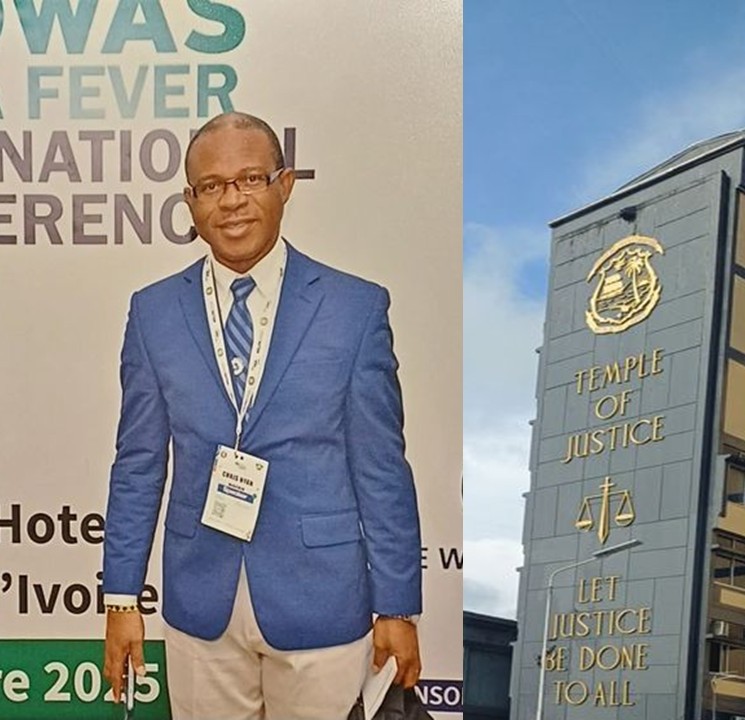
MONROVIA – A recent ruling by the Supreme Court of Liberia has placed the country’s executive branch under intense scrutiny over compliance with judicial authority. The Court ordered the reinstatement or compensation of the Director General of the National Public Health Institute of Liberia (NPHIL) after determining that his dismissal violated statutory and constitutional protections. Yet weeks after the judgment, the ruling reportedly remains unimplemented, raising concerns among legal observers about adherence to the rule of law and the balance of power among Liberia’s branches of government. As THE ANALYST reports, the unfolding situation has triggered debate about institutional accountability and the obligation of public officials to respect Supreme Court mandates.
By Our Correspondent
MONROVIA – In a landmark ruling handed down by the Supreme Court of Liberia on February 16, 2026, the Director General of the National Public Health Institute of Liberia (NPHIL), Dougbeh Christopher Nyan, was ordered immediately reinstated or compensated for the remainder of his statutory tenure following his victory in a wrongful termination case brought against the Executive Branch of the Liberian Government.
However, reports indicate that the ruling has yet to be implemented, prompting concerns that the decision may already be in violation by the Executive Branch, which critics say is showing disregard for the authority of the Supreme Court.
The Court granted the Writ of Prohibition and affirmed the Peremptory Writ, effectively barring the Officer-in-Charge or Acting Director General, Sia Camanor, from carrying out any official functions at NPHIL as of the date the ruling was issued.

Dr. Dougbeh Chris Nyan, Biomedical Scientist, Inventor
Dr. Camanor, believed to be related to President Joseph Nyuma Boakai, previously served as co-chair of the NPHIL Board of Directors and was among signatories to the Board Resolution upon which the President acted to remove Dr. Nyan from office.
During the Supreme Court hearing on January 15, 2026, that Board Resolution—the cornerstone of the government’s defense—was found by the Court to be unlawful and unsupported by evidence. The justices ruled that it violated provisions of the NPHIL Act of 2016 as well as Liberia’s administrative procedural laws.
In the 20-page ruling delivered by Associate Justice (in Chambers) Jamesetta Howard Wolokollie, the Supreme Court held that the Executive Branch acted outside its authority when it dismissed a statutory officer protected by tenure without meeting the removal conditions explicitly established under the NPHIL Act of 2016.
The Court further determined that the dismissal violated Article 20(a) of the 1986 Constitution of Liberia as well as international human rights conventions to which Liberia is a signatory.
Reports from Executive Mansion circles suggest that the Ministry of Justice Liberia has officially informed the Presidency of the Supreme Court’s ruling and its legal implications, including the consequences of failing to adhere to the Writ of Prohibition and the Peremptory Writ issued in favor of Dr. Nyan.
The Ministry reportedly also transmitted a copy of the Court’s decision to Dr. Camanor, who had been appointed by President Boakai to serve as caretaker at the national public health institution.
The Court’s decision effectively validated Dr. Nyan’s earlier communication to the President dated September 17, 2025, in which he argued that the eleven counts cited by the NPHIL Board to justify his removal were unconstitutional and failed to satisfy Section 4.4(i) of the NPHIL Act.
Dr. Nyan contended that the Board’s allegations were “broad, vague, lacking specificity, unsupported by evidence, and functionally inaccurate.”
The Supreme Court agreed with this position, rejecting the government’s central argument that an investigation had justified the dismissal. According to the ruling, the Court found no evidence that any such investigation had actually been conducted.
Allegations of “misconduct” and “gross inefficiency” cited by the Board were also dismissed by the Court, which determined that the accusations were not supported by any legally valid inquiry, investigative report, or documented findings.
Sworn affidavits submitted by Louise Kpoto and NPHIL Board Chairman Stephen Kennedy were similarly found by the Court to lack evidentiary support. Dr. Nyan’s legal team described those submissions as personal attacks that were emotionally charged and politically motivated.
Claims of inefficiency were further contradicted by an independent report from the General Auditing Commission Liberia, which reportedly rated NPHIL’s administrative leadership and financial compliance at 81 percent during Dr. Nyan’s tenure—an improvement over the 61 percent rating recorded under the previous administration.
Under Dr. Nyan’s leadership, NPHIL expanded its diagnostic capacity, strengthened disease surveillance systems, and enhanced administrative coordination. The institute also gained national and international recognition, including designation as an “Africa Regional Center of Excellence for National Public Health Institute Development” by the Africa Centres for Disease Control and Prevention.
Observers have also pointed to a potential conflict of interest involving Dr. Camanor, who simultaneously served as co-chair of the NPHIL Board and participated in crafting and signing the Board Resolution used as the basis for Dr. Nyan’s dismissal. The Court ultimately found that resolution to be unlawful.
Attention has now turned to the role played by the NPHIL Board and the Minister of Health following the Supreme Court ruling. Critics argue that the Court’s findings raise serious questions about the credibility of the allegations submitted to justify Dr. Nyan’s removal.
Some governance commentators suggest that under stricter accountability standards, officials involved in submitting unsupported claims could face calls to step aside for misleading the Presidency and contributing to decisions that have attracted international scrutiny.
For his part, Dr. Nyan has maintained that the case transcends personal employment concerns.
According to him, the matter is fundamentally about exposing what he describes as official misinformation and ensuring adherence to the rule of law in Liberia.
Dr. Nyan, a biomedical scientist, physician, public health expert, and inventor, is internationally recognized for developing the Rapid Multiplex Realtime Isothermal Detection System for Pathogens—known as the “NYAN-TEST”—for which he has received three United States patents.
He is the 2017 recipient of the Africa Innovation Award for Social Impact and the 2025 Africa Genius Award. In 2024, he also led a team of young scientists at NPHIL that identified the Monkeypox Clade IIa virus in Liberia more than fifty years after the pathogen was first detected.
Observers say the situation now represents a critical test for the administration of President Boakai and its commitment to the rule of law.
The Supreme Court’s February 16 ruling gives the government two clear options: reinstate Dr. Nyan to his statutory position or compensate him for the remainder of his tenure along with any additional legal remedies provided by the Court.
Comments are closed.