
STAND Frowns at Boakai Global Honor -Says Governance Record Clouds International Recognition
MONROVIA – A major international peace recognition for President Joseph Nyuma Boakai has ignited sharp domestic and diaspora backlash, with a leading civil society organization mounting a detailed challenge that questions the credibility of the honor against Liberia’s current governance realities. The confrontation exposes a widening gap between external validation and internal accountability narratives, raising deeper questions about how peace, leadership, and democratic performance are measured and projected on the global stage. At issue is not only the symbolism of the award, but whether it reflects conditions on the ground or risks legitimizing unresolved concerns. As THE ANALYST reports, the controversy now places Liberia at the center of a sensitive international credibility debate.
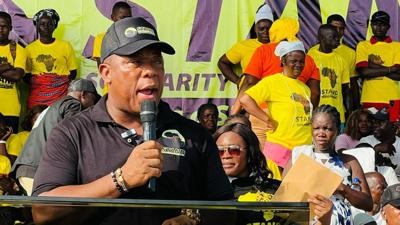
A growing storm of criticism has erupted over the decision to confer a prestigious international peace award on President Joseph Nyuma Boakai, as the civil society organization Solidarity & Trust for a New Day (STAND) formally challenges the honor, arguing that it contradicts prevailing governance and human rights realities within Liberia.
In a strongly worded communication addressed to the Center for African Peace and Conflict Resolution at California State University, Sacramento, STAND outlines what it describes as “serious, egregious, and unresolved governance concerns” that it contends are fundamentally inconsistent with the values underpinning a peace award of international stature.
The letter, signed by STAND Chairman Mulbah K. Morlu Jr., does not merely object to the invitation extended to President Boakai—it directly questions the legitimacy of the conferment itself, arguing that such recognition constitutes an endorsement of leadership conduct that must meet measurable standards of justice, accountability, and societal harmony.
According to STAND, those standards have not been sufficiently met.
The organization points to what it characterizes as a pattern of governance challenges, including disputes over adherence to tenure protections, allegations of non-compliance with judicial decisions, and broader concerns about the strength and independence of Liberia’s rule-of-law institutions. These issues, the group argues, raise fundamental questions about the country’s democratic trajectory under the current administration.
Among the most serious allegations cited is a controversial case involving Ibrahima Khalil Cherif, which STAND claims reflects potential violations of due process and international legal norms.
The organization alleges that Cherif, reportedly a pre-trial detainee at the time, was transferred to authorities in Guinea under unclear circumstances while legal proceedings were still pending—an action that, if substantiated, could have implications for Liberia’s adherence to both domestic and international legal standards.
STAND further raises concerns about the conduct of the security sector, particularly the Liberia National Police, citing what it describes as “credible and repeated allegations of excessive force” against civilians, including students and peaceful demonstrators.
Central to this criticism is Police Inspector General Gregory Coleman, whom the organization accuses of presiding over a policing environment marked by brutality, repression, and alleged violations of fundamental rights.
The inclusion of Coleman in presidential delegations, particularly in the context of international engagements centered on peace and governance, is described by STAND as deeply problematic.
The organization argues that such representation risks sending a signal of tolerance for alleged abuses, thereby undermining the credibility of Liberia’s participation in global peace platforms.
Beyond security sector concerns, the organization’s critique extends to broader governance dynamics.
STAND highlights what it describes as increasing political exclusion, including claims of dismissals and marginalization of individuals perceived to be aligned with opposition forces.
It also points to tensions within the legislative branch, referencing controversies surrounding the removal of House Speaker J. Fonati Koffa and the expulsion of lawmaker Yekeh Kolubah—developments it argues reflect a weakening of institutional balance and separation of powers.
The organization further draws attention to ongoing border tensions with Guinea, disputes linked to concession areas such as Kinjor, and allegations of violence against communities in resource-rich regions.
These issues, it contends, collectively illustrate a governance environment that remains fraught with unresolved challenges.
Economic governance has also come under scrutiny.
STAND references public controversy surrounding high-value expenditures, including reports of a multimillion-dollar presidential residential project, arguing that such spending priorities appear misaligned with the broader economic realities facing ordinary Liberians.
The organization’s concerns extend into the civic space, where it alleges a pattern of repression against dissenting voices. It cites incidents involving the burning of its headquarters following the December 17 “Lead or Leave” protests, as well as the arrest of its members and alleged threats against its leadership, including claims of an assassination attempt targeting Chairman Morlu ahead of a subsequent protest.
While acknowledging that not all allegations have been adjudicated in court, STAND emphasizes that the cumulative pattern—characterized by unresolved claims, limited transparency, and perceived accountability gaps—constitutes a serious governance concern in its own right.
In a parallel public statement, the organization sharpened its critique, describing the award as “deeply insensitive” and warning that it risks insulting victims of poor governance in Liberia.
It further argued that the recognition could reduce the concept of peace leadership to a “hollow endorsement” disconnected from lived realities.
“Peace cannot be externally awarded while democratic space is constrained and violated at home,” the statement asserts, framing the issue as one of fundamental principle rather than political disagreement.
The controversy places the Center for African Peace and Conflict Resolution in a delicate position.
As an academic institution committed to promoting peace and conflict resolution, CAPCR is now confronted with competing narratives: one that presents President Boakai as a symbol of Liberia’s post-conflict recovery and democratic consolidation, and another that questions whether such recognition adequately reflects current governance conditions.
STAND has called on the institution to reconsider the conferment or, at minimum, ensure that any engagement with the Liberian President is grounded in “rigorous, transparent, and accountable dialogue.”
The organization warns that proceeding without addressing these concerns risks undermining the credibility of both the award and the institution itself.
At the heart of the unfolding debate is a broader and more complex question: how should peace leadership be defined and evaluated in contemporary contexts where progress and challenges coexist?
For Liberia, the issue carries significant implications.
International recognition can serve as a powerful tool for diplomatic positioning, investment attraction, and national branding. However, when such recognition is contested domestically, it can also expose underlying tensions and amplify scrutiny of governance practices.
The Boakai award controversy, therefore, is not merely about a single honor. It is a reflection of a deeper struggle over narrative—between external validation and internal accountability, between symbolic recognition and substantive governance performance.
As the scheduled award ceremony approaches in California, attention is likely to intensify, both within Liberia and among international observers. Whether the controversy reshapes the event or simply accompanies it remains to be seen.
What is certain, however, is that the debate has already elevated the stakes—transforming what might have been a routine diplomatic recognition into a defining moment of scrutiny, reflection, and national conversation.
Comments are closed.