Sirleaf Declares Duty Beyond Presidency-Says Liberia Still Needs Leadership, Vows Continued Service
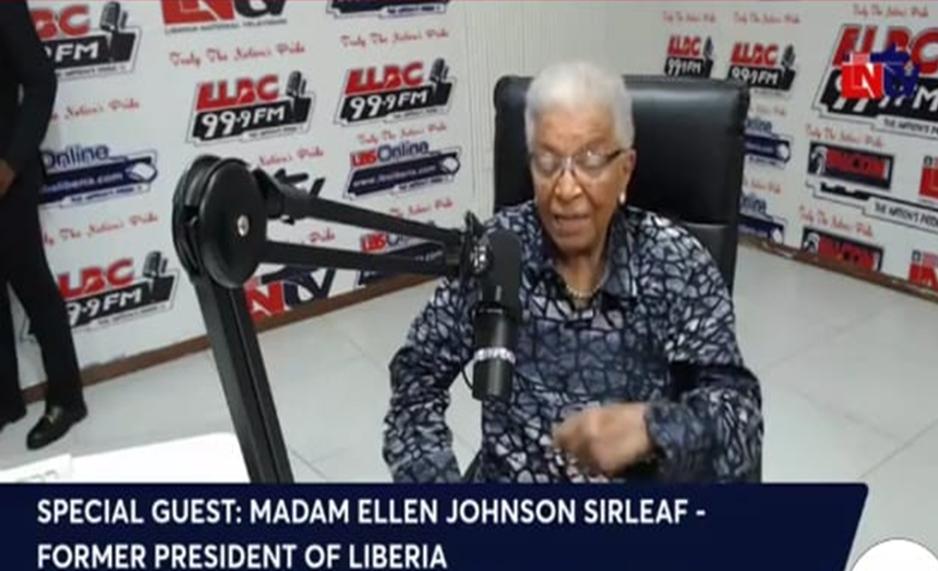
MONROVIA – At a time when Liberia is grappling with land disputes, questions about free speech, patriotism, governance standards, and national direction, former President Ellen Johnson Sirleaf has stepped back into public conversation with reflections that are as pointed as they are philosophical. Speaking on national radio, Liberia’s first female president outlined why she remains engaged in public affairs at 87, warning against selfishness, misinformation, and institutional decay while urging Liberians to rebuild patriotism and respect for law. Her comments, spanning African diplomacy to urban demolitions, offer both a defense of her legacy and a challenge to the nation she once led. THE ANALYST reports.
Former Liberian President and Nobel Peace Laureate Ellen Johnson Sirleaf says her continued engagement in national, continental, and global affairs after leaving office is driven by one simple principle: responsibility to Liberia.
Her words, delivered in a calm but firm tone during a wide-ranging national radio interview, underscored what she described as a moral obligation to remain active in the country’s affairs, even in retirement, especially at a time when Liberia faces complex challenges ranging from governance to land disputes and from youth migration to national cohesion.
“I could easily be sitting down in the United States. But what would I get out of that? Why would I spend all my time going through the things I went through to be president and leave it to go sit down in the United States and let people come and spoil the country? So I do my part. And that I will continue to do,” former President Johnson said.
Appearing on the Liberia Broadcasting System’s thought-provoking program, “The Liberian Renaissance: Changing Minds, Changing Attitudes,” Sirleaf addressed a range of national issues—from her recent appearance at the African Union Summit in Addis Ababa to free speech, land disputes, patriotism, and the establishment of the African Women’s House. The Analyst reports.
Her remarks, though reflective, were unmistakably political in their implications, offering insight into her views on governance, leadership standards, and Liberia’s unfinished national journey.
Why Addis Ababa?
Sirleaf recently attended the African Union Summit of Heads of State in Addis Ababa. Though no longer in office, she clarified that her presence was tied to her continental role.
“I serve as the patron of the African Women Leaders Network, and I have served in that role for several years since I became a former president. And having a right to a seat in the margins of the African Union Summit, I do go to that Summit to promote women in agriculture, which is an intervention program that I co-chair with President Obasanjo for the promotion of women in agriculture. I can sit in the Summit itself and listen to other speeches, or I don’t have to. Most times I don’t,” she explained.
Her explanation reflects the evolving role of former African leaders in continental diplomacy, where ex-heads of state often serve as envoys, mediators, or patrons of development initiatives.
For Liberia, Sirleaf’s continued participation in continental forums maintains a level of diplomatic visibility that many analysts say remains valuable for a small nation navigating global partnerships.
Her work with the African Women Leaders Network, she noted, focuses on strengthening women’s participation in agriculture, governance, and economic empowerment—sectors she believes are critical to Africa’s future stability.
The Iconic Meeting with President Boakai
Addressing public reactions to photos showing her in discussion with President Joseph Boakai during the AU Summit of Heads of State in Addis, Sirleaf dismissed suggestions of political intrigue.
“What I define as leadership is quite different from what the average politician sees,” she said.
While acknowledging that she and Boakai did not have a close personal relationship during his tenure as her vice president, she emphasized that her engagement with him—and even with former President George Weah—is grounded in national interest.
She disclosed that she was invited through the Minister of Foreign Affairs to join discussions involving rotating members of the UN Security Council, following Liberia’s diplomatic engagements.
“As long as whatever I say is correct, factual, bigger, and peaceful, I can say it anytime, anywhere,” she stated.
Her comments were widely interpreted as an appeal for political maturity in Liberia, where former leaders are often viewed through partisan lenses.
Speaking also on the alleged doctored photos that circulated the Internet about her meeting with President Boakai in Addis, Sirleaf criticized the misuse of artificial intelligence in circulating misleading images, warning that while AI is a powerful intellectual tool, it can also be abused to spread misinformation.
“And so, I think for those who put out some rather crazy photos, I am just glad that most of the major countries are now thinking about how they can rein in AI so it doesn’t become a thing for stupid people to use and try to make a lot of problems. But AI can be an intellectual tool; it’s useful, and we like to see many of our students use it as possible. But you also have these degenerates who spread all kinds of news. They don’t have any sense of purpose,” she said.
Her remarks touched a growing concern in Liberia’s media environment, where misinformation campaigns have become more frequent in the age of social media.
On Patriotism and Changing Mindsets
A significant portion of her remarks centered on what she described as Liberia’s deficit in patriotism.
“If we are going to build this country, it has to be built by Liberians dedicated to the promotion of Liberia—not just what they can get out of Liberia for their own interest,” she declared.
Sirleaf lamented what she termed widespread selfishness and a culture of outward migration, arguing that many citizens prioritize opportunities abroad over national development. She called for civic education reforms that instill patriotism and a sense of ownership in young people.
“Each of us has a responsibility. Each one must realize the country’s interest is the best thing… Liberians are very selfish… Look at the state of the country. Let’s ask ourselves why,” she said.
Her comments touched on longstanding concerns about brain drain, youth unemployment, and civic culture in Liberia, issues that have persisted since the post-war reconstruction era.
She called for educational reforms to teach national responsibility.
“Maybe more people have to speak out, more people have to reach out to each other, more leaders will have to feel within themselves that they too have a role to play to change minds and attitudes,” she added.
Free Speech and Responsibility
On the controversial Supreme Court contempt ruling against Justice Yeazan for social media attacks against the judiciary, Sirleaf was cautious but firm about standards of conduct.
While reaffirming her belief in free speech—a principle she advanced during her presidency—she insisted that freedom must be exercised responsibly.
“Free speech also has responsibility,” she said. “If you don’t meet certain international standards, you should bear the punishment.”
Although she declined to delve deeply into the specific case, she suggested the Legislature may need to clarify legal standards governing public expression.
Her comments highlight Liberia’s ongoing debate over balancing press freedom and accountability, especially in a polarized digital age.

The African Women’s House: A Legacy Project
One of Sirleaf’s most ambitious post-presidential initiatives is the Musiehjah – (local Vai language meaning ‘women’s house’) – a house where the women gather to talk, to mediate, to plan, to try to find the way of coexistence with their partners — the House” formally known as the African Women’s House.
The project, under the Ellen Johnson Sirleaf Presidential Center for Women and Development, aims to document and showcase the contributions of eminent African women in leadership, peacebuilding, and development.
“It will attract international people coming to learn, coming to understand, and coming to know part of the history of African women,” she said.
Sirleaf revealed that the Center has signed a contract with Harvard University to archive and digitize her presidential papers, ensuring preservation of Liberia’s modern political history.
Importantly, she clarified that the land for the project is owned by the Center—not by her personally—underscoring that it is not a private asset but a national legacy institution.
On Land Disputes and Demolitions
Turning to the ongoing wave of property demolitions and evictions, Sirleaf struck a firm tone on legality.
“If someone has built on a property that they do not own… and the law grants eviction, it is as simple as that,” she stated.
However, she encouraged compassion for displaced families and called for systemic reforms to address land hoarding, absentee ownership, and underutilized properties.
She suggested government may need to invoke eminent domain where appropriate.
“You cannot develop unless you are willing to take certain strict actions on things that do not conform to national order,” she warned.
Her remarks come amid rising public debate over demolitions in communities across Monrovia and Montserrado County.
A Continuing Commitment
Throughout the interview, Sirleaf’s message was consistent: her engagement has not ended with her presidency.
“I do my part. And that I will continue to do.”
At 87, Liberia’s first female president remains an active voice in governance discourse—advocating patriotism, institutional reform, gender equity, and responsible citizenship.
Whether through continental diplomacy, archival preservation, or public commentary, Ellen Johnson Sirleaf appears determined that her post-presidential years will be defined not by retirement—but by continued relevance to Liberia’s future.
Analyst Perspective
Sirleaf’s reflections arrive at a sensitive national moment.
Liberia is confronting youth drug crises, governance challenges, land conflicts, and economic uncertainty. Her call for patriotism and discipline resonates with some citizens and irritates others who still debate her administration’s legacy.
But beyond politics, her remarks reopen an essential national conversation:
What does leadership mean after power ends?
What does patriotism require from citizens?
And how does Liberia build institutions strong enough to survive personalities?
These questions remain central to Liberia’s future—and Sirleaf’s voice, whether admired or contested, continues to shape that debate.
Comments are closed.