
GVL Pipes in Local Creek Ignite Tensions -Infrastructure Near, Communities Nearby Neglected
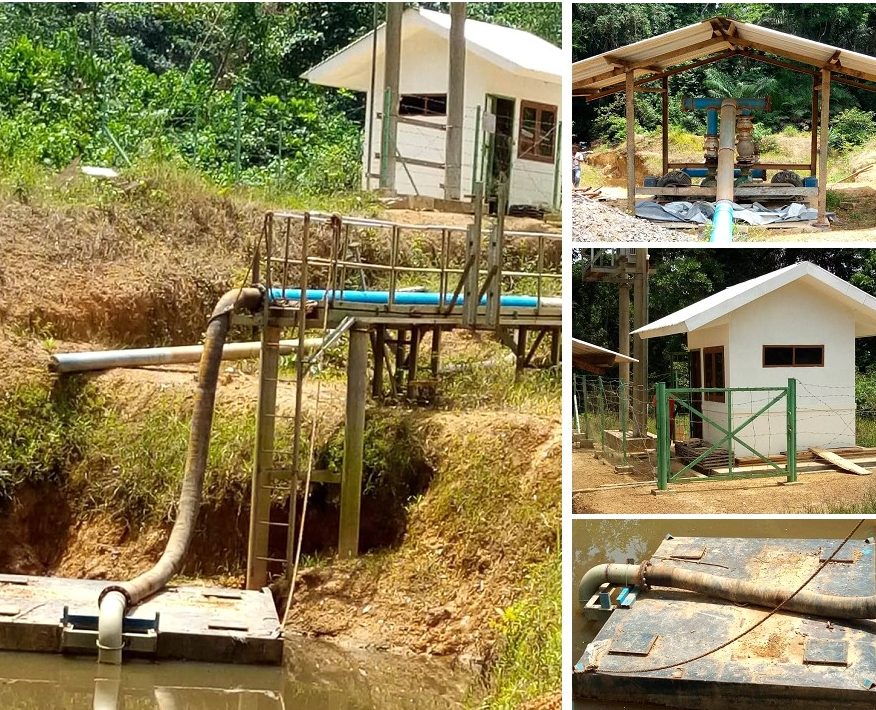
MONROVIA – The exposure of industrial water extraction infrastructure in Konneh Creek, Tarjuowon Statutory District, Sinoe County, has sharpened scrutiny of Golden Veroleum Liberia (GVL), with communities questioning how a critical local resource has sustained plantation operations, including its power sources, for years while nearby towns remain without reliable electricity and basic services. Located within close proximity to Bestnewlue and Wieh, the system’s visibility has reframed recent protests from isolated grievances to a broader debate about equity and accountability. What was once discussed in meetings is now evident on the ground. As government-brokered commitments follow renewed tensions, attention is shifting from promises to measurable outcomes, with communities closely watching whether implementation will finally match expectation. THE ANALYST reports.
The unfolding situation in Tarjuowon Statutory District is not a sudden rupture, but the cumulative result of years of engagement, expectation, and growing unease between Golden Veroleum Liberia (GVL) and its host communities. What has now brought the matter into sharp and unavoidable focus is the emergence of visible, verifiable evidence—an extensive water extraction system installed in Konneh Creek.
At the heart of the current developments lies a network of industrial pipes and pumping systems drawing water from the creek into plantation operations. Supported by power infrastructure, including a large transformer installation, the system sits within close proximity to affected communities—approximately three kilometers from Bestnewlue Town and about one and a half kilometers from Wieh Town. This proximity has become one of the most striking and contentious elements of the entire situation.
For residents, Konneh Creek is not merely a geographic feature. It is a lifeline. It sustains fishing, provides water for household use, and underpins daily survival in a largely rural setting. The presence of industrial-scale extraction infrastructure in such a vital community resource has therefore triggered not just concern, but a deeper sense of imbalance—one that touches on fairness, equity, and the social contract between investor and host community.
What was once discussed in meeting rooms has now become visible on the ground. And that visibility has changed everything.
THE PROTEST
The tensions that had been building quietly over time reached a turning point earlier this week, when residents of Bestnewlue Town, joined by citizens from Sonoah and Wieh, moved from concern to collective action. What began as a localized expression of frustration quickly evolved into a sustained peaceful protest, grounded not in impulse, but in accumulated grievances.
Demonstrators gathered with a clear message: the issues confronting their communities were neither new nor isolated. They spoke of prolonged absence of electricity, deteriorating water sources, and what they perceived as a widening gap between the scale of industrial activity in their midst and the quality of life within their communities. For many, the exposure of the Konneh Creek extraction system provided tangible confirmation of concerns that had long been voiced but insufficiently addressed.
The protest was notable not just for its scale, but for its composition. It drew participation across communities, cutting across towns and social groups, and transforming what might have been seen as a single-community grievance into a district-wide expression of concern. Women, youth, elders, and local leaders all found common ground in the demand for attention and action.
Despite the rising tension, the protest remained largely peaceful, with demonstrators emphasizing dialogue and accountability rather than confrontation. However, the firmness of their stance signaled a shift: patience, long exercised, was no longer open-ended. The communities were no longer asking whether commitments would be made—they were asking whether those commitments would be honored.
GOVERNMENT INTERVENTION
As the protest expanded and tensions heightened, the risk of escalation became evident, prompting swift intervention from the Sinoe County Administration and the leadership of the Tarjuowon Statutory District. Recognizing both the legitimacy of community concerns and the potential consequences of prolonged standoff, authorities moved to de-escalate the situation through engagement rather than enforcement.
Appeals for calm were issued, emphasizing the importance of preserving peace while creating space for structured dialogue. These initial appeals, however, met with measured resistance from protesters, many of whom pointed to a history of unresolved commitments as reason for caution. It was clear that simple assurances would not suffice.
In response, authorities elevated the engagement, convening a high-level stakeholder meeting in Greenville. The meeting brought together representatives of GVL, community leaders, members of the Tarjuowon People’s Association, civil society actors, and local government officials. The objective was not merely to defuse tension, but to create a credible platform for addressing the underlying issues.
The intervention marked a critical turning point. It shifted the situation from open protest to negotiated engagement, while also signaling that the concerns raised had reached a level requiring formal institutional attention. At the same time, it placed a renewed burden on all parties—particularly the company—to respond in a manner that would restore confidence.
THE GREENVILLE RESOLUTION
The Greenville meeting culminated in the signing of a new resolution on April 30, 2026—an agreement that now stands as the latest attempt to address the concerns of affected communities. Central to the resolution is a mandate for GVL to provide electricity to Bestnewlue, Whean, and Sonoah Towns, a commitment explicitly linked to the company’s continued use of Konneh Creek as a water source for its operations.
The resolution represents both an acknowledgment and a promise: acknowledgment of the relationship between resource use and community entitlement, and a promise to correct perceived imbalances through tangible service delivery. It also reflects the role of government as mediator, seeking to translate tension into structured outcomes.
In a reciprocal gesture, community leaders agreed to suspend ongoing protest actions, creating space for implementation. However, this suspension is widely understood to be conditional rather than absolute. It is tied directly to the expectation that the commitments outlined will be acted upon within a reasonable timeframe.
For many observers, the significance of the Greenville resolution lies not in its wording—which echoes previous commitments—but in the context in which it was reached. It was not a routine agreement. It was the product of pressure, visibility, and collective action. And as such, it carries with it heightened expectations.
A PATTERN OF CONCERN
Yet even as the new resolution offers a pathway forward, it also revives a deeper concern among residents—one rooted in past experience. Community members are quick to point to a similar agreement reached in March 2023 in Mamba Point, Monrovia, which contained commitments that, in their view, remain largely unfulfilled.
That earlier resolution, like the current one, was intended to address key issues including electricity and community benefits linked to resource use. However, the absence of visible progress in the intervening period has shaped present perceptions, creating a degree of skepticism around new commitments.
This history has introduced a pattern that residents increasingly recognize: agreements are reached, expectations are raised, but implementation lags. Over time, this pattern has eroded trust and contributed to the very tensions now being addressed.
For community leaders, the concern is not merely about one agreement or another. It is about the credibility of the process itself. Each unimplemented commitment adds weight to the next, making future agreements more difficult to sustain without clear evidence of follow-through.
In this context, the Greenville resolution is being viewed not in isolation, but as part of a broader continuum—one that will ultimately be judged by whether it breaks the cycle or reinforces it.
SHIFT FROM PROMISES TO PERFORMANCE
Perhaps the most significant shift in the current situation is not the protest, nor even the resolution, but the change in how the issue is being framed. The emergence of clear, visual evidence from Konneh Creek has altered the terms of the conversation. What was once abstract is now concrete. What was once discussed is now seen.
This shift has moved the focus from negotiation to verification. It is no longer sufficient to outline commitments in principle; there is now an expectation that those commitments will be matched by observable action. The proximity of the extraction infrastructure to host communities has sharpened this expectation, creating a visible contrast between industrial capacity and community conditions.
Observers note that this transition—from promises to performance—marks a maturation of the discourse. It reflects a growing insistence on accountability, grounded in evidence rather than assumption. It also places greater emphasis on timelines, benchmarks, and measurable outcomes.
In practical terms, this means that future engagement will likely be judged less by the tone of dialogue and more by the substance of delivery. For both the company and the communities, the standard has changed.
WHAT HAPPENS NEXT
In the immediate aftermath of the Greenville engagement, tensions have eased, but the underlying issues remain unresolved. Community leaders have made it clear that their continued cooperation is contingent upon the timely and verifiable implementation of the commitments outlined in the new resolution.
There is, for now, a window of opportunity—a period during which actions can restore confidence and recalibrate relationships. However, that window is not indefinite. The memory of past commitments, and the experience of delayed implementation, has created a heightened sensitivity to inaction.
Residents indicate that they are closely monitoring developments, not through statements or assurances, but through observable change on the ground. The provision of electricity, the rehabilitation of water systems, and the alignment of resource use with community benefit are seen as immediate indicators of progress.
Should these expectations be met, the current moment may mark a turning point toward renewed cooperation. If not, the conditions that gave rise to the recent protest remain present—and could, if left unaddressed, lead to a resumption of community action.
For Tarjuowon, the question now is not whether commitments can be made. It is whether they can be fulfilled.
In Tarjuowon, the distance between infrastructure and community has been measured. The distance between promise and delivery is now what remains to be closed.
Comments are closed.