
Jurors’ Probe Sparks Fierce Constitutional Showdown-Tweah’s lawyer challenges court’s post-verdict authority fiercely
MONROVIA – Liberia’s already polarizing economic sabotage trial involving former Finance Minister Samuel D. Tweah Jr. has now exploded into a profound constitutional confrontation over judicial authority, jury independence, and the sanctity of criminal verdicts. What began as a politically charged prosecution has rapidly transformed into a fierce legal battle testing the limits of post-trial court powers under Liberian jurisprudence. At the center of the unfolding controversy is whether Criminal Court “C” can legally investigate jurors after they were formally discharged following Tweah’s acquittal. As The Analyst reports, defense lawyers insist the court lost all jurisdiction the instant the jury was disbanded, while critics fear the investigation threatens judicial credibility and civic confidence in Liberia’s criminal justice system.
A dramatic constitutional and judicial confrontation is unfolding at the center of Liberia’s most politically sensitive criminal trial, with the defense team of former Finance Minister Samuel D. Tweah Jr. launching an aggressive legal counteroffensive against Criminal Court “C” over its decision to investigate jurors who acquitted the former official and another defendant of major economic crimes charges.
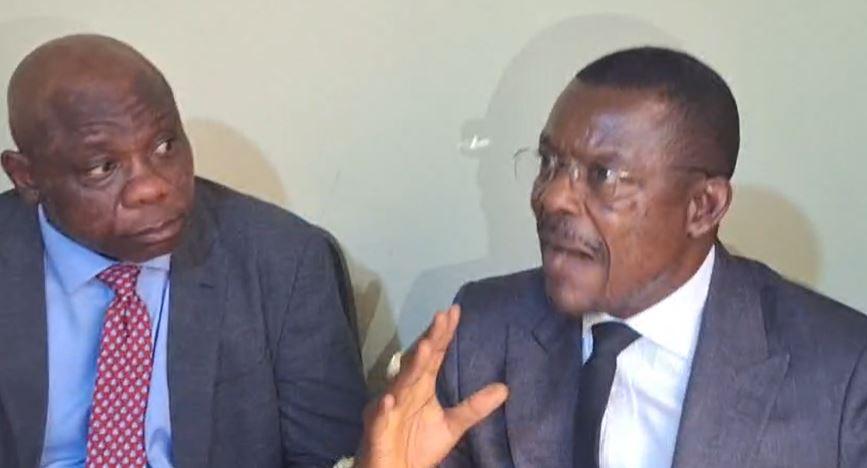
The latest development came Tuesday when Tweah’s lead defense counsel, Cllr. Arthur Johnson, announced at a packed press conference that he had formally petitioned the Supreme Court of Liberia for a writ of prohibition intended to immediately halt what he described as an unlawful and unconstitutional investigation into jurors who were officially discharged after rendering their verdict.
The move now places the nation’s highest court at the center of a potentially far-reaching legal dispute over judicial authority, the finality of verdicts, jury independence, and the limits of post-trial intervention by lower courts.
Cllr. Johnson argued forcefully that Criminal Court “C” has completely exceeded its jurisdiction by attempting to summon or investigate jurors after they had already fulfilled their constitutional duties, delivered their verdict, been individually polled in open court, formally thanked by the presiding judge, and discharged from service.
According to him, once that sequence occurred, the jurors ceased to exist as a legal entity under Liberian law and instantly reverted to private citizenship, thereby stripping the court of any authority over them.
The controversy stems from the May 8, 2026 landmark verdict in which a 12-member jury acquitted former Finance Minister Samuel D. Tweah Jr. and Financial Intelligence Agency Controller Moses P. Cooper on multiple counts including economic sabotage, theft of property, money laundering, criminal conspiracy, and criminal facilitation.
The acquittal immediately generated intense national debate because of the political sensitivity of the case, the stature of the defendants, and widespread perceptions that the prosecution had aggressively pursued convictions against top officials associated with the former administration.
While Tweah and Cooper secured acquittals through a 9-to-3 majority verdict — satisfying statutory requirements under Liberian criminal procedure — the jury reportedly failed to reach the necessary majority on separate counts involving co-defendants Cllr. Nyanti Tuan and Jefferson Karmoh, resulting in partial guilty verdicts and hung determinations on certain charges.
At the center of Cllr. Johnson’s argument is the legal doctrine known as functus officio, a common law principle which essentially holds that once a judicial officer or body has completed its lawful duty, its authority over the matter ceases.
Johnson argued that under Chapter 22 of Liberia’s Civil Procedure Law — which governs jury mechanics applicable to criminal proceedings — the moment a jury is polled, thanked, and discharged by the judge, the court loses all authority over those jurors.
Speaking with visible frustration, Johnson told journalists that the legal process leading to the acquittal was conducted meticulously and transparently in open court.
According to him, the forelady formally submitted the verdict to the clerk, after which the verdict was publicly read aloud. Thereafter, the judge ordered the polling of each juror individually to verify the authenticity and voluntariness of the verdict.
Johnson said each juror explicitly confirmed the verdict on the record.
“The statutory purpose of polling each juror individually in open court is to create an immutable and irreversible record before discharge,” he explained.
He maintained that after the polling process concluded, the court formally acquitted Tweah and Cooper, ordered their release, and directed that they be removed from the defendants’ dock and seated among ordinary citizens in the courtroom.
“Symbolically, by substance and form, they were taken out of the defendant’s dock and told to sit among the general public,” Johnson stated. “They left that courtroom as free citizens, and the court officially thanked and discharged the jurors, sending them home.”
The defense lawyer stressed that the issue now transcends the fate of his clients and has become a major constitutional concern touching the integrity of Liberia’s judicial system.
According to him, the attempt to reopen scrutiny over jurors after they had been discharged undermines the principle of finality in criminal proceedings and risks intimidating ordinary citizens from serving on future juries.
Johnson disclosed that his concerns deepened after receiving notice on May 18, 2026 from Criminal Court “C” indicating that an in-camera investigation would be conducted into allegations of jury tampering.
What particularly alarmed the defense, he said, was that the court allegedly informed parties that individuals who were subjects of the investigation — including prosecutors, defense lawyers, jurors, and court administrators — would not be allowed to remain present during portions of the proceedings.
“The judge told us that the prosecution, defense, jurors, court administrators, etc., were subjects of investigation,” Johnson said. “The judge told us none of those who are subjects of the investigation will be present, but he will conduct the investigation in camera.”
Johnson questioned both the legal basis and procedural fairness of such a process.
“We want to tell the Liberian people and the world that the judge lacks the jurisdiction to conduct the investigation because the term had ended,” he asserted. “Secondly, he has disbanded the jury, and thirdly, you cannot conduct investigation where we are subjects of it and tell us we cannot be present.”
He further argued that the jurors in question served during the February term of court and were not empaneled for the May term, making any attempt to recall or investigate them even more legally problematic.
“We want to let you know, and that is what is being practiced worldwide, that when you disband the jury and tell them to go home into their private lives, you do not call them back,” he declared.
Johnson also attempted to dismantle suggestions that the prosecution objected to the verdict when it was first delivered.
According to him, both the defense and prosecution formally responded to the verdict in open court, and the prosecution itself thanked the jurors for their service.
He quoted the prosecution as telling jurors: “Madam Forelady and members of the jury, notwithstanding the prosecution disagreement to the verdict, the prosecution thanks you kindly for rendering service in line with your duties. We say go in peace and know that nobody can hold you accountable for the verdict that you have rendered here.”
Johnson said it was therefore baffling for the prosecution and court to later pursue what he described as a “stylish disowning” of their own courtroom acceptance of the verdict process.
Legal observers say the unfolding battle could have far-reaching implications for Liberian jurisprudence because it touches on unresolved tensions involving jury independence, judicial accountability, and the limits of trial court powers once verdicts are finalized.
Several legal commentators familiar with Liberian criminal procedure reportedly believe Johnson’s argument carries substantial legal weight because of the long-established common law principle that discharged juries cannot ordinarily be reassembled or subjected to renewed judicial supervision.
Others, however, argue that allegations of jury tampering, if credible, may compel extraordinary judicial intervention in order to preserve public confidence in the integrity of criminal proceedings.
The issue has become even more politically combustible because of widespread perceptions that the prosecution of Tweah carried broader political overtones linked to power struggles following Liberia’s transition of government.
Johnson openly amplified those suspicions during the press conference, accusing state actors of pursuing a politically motivated “witch-hunt” designed to secure Tweah’s conviction “at all costs.”
He argued that the actions of Criminal Court “C” were ultra vires — beyond its lawful authority — and represented a dangerous overreach.
The emotional climax of the press conference came when former Finance Minister Samuel D. Tweah Jr. himself broke down in tears while speaking about the ordeal.
Visibly overwhelmed, Tweah lamented what he described as relentless political persecution despite the verdict delivered by the majority of jurors.
“Nine out of 12 jurors pronounced me not guilty against a powerful government that wants me convicted,” he declared emotionally.
The moment stunned many present at the press conference, particularly because Tweah has long cultivated an image as one of Liberia’s most combative and intellectually forceful political figures.
Members of his legal team eventually consoled him as the press conference drew to a close.
But beyond the emotional scenes now dominating public discussion, the Supreme Court’s eventual handling of the prohibition petition may establish a defining precedent in Liberia’s criminal justice system.
At issue is not merely the fate of one former minister or one controversial jury verdict. The deeper national question emerging is whether lower courts can continue exercising coercive authority over citizens who have already completed jury service and been formally discharged under law.
The answer could significantly shape future criminal prosecutions, jury confidence, and public trust in Liberia’s judiciary for years to come.
Comments are closed.