
GoL-AML MDA Amendment Promises Billions -Jobs, Stronger Local Benefits Set for Liberia
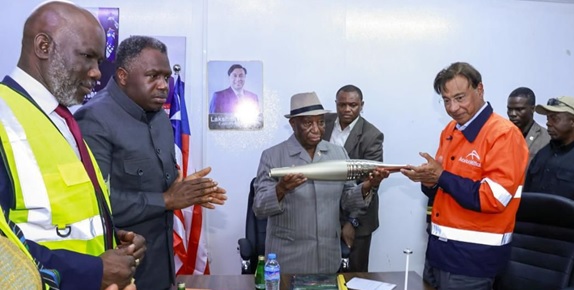
MONROVIA – After years of protracted negotiations, legislative rejection, and public skepticism toward large-scale concession agreements, the Government of Liberia is once again placing its natural resource governance under national and international scrutiny. The newly submitted Third Amendment to the Mineral Development Agreement with ArcelorMittal Liberia represents a deliberate attempt to correct past imbalances that critics say shortchanged the state and host communities. Coming amid heightened demands for accountability, local content, and fair revenue sharing, the revised deal seeks to reset the relationship between Liberia and one of its largest foreign investors. While not without imperfections, the agreement signals a shift toward stronger state leverage, clearer benefits, and a renewed effort to align extractive investments with national development priorities. The Analyst reports.
After more than half a decade of negotiations, false starts, and legislative pushback, the Government of Liberia has submitted to the National Legislature what it describes as a far stronger and more balanced Third Amendment to the Mineral Development Agreement (MDA) with ArcelorMittal Liberia.
Officials say the revised deal, which replaces an earlier version rejected in 2022, significantly increases revenues, deepens Liberian participation in management, expands education and training opportunities, modernizes public infrastructure, and strengthens environmental protections, while still allowing the mining giant to earn a fair return on its investment.
Negotiations between the Government of Liberia and ArcelorMittal Liberia over a Third Amendment to the MDA began as far back as 2020. In September 2021, both sides reached an agreement that was subsequently submitted to the Legislature.
However, in March 2022, lawmakers rejected that version, arguing that several provisions failed to adequately protect national interests, local communities, and long-term development priorities. Rather than abandon the process, the parties returned to the negotiating table, engaging in what government officials describe as four additional years of intense technical and policy-level discussions.
The result, according to the Executive Branch, is a substantially improved agreement that addresses the Legislature’s earlier concerns while aligning Liberia’s mining sector with international best practices.
Though officials concede the deal may not be perfect, they insist it represents a decisive improvement over past arrangements and sends a clear signal to global investors that Liberia is open for business under clearer, fairer, and more transparent rules.
At the heart of the amended agreement is a dramatic increase in immediate and recurring revenues for both the national government and host communities. One of the most striking provisions is a US$200 million signature bonus, payable as a one-time lump sum to the Government of Liberia within 30 days of the agreement’s effective date.
This inflow, officials say, will provide critical fiscal space at a time when the government is seeking to stabilize public finances and expand investment in priority sectors.
In addition to the signature bonus, the agreement raises annual community development funding from US$3 million to US$5 million for Nimba, Bong, and Grand Bassa counties, the areas most directly affected by mining operations.
Importantly, this amount will now be adjusted annually for inflation, protecting the real value of community benefits over time. These funds are earmarked for local socioeconomic projects, including education, health, and livelihood initiatives, and are intended to ensure that mining communities see tangible, sustained gains from resource extraction.
The amendment also introduces a US$200,000 annual infrastructure oversight fee, dedicated specifically to enabling the government to monitor and regulate railroad operations.
Officials say this provision will help strengthen the capacity of the National Rail Authority and ensure that public infrastructure is properly maintained and protected. Mining license fees are also set to rise sharply, with a fixed annual fee of US$500,000 starting in 2031, compared to the US$50,000 paid annually for the previous 25 years.
Royalty payments have likewise been improved, shifting to a 4.5 percent monthly royalty based on the FOB Buchanan price, replacing the old system of quarterly payments made 45 days after the end of each quarter.
Beyond revenues, the Third Amendment places heavy emphasis on jobs and what officials call the “Liberianization” of management. Under the new terms, at least 50 percent of management positions must be held by Liberians within one year, increasing to 75 percent within five years and 90 percent within ten years.
The agreement further requires that, within one year, at least one of the top four senior management positions—Chief Executive Officer, Chief Administrative Officer, Chief Financial Officer, or Chief Operating Officer—be occupied by a Liberian. The company is also obligated to give absolute preference to qualified Liberian citizens at all levels of employment.
Local businesses are another major focus. ArcelorMittal Liberia will be required to prioritize Liberian-owned small and medium-sized enterprises in the procurement of goods and services and to establish a joint committee aimed at supporting and building the capacity of these local firms. Government officials say this provision is designed to ensure that the mining value chain stimulates broader domestic economic activity rather than operating as an enclave.
Education and skills development form a third pillar of the amended agreement. A US$500,000 annual training budget will fund technical scholarships in geology and mining engineering, with preference given to students from Nimba, Bong, and Grand Bassa counties.
The agreement also mandates the establishment of a new campus of the ArcelorMittal Liberia Vocational Training Center in Grand Bassa County and provides for direct annual contributions to the University of Liberia’s Mining and Geology Institute and community colleges in the three affected counties.
Officials argue that these investments will help prepare a new generation of Liberians to take on skilled and leadership roles in the sector.
On infrastructure, the amendment commits the company to a range of public-benefit projects, including repairs to the KM 2.5 Bridge and the St. John River Bridge, paving of the concession road in Buchanan to link it with the city’s main streets, and completion of the long-awaited pavement of the Sanniquellie-to-Yekepa road. Perhaps most transformative is the shift to a multi-user rail system.
The railroad will no longer function as an exclusive company asset but will be opened to other mining companies and small miners, promoting competition and wider economic growth.
ArcelorMittal Liberia is required to upgrade the rail to a capacity of 30 million tonnes per annum and to make at least 8 million tonnes per annum available for approved third-party users.
The government will receive 30 percent of net profits from temporary rail rentals and 100 percent of access fees from other users.
Environmental protections are also strengthened. To safeguard rivers and groundwater, the company will be restricted to using rainwater for its mining operations and will pay US$100,000 annually to the Liberia Water and Sewer Company for water use at its facilities.
Officials say these measures reflect growing recognition of the need to balance industrial activity with environmental stewardship.
Taken together, government officials describe the Third Amendment as a decisive step toward ensuring that Liberia derives greater, more sustainable benefits from its iron ore resources while maintaining investor confidence.
As the Legislature debates the agreement, the Executive is urging lawmakers to view it not in isolation, but as part of a broader effort to reform natural resource governance and deliver measurable gains to ordinary Liberians.
Comments are closed.