

Bility Challenges LWSC Performance Claims-Rejects government water access narrative
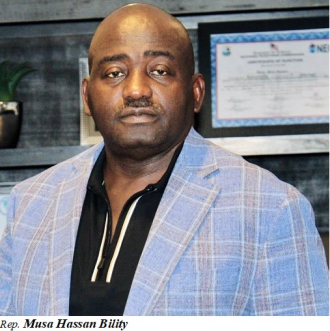
MONROVIA – A fierce public confrontation has erupted over Liberia’s chronic water infrastructure crisis after businessman and political figure Musa Hassan Bility launched a blistering critique against Liberia Water and Sewer Corporation Managing Director Mohammed Ali, accusing the institution of masking decades of systemic failure behind misleading access statistics. The unusually sharp exchange has quickly evolved beyond a technical disagreement into a broader national debate about governance performance, public infrastructure collapse, state accountability, and the widening gap between official narratives and the daily realities confronting ordinary Liberians. At the heart of the dispute lies a politically explosive question increasingly resonating across the country: whether Liberia’s water sector is genuinely progressing or merely surviving through humanitarian interventions and community improvisation. THE ANALYST reports.
Liberian businessman and political figure Musa Hassan Bility has launched a scathing public assault on the leadership of the Liberia Water and Sewer Corporation (LWSC), accusing the institution of attempting to disguise decades of infrastructural failure behind what he described as misleading statistical narratives disconnected from the daily suffering of ordinary Liberians.
In a strongly worded public statement now generating widespread discussion across political and social circles, Bility directly challenged LWSC Managing Director Mohammed Ali over recent claims regarding national water access improvements, insisting that the statistics being celebrated by authorities largely reflect survival efforts by ordinary citizens, NGOs, churches, and international aid organizations rather than meaningful government delivery of modern water infrastructure.
The confrontation has rapidly evolved into a broader national conversation about governance credibility, public service failures, infrastructure decay, and the growing frustration among Liberians over the persistent collapse of basic social services despite repeated official assurances.
At the center of Bility’s criticism is what he views as an attempt by LWSC leadership to politically appropriate humanitarian interventions and community survival mechanisms as evidence of institutional performance.
“Mo Ali, you will not put a spin on this one,” Bility declared bluntly at the opening of his statement.
“Your response completely misses the point.”
The comments followed apparent efforts by LWSC authorities to defend the government’s water access record using internationally recognized access statistics reportedly sourced from organizations such as UNICEF and the Joint Monitoring Program (JMP).
But Bility argued forcefully that access statistics alone cannot be equated with effective state infrastructure delivery.
According to him, the reality confronting ordinary Liberians paints a fundamentally different picture from the one being presented by government officials.
“The issue is not whether ordinary Liberians, NGOs, churches, communities, international partners, and private citizens are digging wells and finding ways to survive on their own,” Bility wrote.
“The real issue is: what exactly has the Liberia Water and Sewer Corporation done under your leadership to justify these celebratory statistics?”
The remarks struck directly at one of the most politically sensitive governance issues in Liberia — the chronic failure of public infrastructure systems to meet basic national needs.
For decades, reliable access to clean piped water and functioning sewage systems has remained one of the country’s most persistent development challenges.
Large sections of Monrovia and other urban centers continue to depend heavily on informal water distribution networks, wheelbarrow vendors, hand pumps, shallow wells, rainwater collection systems, and community-funded boreholes.
In many rural communities, humanitarian organizations, religious groups, and development partners have effectively become the primary providers of water access infrastructure.
Bility argued that these realities expose not government success but institutional collapse masked by the resilience of ordinary citizens forced to survive outside formal state systems.
“You are now attempting to politically harvest numbers produced largely by the resilience and survival instincts of ordinary Liberians abandoned by the system,” he charged.
“Families waking up at 4 a.m. to fetch water from hand pumps, communities contributing money to build local wells, NGOs installing boreholes, international partners funding rural water projects, and citizens depending on rainwater collection are not evidence of effective government performance. It is evidence of government failure, covered by the suffering of people.”
The statement represents one of the harshest recent public critiques directed at the LWSC and reflects mounting impatience among sections of the population regarding the pace of infrastructure development under successive governments.
Bility argued that the Liberia Water and Sewer Corporation was created not merely to monitor statistics but to directly provide sustainable national water infrastructure.
“The Liberia Water and Sewer Corporation was not created to supervise statistics,” he declared. “It was created to provide water.”
From there, the businessman launched into a barrage of rhetorical questions aimed at exposing what he sees as glaring failures within Liberia’s water infrastructure landscape.
“Where are the LWSC pipelines?” he asked.
“Where are the functioning sewage systems?”
“Where are the modern treatment plants?”
“Where does LWSC directly execute the major national expansion projects?”
“Where are the neighborhoods in Monrovia and across Liberia enjoying reliable piped water 24 hours a day because of your institution’s work?”
Those questions touch on longstanding structural deficiencies that have plagued Liberia’s urban development and public health sectors for decades.
Much of Liberia’s water and sewage infrastructure was either destroyed or severely degraded during the country’s prolonged civil conflicts, leaving many communities dependent on fragmented, underfunded, or entirely informal systems.
Postwar reconstruction efforts have achieved some expansion in water access, particularly through donor-supported projects and humanitarian interventions, but critics argue that comprehensive nationwide infrastructure modernization remains far from reality.
Bility’s intervention appears designed to force attention away from broad statistical indicators and toward the visible condition of physical infrastructure experienced by ordinary citizens daily.
“You cannot reduce national responsibility to percentages on a UNICEF website,” he wrote.
“At the same time, the majority of Liberians still buy water from wheelbarrows, store it in buckets, rely on hand pumps, or walk long distances every day to find clean water.”
One of the core arguments advanced by Bility is that internationally recognized definitions of “basic drinking water access” should not automatically be interpreted as evidence of government performance.
He argued that villages benefiting from charity-funded hand pumps may technically satisfy international water access classifications without reflecting any meaningful state-led infrastructure delivery.
“A village with a charity-funded hand pump may technically qualify under JMP’s definitions as having ‘basic drinking water access,’ but that does not mean LWSC provided sustainable national water infrastructure,” he argued.
“Those are two completely different things.”
The statement also reflects a growing trend in Liberian political discourse where public officials and critics increasingly clash over the interpretation of development indicators and governance performance metrics.
Government institutions frequently cite statistical improvements in sectors such as health, education, water access, and infrastructure as evidence of national progress.
Critics, however, often counter that aggregate statistics conceal severe inequalities, weak service quality, institutional failures, and heavy dependence on international donor interventions.
Bility framed the debate in moral as well as administrative terms.
“The danger with your statement is that it attempts to convert humanitarian survival mechanisms into government achievements,” he declared.
“That is intellectually dishonest and administratively irresponsible.”
The criticism is particularly politically significant because water access remains closely linked to broader concerns about urban poverty, sanitation, disease prevention, public health, and social inequality.
In many densely populated communities across Monrovia and other cities, inadequate water infrastructure continues to contribute to recurring sanitation crises and heightened vulnerability to waterborne diseases.
Critics have repeatedly argued that the absence of modern sewage systems and reliable water networks represents not merely an infrastructure problem but a major governance and public health emergency.
Bility’s intervention therefore taps into frustrations extending far beyond partisan politics alone.
Importantly, he emphasized that Liberians are not demanding abstract statistical reassurance but visible, functioning infrastructure capable of meeting the needs of a modern nation.
“Liberians are not asking for statistical comfort,” he asserted. “They are asking for a functioning national infrastructure.”
He insisted that the fundamental issue was never whether some Liberians can somehow access water somewhere, but whether the country is genuinely building a reliable and sustainable national water system.
“The concern is whether Liberia, under your stewardship at LWSC, is building a serious, modern, reliable national water system worthy of a country in 2026,” Bility argued.
“That answer is still painfully unclear.”
The sharp exchange now places renewed pressure on the Liberia Water and Sewer Corporation and the government more broadly to demonstrate tangible progress in expanding modern water and sewage infrastructure nationwide.
It also highlights the increasing political risks associated with governance narratives that rely heavily on statistical indicators while ordinary citizens continue experiencing severe deficiencies in daily public services.
As debate intensifies, the controversy may ultimately force broader national reflection on what constitutes genuine development success in Liberia — numerical improvements in access metrics, or the visible existence of durable, functioning infrastructure systems capable of transforming everyday life for ordinary citizens.
Comments are closed.