

Beijing Opens Doors for Liberian Agriculture -MoA delegation targets post-harvest loss reduction
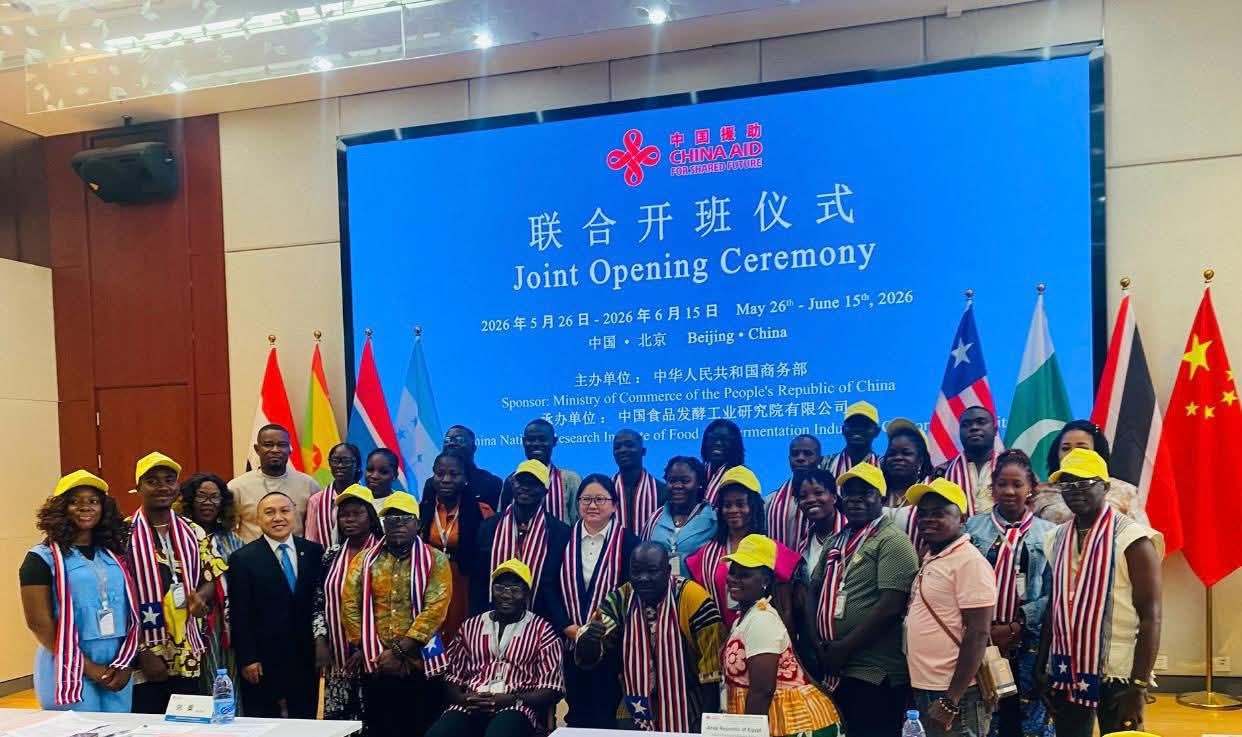
Twenty-nine staff members of Liberia’s Ministry of Agriculture have commenced an intensive 21-day specialised training programme in Beijing, China, focused on agricultural product processing, storage, and preservation — a bilateral initiative conducted in collaboration with the China National Research Institute of Food and Fermentation Industries Corporation Limited. The delegation, which includes fourteen female participants, joins a broader cohort of fifty-two trainees drawn from several countries and forms part of a deepening cooperation between the governments of Liberia and the People’s Republic of China in agricultural development and technical exchange. As THE ANALYST reports, the programme, expected to run through mid-June 2026, has been framed by its organisers as a strategic investment in Liberia’s agricultural transformation agenda.
For a country with vast arable land, a favourable agricultural climate, and a rural population whose livelihoods depend substantially on farming, Liberia’s persistent inability to process, preserve, and add value to its own agricultural output stands as one of the most consequential and correctable failures in its national development story.
The 21-day specialised training programme that officially commenced this week in Beijing, bringing together twenty-nine Ministry of Agriculture staff for intensive technical instruction in food processing, preservation, and storage, is the latest attempt to begin closing that gap — this time through direct knowledge transfer from one of the world’s most advanced food technology systems.
The programme is conducted in partnership with the China National Research Institute of Food and Fermentation Industries Corporation Limited and forms part of the broader bilateral cooperation framework between the Republic of Liberia and the People’s Republic of China, which has over recent years expanded well beyond infrastructure to encompass technical capacity development in sectors critical to long-term national sustainability.
The delegation from Liberia’s Ministry of Agriculture joins a wider international group of fifty-two trainees from multiple countries, positioning Liberian officials within a global network of agricultural practitioners engaged with common challenges of food security and post-harvest management.
The composition of the Liberian delegation carries its own significance. Of the twenty-nine participants, fourteen are women — a proportion that reflects growing institutional recognition of the central role women play in Liberia’s agricultural economy, particularly in smallholder farming, food processing, and market supply chains. The deliberate inclusion of women in the technical delegation has been welcomed by gender and development advocates who have long argued that agricultural capacity building initiatives that fail to centre women’s expertise are structurally incomplete.
Speaking at the opening ceremony in Beijing, Team Lead Jay Doe Welah Jr. expressed profound appreciation to the Government and people of China, the China National Research Institute, and the leadership of Liberia’s Ministry of Agriculture for creating the opportunity. Welah framed the training in terms that went beyond professional development, describing it as a strategic investment in Liberia’s agricultural transformation agenda. ‘This opportunity is not only about learning new technologies and modern practices,’ Welah stated. ‘It is about building the human capacity needed to transform Liberia’s agricultural sector into a productive, resilient, and economically viable system capable of feeding the nation and contributing meaningfully to national development.’
The urgency behind that aspiration is grounded in hard economic reality. Liberia continues to face serious agricultural constraints that are not primarily climatic or geographic — the land and the weather are broadly favourable — but institutional and technological.
Limited processing capacity, inadequate storage infrastructure, poor preservation methods, and high post-harvest losses combine to ensure that substantial quantities of locally produced crops perish annually before they can reach market.
These losses reduce farmers’ incomes directly, destabilise local food supply chains, increase dependence on imported food products, and ultimately contribute to the broader food insecurity that affects significant portions of Liberia’s population.
The training programme in Beijing is calibrated to address precisely these deficiencies. Participants are expected to gain hands-on exposure to advanced food processing technologies, efficient storage systems, modern packaging techniques, quality control mechanisms, and innovative preservation practices developed and refined in China’s extensive agro-industrial experience. Crucially, the training is not conceived as an academic exercise but as a practical intervention — the techniques and systems to which participants will be exposed are expected to be directly adaptable to Liberia’s local agricultural environment and institutional context.
The economic argument for investment in this area is substantial. Improved processing and preservation systems extend the shelf life of agricultural products, creating market opportunities for local farmers, increasing the year-round availability of locally produced food, and reducing dependence on the imported processed goods that currently represent a significant proportion of Liberia’s food import bill. Value addition through agro-processing has the demonstrable potential to create employment, stimulate small and medium-sized enterprises, and gradually transition Liberia from exporting raw agricultural commodities — a position that consistently disadvantages developing economies in global trade — to producing value-added goods capable of meeting regional and international commercial standards.
The training programme is therefore expected to contribute across multiple dimensions of Liberia’s national development priorities: poverty reduction, rural empowerment, youth employment, gender inclusion, and economic diversification. It also deepens a bilateral relationship with China that has proven practically significant for Liberia across infrastructure, health, education, and now increasingly in the technical development of the country’s productive agricultural base.
Upon completing the programme in mid-June, the trained Ministry of Agriculture staff are expected to return to Liberia and serve as institutional transmission agents — sharing newly acquired knowledge with colleagues, farmers, cooperatives, and agricultural institutions across the country.
Whether that transmission process is supported by the institutional structures, follow-up funding, and policy environment necessary to translate training into sustained system-level change will ultimately determine the programme’s long-term value. For now, the twenty-nine officials in Beijing represent a deliberate and concrete investment in the proposition that Liberia’s agricultural transformation begins with the people who understand both the land and the systems needed to make it work.
Comments are closed.