
Michael George Renews Democracy Architects Recognition Call-Submits follow-up letter to President Boakai
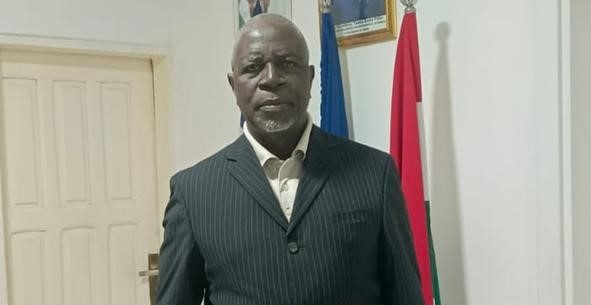
MONROVIA – Liberian political advocate Michael C. G. George has renewed his call for national recognition of the architects of multiparty democracy. He submitted a follow-up letter to President Joseph N. Boakai on June 30, expanding his May 13 request. The letter seeks official recognition for the men and women who ended Liberia’s century-long one-party rule. George identified four groups, including detainees of the 1979 rice riots and the so-called 77 lead persons. Others are students held at Belleh Yallah prison and professors detained at the Monrovia Central Prison. He wants a National Roll of Honor established and the history integrated into national civics education. As THE ANALYST reports, George said he has received no official acknowledgment, thus prompting a follow-up communication.
In the renewed communication addressed to the Executive Mansion on Capitol Hill, Mr. George said he was respectfully following up on his letter of May 13, 2026, which requested national recognition for the architects of multiparty democracy in Liberia. Having received no acknowledgment to date, he said, he was renewing and broadening the call to honor the patriots who broke decades of one-party rule.
Four Groups Identified for Recognition
Mr. George recalled that for more than a century, Liberia operated under a dominant one-party system in which citizens could not freely vote, speak, or organize. He maintained that the political wall cracked and eventually crumbled only because ordinary Liberians refused to be silenced, in a struggle for freedom that began before April 12, 1980.
The first group named in the letter comprises the detainees of the 1979 rice riots, described as citizens who demanded economic justice and political accountability while enduring beatings and unlawful detention without trial. The second group is the so-called 77 lead persons, advocates who were arrested and imprisoned for demanding multiparty democracy, a free press, and the right to choose their leaders.
According to Mr. George, many of the 77 endured dehumanizing conditions in military prisons, where they were beaten, stripped naked, and forced to sleep on bare cement. He said they remained committed to the belief that power belongs to the people.
The third group consists of students subjected to inhumane conditions at the maximum-security Belleh Yallah prison for speaking, organizing, and refusing tyranny. The fourth covers professors, student leaders, and civil advocates detained at the Monrovia Central Prison and various police depots across the country between 1979 and 2003 for their continued defiance of totalitarianism.
Courage That Opened Political Space
Mr. George noted that following the lifting of the ban on political activities in 1984, those men and women advocated for constitutional rule, conducted grassroots political education, organized elections, and championed democratic values from the 1984 Constitutional Referendum through the post-2005 period. Their collective courage, he argued, broke the political monopoly and gave Liberia its vibrant press and functional multiparty system.
“For more than 100 years, most Liberians could not vote, speak, or organize outside one party,” Mr. George wrote. “Before 1980, the nation had one radio station and one newspaper. Political space was sealed. Their courage opened the space for the hundreds of radio stations, newspapers, TV stations, and political parties we have today. The government you lead exists inside the house they built with suffering.”
Three Requests to the Administration
Mr. George is asking the Boakai administration to officially recognize the four groups as the foundational architects of multiparty democracy in Liberia. He is also requesting the establishment of a National Roll of Honor to permanently preserve their names, testimonies, and sacrifices for future generations, as well as the integration of this history into national civics education so that every Liberian child learns that freedom has a price.
He argued that formal recognition costs the state nothing, while silence dishonors those who sacrificed so much. Mr. George invoked Article 1 of the Constitution, which declares that all power is inherent in the people, saying those men and women proved that fundamental truth with their bodies and their blood.
“Recognition costs the state nothing. Silence dishonors those who could not speak for themselves,” he stated. He expressed trust that the President’s leadership would honor their legacy and respond to the initial May 13, 2026 communication.
Copies of the letter were sent to the President Pro-Tempore of the Liberian Senate and the Speaker of the House of Representatives. Attached to it was the list of the 77 lead persons contained in the earlier correspondence.
Comments are closed.