

Dillon Pushes Sweeping Judicial Reforms Challenges chamber justice authority framework
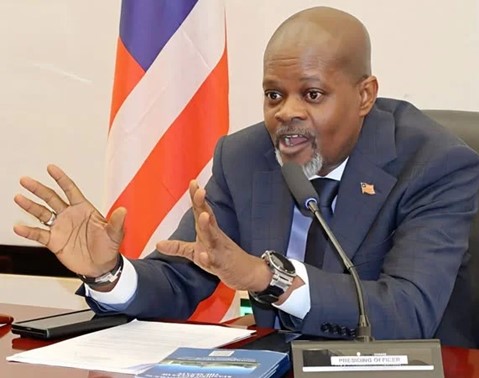
The credibility of democratic institutions often depends on whether citizens believe power is subject to accountability and review. In Liberia, that debate has resurfaced through renewed calls by Montserrado County Senator Abraham Darius Dillon for reforms affecting both the judiciary and governance institutions. At the center of his concern is a longstanding legal practice that permits a single Supreme Court Justice sitting in Chambers to deny certain extraordinary writs without review by the Full Bench. Dillon argues that such authority raises questions about access to justice and judicial accountability. His concerns extend beyond the courts to broader issues of constitutional governance and public trust, as THE ANALYST reports.
Gaps In Justice System, Raises Governance Concerns
Montserrado County Senator Abraham Darius Dillon has intensified his campaign for judicial and governance reforms, calling attention to what he describes as significant procedural gaps within Liberia’s justice system and raising concerns about accountability in public institutions. The outspoken lawmaker is questioning the authority of a single Supreme Court Justice sitting in Chambers to deny petitions for writs of prohibition without allowing litigants an opportunity to seek review before the Full Bench of the Supreme Court.
According to Dillon, the issue touches the very foundation of access to justice, judicial accountability, and public confidence in the rule of law.
The senator’s latest intervention places renewed focus on a legal practice that has existed within Liberia’s judicial system for years but has rarely been subjected to sustained public scrutiny at the highest levels of government.
For Dillon, however, the matter is not merely a technical legal question. Rather, he sees it as a broader governance issue with implications for fairness, due process, and the constitutional rights of litigants seeking judicial relief.
QUESTIONING THE POWER OF A SINGLE JUSTICE
At the center of Dillon’s argument is the role of a Justice in Chambers.
Under existing judicial practice, petitions for certain extraordinary writs, including writs of prohibition, may initially be considered by a Justice sitting in Chambers.
Dillon argues that while such authority may be necessary for administrative efficiency, concerns arise when a single Justice possesses the ability to deny a petition without the petitioner having an avenue to seek review by the Full Bench of the Supreme Court.
The senator believes that decisions carrying significant legal consequences should not rest exclusively in the hands of one member of the nation’s highest court.
According to him, litigants who believe they have been denied relief improperly should have an opportunity to present their arguments before the entire Supreme Court.
He contends that such a mechanism would strengthen public confidence in judicial outcomes and reinforce perceptions of fairness within the legal system.
ACCESS TO JUSTICE AT ISSUE
Dillon’s concerns stem from what he sees as a limitation on access to justice.
The senator argues that when a petition is denied at the Chambers level without further review, litigants may effectively find themselves without a meaningful avenue for reconsideration.
Such situations, he maintains, create the impression that judicial review has been prematurely exhausted.
In a democratic society governed by the rule of law, Dillon believes citizens should enjoy adequate procedural safeguards whenever significant legal rights are at stake.
According to him, judicial procedures must not only be fair but must also be perceived as fair by the public.
Legal scholars frequently note that public confidence in courts depends heavily on transparency, consistency, and the availability of review mechanisms that ensure decisions can be reconsidered when necessary.
Dillon’s proposal seeks to place those principles at the center of the conversation.
LONGSTANDING CONCERN FOR THE SENATOR
The Montserrado County lawmaker revealed that his concerns regarding the authority of a Justice in Chambers are not new.
According to him, he first raised the issue during confirmation proceedings involving former Chief Justice Sie-A-Nyene G. Yuoh during the administration of former President George Manneh Weah.
Dillon said he subsequently revisited the matter during confirmation hearings involving current Chief Justice Yamie Quiqui Gbeisay, both when Gbeisay was nominated as Associate Justice and later when he was elevated to the position of Chief Justice.
Despite repeatedly seeking clarification from senior members of the judiciary and legal practitioners, the senator maintains that he has yet to receive what he considers a satisfactory explanation regarding the legal foundation for such authority.
His persistence on the issue underscores the seriousness with which he views the matter.
CALL FOR LEGISLATIVE INTERVENTION
Because he believes the current arrangement raises unresolved legal and constitutional questions, Dillon is now advocating legislative reform.
He argues that lawmakers should enact legislation clearly defining the powers and limitations of a Justice in Chambers while ensuring that litigants retain the right to seek review before the Full Bench in cases involving denied writs of prohibition.
“Up to now, I have not received a clear answer. Therefore, there is a need for judicial reform legislation that clearly defines the powers of a Justice in Chambers and ensures that a writ of prohibition cannot be denied solely by one Justice without review by the Full Bench of the Supreme Court,” Dillon asserted.
The proposal, if pursued legislatively, could spark broader discussions regarding judicial procedure and the balance between efficiency and accountability within Liberia’s court system.
UNDERSTANDING THE WRIT OF PROHIBITION
Legal practitioners note that a writ of prohibition is among the extraordinary remedies available within the judicial system.
It is generally used to prevent a lower court, tribunal, or public authority from acting beyond its jurisdiction or exercising powers in a manner inconsistent with the law.
Because such petitions often involve urgent legal questions and potentially significant consequences, Dillon believes they warrant fuller judicial consideration whenever relief is denied.
Supporters of reform argue that providing an avenue for Full Bench review would create an additional layer of judicial scrutiny without necessarily undermining the authority of individual Justices.
Critics of such proposals, however, may contend that existing procedures already provide sufficient safeguards and that additional review requirements could create delays within an already burdened court system.
The debate therefore raises important questions regarding judicial efficiency and access to justice.
GOVERNANCE COMMISSION ISSUE ALSO RAISED
Beyond the judiciary, Senator Dillon also turned his attention to broader governance concerns.
He expressed reservations about the continued occupancy of the position of Chairman of the Governance Commission without Senate confirmation.
According to the senator, serving in a tenure-protected office without confirmation by the Liberian Senate raises questions regarding accountability, legitimacy, and adherence to established governance standards.
Dillon specifically referenced Governance Commission Chairman Professor Alaric Tokpa, arguing that the situation presents a contradiction between the principles the institution promotes and the manner in which its leadership status remains unresolved.
For the senator, institutions charged with promoting good governance should themselves exemplify strict compliance with governance requirements.
CONFIRMATION AND LEGITIMACY
Dillon argued that constitutional reform advocacy and governance leadership should be carried out by officials whose appointments have undergone the scrutiny and approval required by law.
He believes confirmation proceedings provide an important mechanism through which public officials are held accountable and their qualifications examined.
Without such a process, he contends, questions may persist regarding the legitimacy of an officeholder’s mandate.
The senator therefore called upon Professor Tokpa to make himself available for confirmation proceedings and urged that the President formally submit the nomination to the Liberian Senate for consideration.
His remarks reflect a broader concern regarding adherence to institutional procedures throughout government.
BROADER CAMPAIGN FOR INSTITUTIONAL REFORM
Observers note that Dillon’s latest statements fit within a broader pattern of advocacy that has characterized much of his public service.
Throughout his tenure in the Senate, he has frequently positioned himself as an advocate for transparency, accountability, constitutional compliance, and institutional reform.
Whether addressing issues relating to public finance, governance, appointments, or judicial practice, the senator has often argued that strong institutions remain essential to Liberia’s democratic development.
His latest focus on judicial review mechanisms and Senate confirmation processes reflects that same philosophy.
Supporters view such interventions as necessary efforts to strengthen public institutions.
Critics, meanwhile, may argue that some concerns involve matters traditionally addressed through judicial interpretation rather than legislative action.
Regardless of perspective, the issues raised by Dillon are likely to generate discussion among legal professionals, lawmakers, civil society organizations, and governance experts.
A DEBATE WITH CONSTITUTIONAL IMPLICATIONS
The questions raised by Senator Dillon ultimately touch upon several fundamental pillars of democratic governance: access to justice, separation of powers, institutional accountability, and public confidence in government.
As Liberia continues efforts to strengthen democratic institutions and consolidate the rule of law, debates concerning judicial authority and governance standards are likely to assume increasing importance.
Whether his proposals result in legislative action remains to be seen.
However, Dillon’s intervention has succeeded in drawing attention to legal and governance questions that many observers believe deserve deeper national examination.
For now, the senator’s call for reform places both the judiciary and governance institutions under renewed public scrutiny while opening a broader conversation about how Liberia can continue strengthening the systems that underpin democratic accountability and constitutional governance.
Comments are closed.