
Legislature’s Digital Deficit Haunts Nation -Can Boakai’s EO-163 do the rescue, spur needed reform?
MONROVIA – In 1970, the United States Congress passed the Legislative Reorganization Act, authorising the installation of electronic voting and quorum-call machinery in the House of Representatives — a system that commenced operation in 1973 and has since produced an unbroken democratic ledger. That ledger is so precise that Wyoming Senator John Barrasso recently celebrated Susan Collins of Maine as she approached 10,000 consecutive votes in Congress since 1997. Fifty-three years after Washington reorganised, Monrovia has not. Liberia’s National Legislature — still largely manual, digitally deficient, and ranked 25th among 33 African parliaments — now confronts a defining moment: President Joseph Nyuma Boakai’s Executive Order No. 163. The man who urged digital reform as Senate President in 2011 now commands it from the Executive Mansion. Whether EO-163 becomes Liberia’s own reorganization act — or another deferred promise — will determine the democratic credibility of the 55th Legislature. THE ANALYST reports.
A Vision Deferred — The 2011 Inauguration and Its Unfulfilled Promise
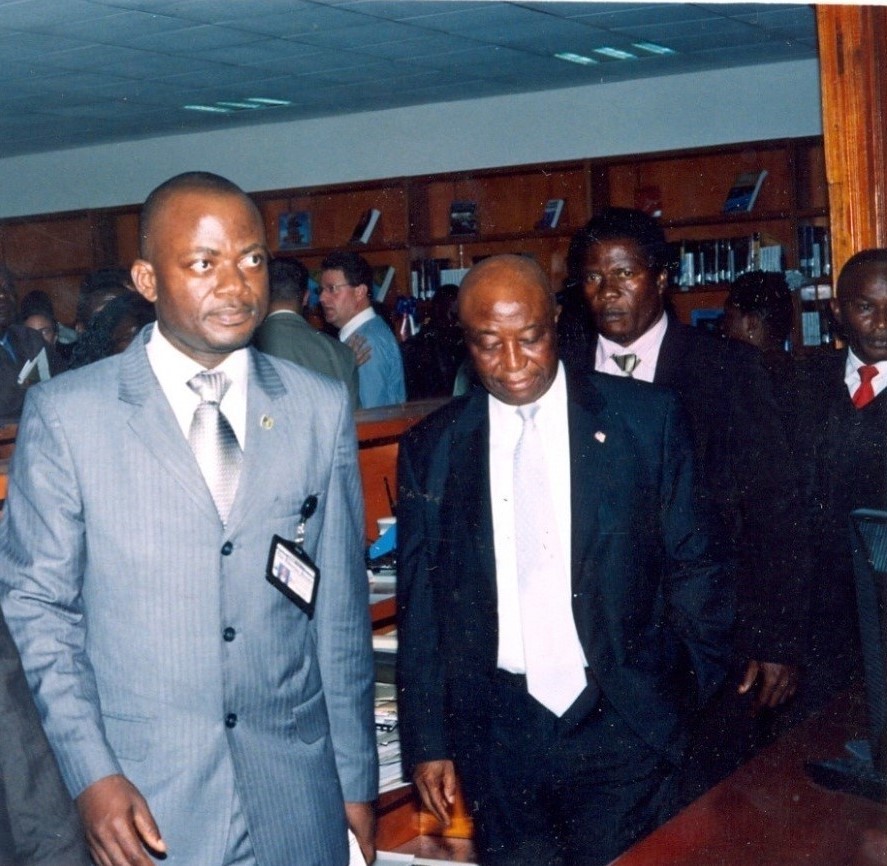
On April 27, 2011, a ceremony at the Capitol Building carried the weight of a nation’s democratic aspirations. Ambassador Joseph Nyumah Boakai, then-President of the Liberian Senate, formally inaugurated the Legislative Information Service — a bicameral research and knowledge resource centre established with the support of the United States House of Representatives, channelled through USAID and the National Democratic Institute (NDI). The refurbished library and archive facilities gleamed with institutional promise. But it was Boakai’s address that electrified observers: he issued a clear and urgent challenge to the lawmakers of the 52nd Legislature to “digitalise the institution and use information technology for the conduct of top-notch legislative research.”
That challenge was not a routine bureaucratic nudge. It was a philosophical and strategic declaration — a demand that Liberia’s sovereign legislature break decisively with the analogue past and embrace the efficiency, transparency, and institutional memory that only a fully wired parliamentary operation could deliver. Political observers, civil society watchers, and parliamentary advocates took note, convinced that the era of manual voting, paper-driven archiving, and opaque legislative records was drawing to a close.
They were wrong. More than a decade and a half later, the Liberian Legislature remains mired in the very deficiencies that Boakai’s speech identified. The digital transformation that seemed within reach in 2011 has proved to be far more elusive than anyone anticipated.
Fifteen Years of Digital Stagnation — What Went Wrong
The Legislative Information Service, which marks its 15th anniversary this year, has not stood idly by. Its director, B. McCarthy Weh II, has consistently documented and advocated for the reforms his department was created to support. In 2015, the LIS submitted a 12-count comprehensive reform proposal to the leadership committees of both the House and Senate — through the offices of then-Speaker J. Alex Tyler and Pro Temp Armah Z. Jallah — a proposal that included Count-5, a direct call for mandatory electronic voting in both chambers. The proposal was submitted and resubmitted to every successive Speaker and President Pro Tempore to date. None have fully acted upon it.
The data speaks for itself. At an LIS-NAYMOTE Workshop in 2025, NAYMOTE — the National Youth Movement for Transparent Elections — reported that the Liberian Legislature ranks 25th out of 33 parliaments on the 2024 Open Parliament Index, second edition, with an overall score of 41.67 percent. That placing, deep in the lower-to-middle tier, is not merely embarrassing — it is a democratic liability that weakens institutional credibility, limits public engagement, and undermines the legislature’s capacity to exercise meaningful oversight over the executive branch.
The specific deficiencies are well-catalogued: electronic voting and quorum-call systems are absent in both chambers; there is no comprehensive, functional legislative website covering the full scope of both houses; real-time public monitoring of plenary sessions remains unavailable; digital archiving of legislative records is inadequate; and internet connectivity within the Capitol Building remains unreliable. These are not aspirational luxuries. They are baseline democratic infrastructure that parliaments across Sub-Saharan Africa and the wider world have long since incorporated into their operations.
Even equipment that was provided — by the World Bank to the Senate and through NDI’s initial support to the House — has remained largely underutilised. The machinery exists, but the political will and institutional framework to deploy it consistently and permanently has been absent.
EO-163 — A Presidential Second Act
Against this backdrop, President Boakai’s signing of Executive Order No. 163 carries a peculiar symmetry. The man who urged the legislature to digitise in 2011, now wielding executive authority, has returned to the same agenda — this time armed with a presidential directive rather than a senate president’s appeal. Executive Order No. 163 establishes the National Digitalization and Modernization Initiative (NDMI) and the Office of Technology, Digitalization, and Innovation (OTDI). The order’s defining characteristic is its “whole-of-government” architecture: it explicitly signals that digital transformation cannot be confined to executive ministries and agencies but must extend to the legislature and the judiciary to achieve genuinely accountable, transparent, and responsive governance.
The LIS has welcomed EO-163 without reservation. In the department’s formal assessment, the order represents “the culmination of a consistent, long-standing commitment by President Boakai — from President of the Senate to President of Liberia — to modernise Liberia’s governance.” That continuity of vision is significant. It is relatively rare for an African head of state to follow a reform agenda across two distinct roles spanning fifteen years.
But the order also arrives at a moment of fresh institutional momentum at the legislature itself. As recently as April 20, 2026, the LIS formally communicated with the Chairpersons on Ways, Means, Finance and Budget of both Houses, with copies served to the Speaker and the President Pro Tempore, proposing a US$1,000,000 appropriation under the Public Sector Investment Program for a comprehensive e-Legislature programme covering the period 2026 to 2029. Of that amount, US$475,000 was specifically designated for information technology system upgrades. The supplementary budget cycle has reportedly seen US$475,000 appropriated for IT system upgrades — a partial advance, but still far short of the full digitalisation overhaul the LIS has consistently advocated.
The US Congressional Parallel — A Model for Legislative Reform
The LIS and Liberian legislative reformers have long pointed to the United States Congress as a relevant institutional precedent. The U.S. Legislative Reorganization Act of 1970, building on the foundational 1946 act, mandated the installation of electronic voting and quorum-call machinery in the House of Representatives. That system commenced operation in 1973, and has since produced a meticulous, searchable, publicly accessible record of every legislative vote cast by every member of Congress. The power of that institutional memory was on display when Wyoming Senator John Barrasso recently celebrated Susan Collins of Maine as she approached 10,000 consecutive votes in the U.S. Congress since 1997 — a milestone made possible only because electronic tabulation has tracked every single vote for over five decades.
The LIS argues, compellingly, that EO-163 should serve as Liberia’s own “reorganisation” moment — a defining inflection point after which the legislature’s operational infrastructure is never again allowed to fall below internationally recognised democratic standards. Just as the 1970 U.S. act was a political commitment backed by institutional machinery, any future National Digitalization Act that President Boakai desires to legislate should make electronic voting and quorum-call systems mandatory in both chambers of the National Legislature.
The e-Legislature Blueprint — What Full Digitisation Looks Like
The LIS has articulated a clear and actionable vision of what a fully digitised Liberian Legislature would look like. The e-Legislature programme envisions: the installation of effective and uninterrupted conferencing equipment in both chambers; a mandatory transition from manual to electronic voting; the establishment of a comprehensive functional legislative website covering the full bicameral institution; the construction of a wall-mounted television monitoring system for plenary sessions; full digital archiving of the legislative repository for online public access; and a stable, high-speed internet service capable of supporting a genuinely paperless parliamentary operation.
Additionally, in June 2025, the LIS worked with the Office of the House Rules and Order Committee Chair to produce an e-House programme document — still under internal review — that provides a structural roadmap for the House of Representatives’ own digital transition. These are not abstract proposals. They are technically feasible, financially costed, and institutionally grounded documents awaiting political adoption.
The 55th Legislature has taken some preliminary steps. The Office of the Speaker has engaged with an under-construction legislative website, and the Pro Tempore has shown some commitment to modernising the LIS physical space. But as the LIS underscores, these preliminary efforts, however welcome, fall well short of the comprehensive transformation that international parliamentary standards demand.
The Stakes — Democratic Credibility, Regional Standing, and Future Governance
The consequences of continued digital stagnation extend beyond institutional embarrassment. A legislature without robust electronic voting lacks the capacity to produce a reliable, legally defensible legislative record. Votes can be disputed, records can be questioned, and public trust in the legislative process is weakened precisely when it is most needed.
Regional parliamentary assessments confirm the severity of the challenge. The Liberian Legislature does not appear among the top-tier digitally advanced parliaments in Africa. On continental parliamentary indices, it occupies the lower-to-middle tier — a placement that undermines Liberia’s credibility in regional governance forums and weakens its negotiating position on international democratic commitments.
EO-163 and its whole-of-government mandate present the most compelling opportunity yet to change this trajectory. The LIS has called — “respectfully but firmly” — on the 55th Legislature to fully embrace the order’s vision and to allocate the necessary resources to operationalise an e-Legislature before the expiration of its six-year tenure. The investment, the department argues, is not merely an expenditure: it is a democratic imperative.
Whether the legislators who must enact these reforms share that conviction will determine whether Boakai’s 2011 vision finally becomes reality, or whether Liberia continues to watch the world’s parliaments modernise while its own legislative machinery remains frozen in a pre-digital past. The order has been signed. The blueprint is on the table. The appropriation request is before the legislature. Now, the question is whether political will can finally close the gap between fifteen years of aspiration and the democratic institutional modernity that a sovereign legislature owes its people.
Comments are closed.