
Barbu-Brown Clash Escalates-War Court Debate Turns Personal
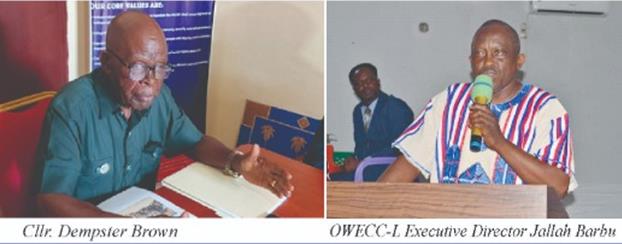
MONROVIA – Liberia’s already contentious path toward establishing a War and Economic Crimes Court has taken a sharper and more personal turn as a public dispute between OWECC-L Executive Director Jallah Barbu and INCHR Chairperson Dempster Brown intensifies. What began as a disagreement over legal interpretation and institutional mandate has evolved into a broader confrontation touching on professional credibility, financial accountability, and the integrity of the transitional justice process. The exchange underscores growing friction among key actors tasked with advancing accountability for past atrocities, raising concerns about coordination and public perception. As rhetoric hardens, the debate risks overshadowing the urgent national objective of delivering justice. THE ANALYST reports.
The debate surrounding Liberia’s War and Economic Crimes Court (WECC) has entered a new and more confrontational phase following a strongly worded rebuttal by Dr. Jallah A. Barbu, Executive Director of the Office for the Establishment of the War and Economic Crimes Court in Liberia (OWECC-L), directed at Cllr. Dempster Brown, Chairperson of the Independent National Commission on Human Rights (INCHR).
What had previously been a technical and policy-driven discourse over the pace, structure, and legal grounding of the court has now escalated into a dispute marked by sharp personal criticism and competing interpretations of authority, mandate, and process.
At the center of the controversy is a series of public statements in which Dr. Barbu described Cllr. Brown as “a complete embarrassment to the legal profession,” accusing him of lacking a proper understanding of the Executive Orders that established OWECC-L and guide its operations.
Barbu’s remarks, delivered during a radio appearance, represent one of the most direct and personal criticisms exchanged among officials involved in Liberia’s transitional justice architecture, signaling a breakdown in what had been expected to be coordinated institutional engagement.
The dispute traces back to earlier comments by Cllr. Brown, who questioned the actions of OWECC-L, particularly its decision to establish regional offices prior to the formal establishment of the War and Economic Crimes Court. Brown characterized this move as a “misapplication of government funds,” arguing that such steps were premature and risk undermining accountability.
He further raised concerns about the legality of OWECC-L’s activities, suggesting that the Office may have exceeded its mandate and that its actions could potentially complicate the broader justice process.
In response, Dr. Barbu rejected these assertions in unequivocal terms, insisting that the establishment of regional offices is not only lawful but essential to fulfilling OWECC-L’s mandate.
According to Barbu, Executive Order 131, issued by President Joseph Nyuma Boakai in 2024 and subsequently renewed in 2025, clearly empowers the Office to undertake preparatory activities for the War and Economic Crimes Court. These activities, he argued, include outreach, evidence collection, and engagement with victims and survivors across the country.
“The regional offices are not wasteful spending; they are essential to bring justice closer to the people,” Barbu stated, framing decentralization as a cornerstone of inclusivity and accessibility in the justice process.
This argument reflects a broader philosophy underpinning OWECC-L’s approach—that transitional justice must extend beyond the capital and actively involve communities affected by Liberia’s civil wars.
Barbu emphasized that victims and survivors in rural areas must have meaningful access to the process, and that establishing regional offices is a practical step toward achieving that goal.
Beyond defending the Office’s actions, Barbu also sought to clarify its mandate, noting that OWECC-L is tasked with preparing the groundwork for the eventual court. This includes mobilizing victims, documenting experiences, and ensuring that the process is comprehensive and inclusive.
He rejected suggestions that these activities constitute overreach, arguing instead that they are necessary to ensure that the court, once established, is effective and responsive to the needs of the population.
On the issue of financial accountability, Barbu maintained that all funds allocated to OWECC-L are managed transparently and in accordance with government regulations. He dismissed allegations of misapplication as unfounded, reiterating that expenditures related to regional offices are part of a strategic effort to decentralize operations.
This defense is significant in the context of broader concerns about governance and accountability in Liberia, where public scrutiny of government spending remains high.
The dispute also extends to the quality and legitimacy of draft legislation prepared by OWECC-L. Brown had reportedly questioned whether the drafts meet international standards, raising doubts about their suitability as the legal foundation for the court.
Barbu responded by asserting that the drafts were developed in consultation with legal experts and transitional justice practitioners, and that they align with international best practices.
“The assertion that these drafts do not meet international standards is unfounded and misleading,” he said, reinforcing the Office’s position that its work is both credible and technically sound.
Perhaps the most contentious aspect of Barbu’s response, however, is his direct challenge to Brown’s professional standing. By questioning his credentials and describing him as “masquerading as a lawyer,” Barbu has elevated the dispute beyond policy disagreement into the realm of personal credibility.
This development has raised concerns about the tone of public discourse among officials tasked with advancing a process that requires trust, cooperation, and institutional cohesion.
At a broader level, the exchange highlights the challenges of coordinating multiple institutions within Liberia’s transitional justice framework. With OWECC-L, the Ministry of Justice, the INCHR, and other stakeholders all playing roles, clarity of mandate and alignment of objectives are critical.
When these elements are not fully synchronized, disagreements can quickly escalate into public disputes, as evidenced by the current situation.
The implications of this conflict extend beyond the individuals involved. For victims and survivors of Liberia’s civil wars, the establishment of a War and Economic Crimes Court represents a long-awaited opportunity for justice and acknowledgment.
Public disagreements among key actors risk undermining confidence in the process, potentially creating uncertainty about its direction and effectiveness.
At the same time, the debate reflects genuine concerns about how best to design and implement a court that is both credible and inclusive. Questions about mandate, resource allocation, and legal standards are not trivial; they are central to the success of the initiative.
However, the manner in which these questions are addressed can significantly influence public perception. Constructive dialogue and coordinated action are more likely to build confidence, while public confrontations may have the opposite effect.
In calling for collaboration, OWECC-L has urged all stakeholders to engage in good faith, emphasizing that the ultimate goal is to deliver justice for victims without unnecessary delay.
“The Office urges all partners and institutions to prioritize collaboration over confrontation,” Barbu stated, even as his remarks toward Brown suggested a level of frustration with what he perceives as misinformation or misinterpretation.
The path forward will require careful navigation. Balancing accountability, inclusivity, and legal rigor is a complex task, made more challenging by the high expectations and emotional weight associated with transitional justice.
As Liberia continues to grapple with its past, the establishment of the War and Economic Crimes Court remains a central objective. Achieving this goal will depend not only on legal frameworks and institutional mandates but also on the ability of key actors to work together effectively.
For now, the dispute between Barbu and Brown serves as both a warning and an opportunity—a reminder of the stakes involved and the importance of maintaining focus on the broader national interest.
Whether this moment leads to greater alignment or deeper division will be a defining factor in the trajectory of Liberia’s justice process.
Comments are closed.