

The ‘Honorable’ War: Gbowee takes on Legislature -Senate brands laureate’s account ‘false, misleading’
MONROVIA – Nobel laureate Leymah Roberta Gbowee has thrown down a gauntlet the Liberian Legislature cannot easily ignore. Her demand that citizens strip lawmakers of the title ‘Honorable’ strikes at the heart of legislative legitimacy. It asks whether honor attaches to office or must be earned through integrity and service. Behind the war of words lies a Legislature dogged by corruption allegations and bleeding public trust. The feud turned raw Thursday when Gbowee accused senators of shutting out her student mentees over the title. As THE ANALYST reports, the Senate has fired back hard, branding her account false and misleading, and she has now dared lawmakers to cite any law compelling the honorific, staking US$10,000 (L$1,823,600) on the charge.
The controversy began with remarks posted on Gbowee’s Facebook page as part of her “Wednesday Word” series. The Nobel Peace Prize laureate urged Liberians to stop referring to members of the National Legislature as “Honorable,” arguing the title should be reserved for individuals who demonstrate integrity, dedicated public service, and moral leadership rather than merely holding elected office.
Gbowee questioned the legitimacy of lawmakers introducing themselves with the title, insisting genuine honor is not conferred by election alone. “Stop calling those people honorable,” she wrote. “Honorable is a title that comes with a lot of responsibilities. It is earned through years of dedicated service with integrity.”
She pressed further by asking legislators, “Who gave you that name? Who told you that you are honorable?” She then urged Liberians to refer to elected officials simply by the names given to them by their parents.
Although Gbowee did not single out any individual lawmaker, her comments tapped growing public frustration with the performance and credibility of the Legislature. The institution has faced repeated criticism over political infighting, corruption allegations, transparency questions, and declining public confidence.
Lawmakers Defend Constitutional Tradition
Among the first to respond was Representative Musa Hassan Bility, who rejected Gbowee’s position outright. He maintained that the title derives from the democratic mandate granted by the electorate. “I’m Honorable Musa Hassan Bility,” he declared. “I earned this title the moment my people stood in the sun and rain and voted for me in a democratic election.”
Bility argued that the honor attached to his office flows directly from the confidence placed in him by his constituents. He pledged to uphold that trust throughout his tenure. “Until the second working Monday of January 2030, I will proudly carry this title,” he stated. “I’m not afraid of the honor bestowed upon me by my people. Never. And I will do everything to uphold the honor bestowed upon me.”
Representative Moima Dabah Briggs-Mensah of Bong County’s District Six also defended the title, approaching the issue from a constitutional and institutional perspective rather than a personal one. According to Briggs-Mensah, the designation “Honorable” is not self-assumed but legally attached to the office of a legislator. “With due respect, my Nobel Laureate, the law confers the title ‘Honorable’ on the office, not on personal opinion,” she wrote.
She argued that criticism should target the conduct of individual officeholders instead of undermining the constitutional dignity of the offices they occupy. “If an officeholder fails the people, criticize the individual, not the institution,” she said, adding that respect for public offices remains essential even as citizens demand accountability.
Briggs-Mensah noted that she welcomes public scrutiny. She cautioned, however, that dismissing constitutional offices and the honor traditionally associated with them risks weakening respect for democratic institutions.
Opposition Leader Cites Honorific Convention
Opposition political leader Simeon Freeman also entered the discussion, describing Gbowee’s interpretation of the word “Honorable” as a misunderstanding of how honorific titles function in governance and diplomacy. Freeman argued that “Honorable” is an honorific, a formal title of respect attached to certain public offices rather than a certification of personal virtue.
He compared it to the diplomatic title “Your Excellency,” commonly used for presidents and ambassadors. “In diplomacy, ambassadors and presidents of nations are honorifically titled ‘Your Excellency.’ This doesn’t mean they are excellent people but respectfully referenced as such,” Freeman explained.
He warned against allowing dissatisfaction with elected officials to reshape long-standing conventions governing official titles. “Whatever our dislikes are for members of the Legislature, it must not lead us to project ignorance of honorific words into the national discourse,” he stated.
Freeman encouraged young Liberians to continue according constitutional officeholders the titles prescribed by protocol. He said citizens should simultaneously hold those officials accountable for their performance.
Accountability Versus Institutional Respect
Beyond the exchanges themselves, the debate reflects a deeper national conversation about the relationship between public office, ethical leadership, and democratic accountability. Gbowee’s argument is rooted in a moral understanding of honor, one in which respect must be continually earned through integrity, humility, and faithful service.
Her criticism resonates with many Liberians who believe public officials have fallen short of citizens’ expectations amid persistent governance challenges. Those responding to her, however, distinguish between the individual and the institution.
Their central argument is that honorific titles exist to preserve the dignity of constitutional offices regardless of the strengths or shortcomings of their occupants. In this view, refusing such titles because of dissatisfaction with officeholders risks eroding respect for the institutions themselves.
The exchange also illustrates how social media has become an increasingly influential arena for shaping public discourse in Liberia. National figures now use digital platforms to debate constitutional norms, political culture, and standards of leadership.
While no legal question has emerged over legislators’ entitlement to use the title, the controversy has reopened a broader discussion. At issue is whether respect for public office should be unconditional or continually reinforced by ethical conduct and effective service.
Students’ Senate Visit Sparks Accusation
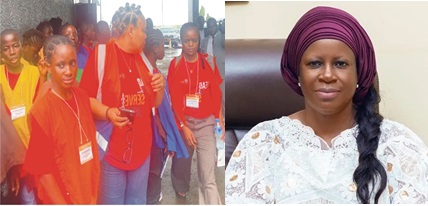
The controversy took a more dramatic turn Thursday when Gbowee alleged that members of the Liberian Senate refused to receive students participating in her annual civic education initiative. She linked the alleged snub to her refusal to address lawmakers as “Honorable.”
Speaking in a video posted on social media, Gbowee claimed that children from River Gee, Sinoe, Gbarpolu, and Montserrado counties were prevented from presenting a statement before the Senate. She said the visit collapsed because she declined to enter the chamber and formally address senators using the honorific.
According to Gbowee, the students were participating in the 10th edition of “Peace Through Fair Play.” The annual civic engagement program exposes young Liberians from the country’s leeward counties to the three branches of government through visits to the Supreme Court, the Capitol Building, and the Executive Mansion.
She said the delegation had already completed a successful visit to the Supreme Court before proceeding to the Senate, where Senator Botoe Kanneh welcomed the group. The students, she explained, had been scheduled to read a statement to senators.
Gbowee alleged, however, that the visit stalled because senators expected her to accompany the children into the chamber and address them as “Honorable Senators.” “I refused to do it,” Gbowee said. “I elected to stay out of their chambers but let them allow the children who came from as far as Belle Yallah, River Gee and Sinoe to go in and greet them. It was an absolute no.”
She described the incident as disappointing and accused lawmakers of placing personal pride above the civic education of Liberia’s next generation. “Think about this,” she said. “The next generation of Liberian children who you are supposed to inspire to be the best they can be… because one person decided that you should not be called honorable.”
Gbowee questioned why students should become casualties of what she characterized as lawmakers’ insistence on an unearned title. “It is pathetic—really, really pathetic—that people would put their egos above the well-being of Liberian children,” she added.
Constitutional Challenge and Cash Wager
In the same statement, Gbowee said she had consulted what she described as “a lawyer at the highest level in the Republic of Liberia.” She sought to determine whether the Constitution requires elected officials to be addressed as “Honorable” and was informed that no such provision exists.
She subsequently challenged any senator or representative to produce a constitutional or statutory provision making the title mandatory. “If anyone can show me where in the Constitution of the Republic of Liberia—or in our laws—that elected officials must be called ‘Honorable,’ I will write a check for US$10,000 (L$1,823,600) to their constituents,” she declared.
Gbowee concluded by saying she stood by her position and was prepared to face any consequences arising from her comments. “I have said my bit,” she remarked. “I wait to be summoned.”
Senate Dismisses Gbowee’s Account
The Press and Public Affairs Department of the Liberian Senate has meanwhile dismissed as “false and misleading” Gbowee’s claim that children under her mentorship were denied access to the Senate Chambers on Thursday, July 9, 2026. In a statement issued the same day, the department said Gbowee at no time engaged the Senate leadership regarding the children’s visit.
According to the release, the Office of the President Pro Tempore received a communication at approximately 1:25 p.m. on Tuesday, July 7, 2026, from Mr. David S. Konneh. The communication requested that the Senate host Gbowee’s mentees and provide lunch during their visit.
The Senate explained that when Gbowee and the children arrived at the Capitol, senators were in a consultative meeting preparing for the day’s plenary session, which involved a substantial legislative agenda. Rather than waiting for the meeting to conclude, the statement said, Gbowee chose to address the media, alleging the children had been denied access and voicing her refusal to call senators “Honorable.”
The Senate further emphasized that President Pro Tempore Nyonblee Karnga-Lawrence, as both a mother and mentor to many young people, would never deny children the opportunity to visit the chambers and witness where lawmakers deliberate on national matters. It described Gbowee’s reported statement, “I will not call any of them Honorable,” as disrespectful toward the country’s elected leaders.
Additionally, the Senate called on Gbowee to openly address any concerns she may have with members of the Legislature rather than using the children’s visit as what it described as a scapegoat. The department noted that Gbowee and her mentees have on several previous occasions been granted access to Senate facilities, including the Office of the President Pro Tempore and the offices of other senators.
Comments are closed.