

War Memorial Unveiled -Boakai’s Bali Island park to honor victims
MONROVIA – Twenty-three years after the guns fell silent, Liberia is finally drawing its grief in concrete. President Joseph Nyuma Boakai has unveiled the model of a national memorial park on Bali Island. The design is vast: a 15-story county tower, a peace museum, an eternal flame and a Heroes’ Park. Yet, as reported, the ceremony disclosed no cost, no funding source and no construction timeline. That gap will shape how quickly the vision becomes more than a model. Several speakers also tied remembrance to justice. The United Nations, ECOMOG veterans and youth leaders all invoked the War and Economic Crimes Court. The memorial’s credibility may therefore rest on the court’s progress, as THE ANALYST reports.
In a historic and emotionally charged gathering that bridges decades of national pain with a resolute vision for the future, President Joseph Nyuma Boakai took a monumental leap toward peace, national unity and reconciliation when he officially unveiled the architectural model for a sprawling, state-of-the-art national memorial park to be constructed on Bali Island in Monrovia.
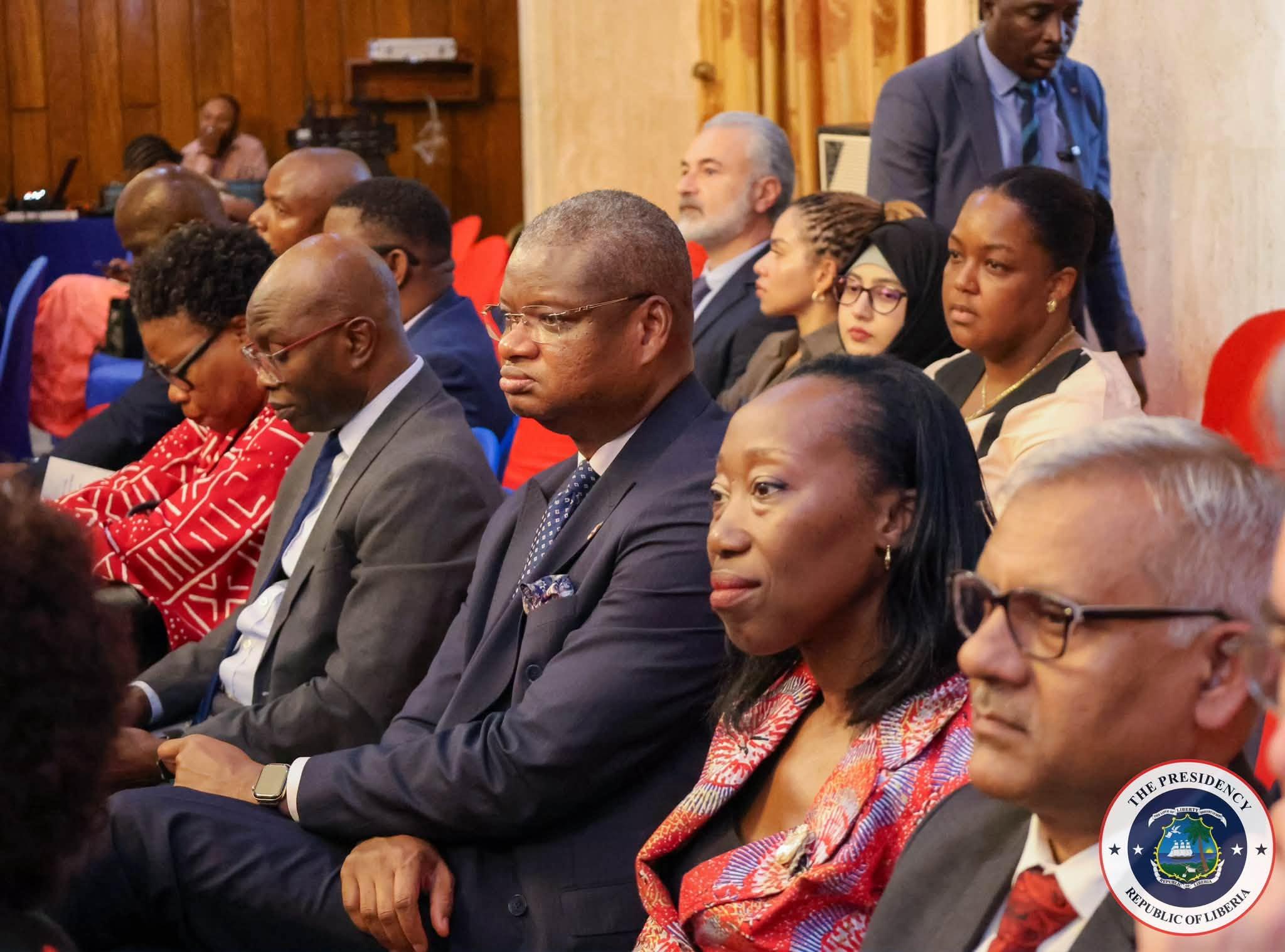
The unveiling ceremony, held at the Parlor of the Executive Mansion last weekend, brought together high-ranking government officials, diplomatic partners, international organization representatives, security veterans, traditional elders, religious leaders and youth advocates.
Together, they witnessed the presentation of a visionary blueprint designed to permanently honor the victims and survivors of the 14-year civil war that nearly brought the nation to extinction, while providing a sacred space for civic education, tourism and national reflection.
Inside the Bali Island Memorial
Presenting the design to President Boakai, Project Designer Joe Mulbah walked attendees through the comprehensive layout of the facility, which is poised to become a landmark of historical preservation in West Africa.
The master plan begins with a pedestrian-friendly entrance and a spacious parking complex capable of accommodating up to 700 vehicles. Upon entering, visitors are greeted by a central plaza flanked on the right by monuments dedicated to Economic Community of West African States (ECOWAS) member states and the force commanders who served during Liberia’s conflict, and on the left by a dedicated United Nations (UN) memorial monument.
At the heart of the median stands the Liberian flag, surrounded by the banners of the 15 political subdivisions where the war took place, each with its own peculiar history of the pain, agony and bitter memories the citizens still harbor.
According to Mulbah, the park integrates civic and commercial amenities, including a souvenir shop and snack areas, leading directly into the striking Liberia Peace, Reconciliation and Memorial Museum.
Mulbah asserted that the museum, architecturally shaped to mirror the image of mothers and sisters who stood under sun and rain with raised hands praying for peace, serves as the emotional anchor of the park.
Beyond the museum lies a grand parade ground flanked by evocative artistic installations depicting citizens fleeing with bundles on their heads and the tumultuous realities of the war years.
He further said the centerpiece of the complex is a towering 15-story memorial structure, with each floor symbolizing one of the nation’s 15 counties and cataloging the unique historical experiences of those regions during the conflict.
Crowning the tower is West Africa’s first astronomical observatory, offering views of the galaxy, alongside an automated eternal flame scheduled to ignite at 7 p.m. every evening across the Monrovia skyline as a nightly reminder of the vow: “No more war, only peace.”
The entire complex will be sustained by a dedicated solar farm to ensure uninterrupted green energy. Furthermore, the grounds will house a National Heroes’ Park, a dignified final resting place for the nation’s founding and historical leaders previously buried across disparate counties.
Opening Remarks and Government Commitment
Setting the tone for the ceremony, the Minister of State without Portfolio, Hon. Mamaka Bility, delivered heartfelt welcome remarks, emphasizing that the memorial belongs first and foremost to the families of victims and survivors.
“We have gathered here to remember the lives lost, the families broken, and communities scarred, and to affirm together that their memories will live on,” Bility stated. She noted that the unveiling feeds directly into the upcoming deliberations of the Liberia Peace, Reconciliation and Memorial Museum Steering Committee, scheduled to meet from November 16 to 18, 2026, to institutionalize historical preservation for future generations.
Foreign Minister Sara Beysolow Nyanti expanded the scope of the occasion by connecting Liberia’s domestic healing process to its broader diplomatic standing and its upcoming presidency of the United Nations Security Council.
Highlighting the heroic interventions of the ECOWAS Monitoring Group (ECOMOG), comprising troop contributions from Nigeria, Ghana, Guinea, Sierra Leone and across the subregion, Nyanti recalled how West African neighbors stood as family when Liberia’s house was on fire.
“West Africans didn’t stand with us merely as military, police, or civil engineers; they stood first as family,” Nyanti remarked.
She noted that this spirit of solidarity informs Liberia’s current peace and security agenda at the UN, ensuring that the nation’s youth are protected from falling into extremism and are instead empowered as agents of sustainable development.
International Partnership and Security Reflections
A representative of the Resident Coordinator of the United Nations in Liberia reaffirmed the international community’s unwavering support for President Boakai’s dual pursuit of accountability and national healing.
Noting that memorialization is vital because societies “forgive but do not forget,” the UN envoy praised the administration for ensuring that justice remains a reality for victims and survivors through the ongoing establishment of the War and Economic Crimes Court (WECC), hand-in-hand with grassroots peacebuilding.
Echoing these sentiments, Retired Major General Daniel Ziankahn, Chairman of the ECOMOG Committee, underscored that national memorials catalogue collective sacrifices and elevate a nation’s status onto the global stage alongside countries like Rwanda, South Africa, Japan and Ghana.
He noted that the Bali Island memorial will comprehensively document historical milestones, from the landing of settlers on Providence Island to the deployment of international peacekeepers.
While thanking President Boakai for affording him the opportunity to serve on the committee, Ziankahn provided insight into what the memorial will be used for and its importance to preserving Liberia’s history through storytelling from its formative stage:
“The National memorial to be unveiled today will represent a unique collection of significant historical event that symbolizes our resilient journey through conflict, peace and reconciliation and ultimately nation building,” he said. “The national memorial will depict historical event of conflict, peace arrangement from the landing of the settlers on the Providence Island to the deployment of troops from ECOWAS or ECOMOG and UNMIL as well as every significant event that has shaped our nation in a positive way.”
He thanked members of his committee and other stakeholders, especially former River Gee Senator Conmany Wesseh, Sister Laurene Brown and Nathaniel Kwabo, Director of Cabinet, for their tireless efforts to make the journey come through.
Religious, Traditional and Youth Perspectives
Speaking through a proxy, the Chairman of the Inter-Religious Council, Alhadji Ibrahim Fumba Sheriff, who is also the Chairman of the Muslim Council of Liberia, stressed that the memorial is more than physical concrete, adding that it is a renewal of national commitment to justice, tolerance and forgiveness.
“Peace is not merely the absence of war; it requires justice for all of us,” Sheriff noted.
He said the memorial must remind Liberians of the painful consequences of the civil war and serve as a memory for the loss of families, relatives and friends who passed away during the war.
“We are not only unveiling the memorial; we are receiving one of the histories that will forever be remembered. We will also be making history that every Liberian will be proud of. We are renewing our national commitment to peace, justice, forgiveness and unity.”
“As religious leaders, we believe that peace is not just simply the absence of war, but it requires justice for all of us. Every Liberian must remember that we are responsible to have justice in Liberia, mutual respect for all, tolerance and accountability as well as for forgiveness,” he said.
The Chairman of the Traditional Council of Liberia, Chief Arthur W. Dowah, praised President Boakai for visionary leadership, assuring traditional backing for peace maintenance and infrastructural development across the country.
He said it takes a leader of foresight to initiate such a project, which will go a long way in remembering Liberia’s brutal past, just as he praised the President for the level of development in the country and for keeping the peace.
“Mr. President, we want to thank you for the development you are bringing to this country, especially the yellow machines that will build our roads for development.
“We also want to thank you for the peace we are enjoying today because everybody is free to move around without any problem. Thank you too for this project to remember all our past leaders who made sacrifices in this country but today they are no more,” Dowah said.
Meanwhile, a powerful intervention came from the representative of the Federation of Liberian Youth (FLY), who voiced the generation’s dual commitment to supporting the War and Economic Crimes Court to end impunity while stepping up as active architects of peace.
“Some lives were lost, some stolen and the entire generation inherited the burden of a broken nation.
FLY supports the establishment of the WECC and, following our protest at the national legislature last week, we will continue demonstrating until it is created,” she said.
She said that while the President has shown unprecedented resolve in supporting the push to end impunity, the occasion should provide an opportunity to make a promise that the generation that inherited the wounds of the war must be the generation that secures the peace.
“The people must not be merely the beneficiary of reconciliation; we must be its architects, its Ambassador and its guardians. We cannot build a peaceful Liberia while excluding the very generation that will inherit its future.”
“To those who suffered, we owe remembrance; to those who lost, we owe dignity; to the generation coming after us, we owe a country where no child will ever have to experience what our parents and relatives have to endure,” she concluded.
As the model of the Bali Island Memorial Park stands revealed, Liberia signals to the world that out of the ashes of a tragic past, a united, resilient and peaceful nation is rising.
Comments are closed.