

‘Youth Education Is Revolutionary Investment’ -Kpadeh presses Legislature on education budget
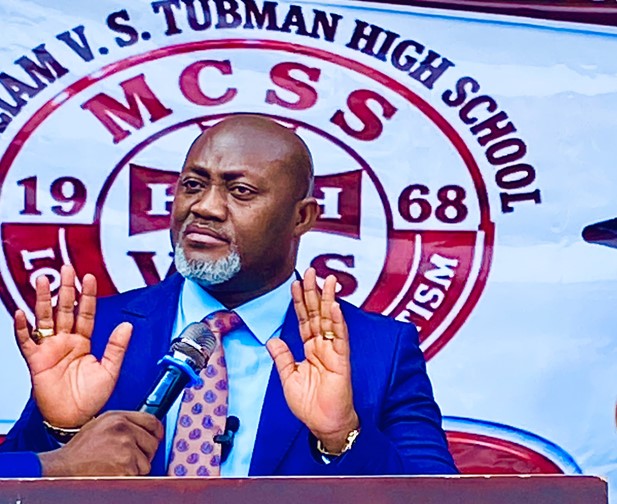
MONROVIA – A graduation speech has become a budget argument. Amb. Robert Wilmot Kpadeh used Tubman High School’s 58th commencement to press a national case. His theme, “The Quintessence of Knowledge,” holds that learning matters only when deployed. He then aimed that idea at power. He commended President Joseph Boakai for raising education’s share in the draft budget. In the same breath, he urged lawmakers to go further in the 2027 budget. The timing sharpens the point. Liberia takes the presidency of the United Nations Security Council within days. It runs the world’s largest ship registry. Yet its classrooms still lack laboratories and internet. THE ANALYST reports.
Liberia’s Permanent Representative to the International Maritime Organization (IMO), H.E. Amb. Robert Wilmot Kpadeh, has charged the Graduating Class of 2026 of the William V. S. Tubman High School to put their knowledge to work. He delivered the charge on Sunday, November 22, 2026, as keynote speaker at the school’s 58th Graduation Ceremony.
The ceremony was held on the school’s main campus on 12th Street, Sinkor, Monrovia. Kpadeh built his address around the theme “The Quintessence of Knowledge.” He argued that knowledge reaches its true majesty “not when it is accumulated, but when it is deployed.”
The diplomat also turned to national policy. He commended President Joseph Boakai for an increased allotment for education in the current draft national budget. He then urged the National Legislature to apportion even more money to the sector as it deliberates on the 2027 national budget.
Kpadeh recognized the Superintendent of the Monrovia Consolidated School System (MCSS), Principal Fallah of Tubman High, the vice principals and administration, faculty and staff, invited guests, and members of the press. He also saluted the parents and guardians of the graduates.
Knowledge That Goes to Work
Kpadeh told the graduates that the soul of knowledge is not found in gathering it. “Knowledge reaches its true majesty not when it is accumulated, but when it is deployed — to transform lives, to fortify communities, to inspire a generation, and to shape the future,” he declared.
“A library locked and unread changes nothing. A mind full and unused blesses no one. Knowledge becomes glorious only when it goes to work and effectuates positive change,” the envoy added. He described the quintessence of a thing as “its purest and highest essence; its very soul and its manifesting power.”
The IMO envoy recounted the roles he has played in life. “I have been many things in this one life — a young reporter chasing the truth with a notebook; a teacher before a chalkboard; a servant of the public trust; and today a diplomat effectively representing Liberia at a significantly critical multilateral frontier, which is the International Maritime Organization (IMO),” he noted.
He said few podiums he has mounted moved him as much as this one. “For this is where it all begins. This is where the future of a nation sits before me, in uniform, waiting to be unleashed in a fast-changing world craving for more innovative and enterprising minds,” he stated.
Kpadeh saluted the class as “the STARS of this hour, the dreamers in these beautiful gowns, the hope of our nation.” He told them the day was more than a celebration of what they had accomplished.
“Today is not merely a celebration of what you have done. It is a celebration of who you are now prepared to become,” he said. He then offered an admonition for their life’s journey: “A certificate tells the world what you studied; what you do with your knowledge tells the world who you are.”
“A certificate is a record of the past. Your life will be the record of what that knowledge becomes,” Kpadeh emphasized.
A Hallowed Wall of Learning
Kpadeh reminded the graduates that they were standing on “a historic and sacred ground.” He described Tubman High as “a hallowed wall that, generation after generation, has molded the minds of some of Liberia’s most erudite professionals, its finest leaders, and its respected academics.”
“The veneration of William V. S. Tubman High School was earned here, in these very classrooms, by the men and women it shaped and sent out into the service of the nation,” he said. “It is a school long reputable for inspiring academic excellence and nobility — and that reputation is now placed in your keeping.”
“You carry a name that many before you carried well, and the carrying of it is itself a kind of duty,” he told the class. He then turned to the history of the land into which they were born.
He described Liberia as “the oldest independent republic on the entire continent of Africa.” When much of the world doubted whether the African could govern himself, he said, the small nation on the Grain Coast “lifted its single star and declared to all mankind that the love of liberty had brought us here.”
“We have known seasons of glory, and we have endured periods of devastation — strife, civil wars, Ebola, socioeconomic hardship that would have shattered a lesser people,” Kpadeh recalled. “And yet, here we still stand. Still graduating our children. Still daring to dream. And still raising our country’s flag high in many respects.”
Liberia’s Global Standing Cited
The envoy pointed to Liberia’s international standing. “I am talking about a Liberia that will assume the Presidency of the United Nations Security Council in about a week,” he said. “I am talking about the world’s largest ship registry, and many things Liberia is reputed for.”
He explained why he recited that history. “Because every chapter of human progress — every single one — was written by knowledge put to work,” Kpadeh asserted.
He said the great pyramids of Egypt “did not rise out of ignorance; they rose out of mathematics and engineering.” Disease, he added, retreated because educated physicians tackled and defeated it, and darkness lifted “before the minds that learned to transform the lightning into electric current.” “From the ancient library of Alexandria to the laboratories of this modern era, the whole story of mankind is the story of what trained minds can do,” he declared.
Blyden, Mandela, Garvey Invoked
Kpadeh said the African continent has given the world towering intellects. He invoked Edward Wilmot Blyden, whom he called a scholar, statesman, and a father of Pan-African thought, who “proved with his life that the African mind could stand shoulder to shoulder with any mind on earth.”
He also recalled Nelson Mandela, who he said emerged from 27 years in prison “not with bitterness but with a nation cradled in his heart.” Mandela, Kpadeh noted, told the world plainly: “Education is the most powerful weapon which you can use to change the world.”
“Ponder over the word — weapon,” the envoy urged. “Education is not an ornament to be worn on the day of graduation and hung on the wall thereafter. It is a weapon. And this afternoon, William V. S. Tubman High School places the most powerful weapon into your hands.”
He then summoned “the thunder of Marcus Garvey,” whom he called “that mighty son of our race,” and quoted his cry: “Up, you mighty race; you can accomplish what you will!” “Graduates, that cry rings down the century, and it is meant for you. You are that mighty race,” Kpadeh said.
“In your veins runs the blood of a people who governed themselves when the world swore they could not — and whatever you will to accomplish, with knowledge sharp in your hands, no power on this earth can deny you,” he added.
Education as Shared Destiny
Addressing the elders present, Kpadeh described the education of a people as “the single most vital investment any society can make in its shared destiny.” He said investing in the power of the mind fuels human capital and progress, inspires change, raises a nation to higher heights, and secures “a prosperity that will outlive any one administration.”
“For what is a nation, in the end, but the sum of its trained minds?” he asked. He went on to ask who would heal the sick, build roads and bridges, fly aircraft, power cities, and write the code that will run the Liberia of tomorrow, if not the scholars before him.
“Who will sail our ships if not the mariners or marine engineers we educate? Who will teach the next generation, launch the enterprises, and lead the communities — if not you?” Kpadeh asked. “Graduates, you are not merely the beneficiaries of education. You are the architects of everything that is to come.”
He told the class that this lays “a sacred charge” upon their young shoulders. “Your nation invested in you. Your families sacrificed for you,” he said, pointing to “mothers and fathers who went without, so that you could go forward.” He added that their teachers poured themselves into them, “often for little reward and even less thanks.”
“A debt of that kind is never repaid with applause. It is repaid with service. It is repaid with principled leadership. It is repaid with bold ideas that make life better for somebody other than yourself,” he stressed.
A Charge to the Graduates
Kpadeh then charged the class to step forward with courage, discipline, and “an unshakable confidence.” He meant, he said, “not the arrogance of those who imagine they know everything, but the quiet confidence of those who have learned how to learn.”
He warned that the world beyond the school gate “is fiercely competitive, and it is changing faster than any generation before you has ever witnessed.” “The certificate you receive today will not be enough for tomorrow. The only people who will truly thrive in this new age are those who never stop learning,” he cautioned.
“So I beg you — become a student for life. Let curiosity be the fire that never goes out in you. Pursue mastery in everything your hand finds to do,” Kpadeh pleaded.
He told the graduates that the diploma is not the end of their education but the opening of it. “Today you do not graduate out of learning — you graduate into it. High school is the gate, not the garden; the first chapter, and not the last page,” he said.
He said those bound for college and university, the trades, and the professions are only now setting foot on “the long and climbing road of educated life.” “Walk that road, I beg you, all the way to its end,” he urged.
Excellence in Every Task
Kpadeh asked the graduates to walk every road with excellence. He quoted the words the Reverend Dr. Martin Luther King, Jr. spoke to the young people of his own day:
“If it falls to you to be a street sweeper, sweep streets like Michelangelo painted pictures. Sweep streets like Beethoven composed music. Sweep streets so well that all the hosts of heaven and earth will pause to say, ‘Here lived a great street sweeper who did his job well.’”
“There, graduates, is the whole secret,” Kpadeh said. “It is never the size of the task that measures the man or woman; it is the size of the excellence they pour into it.”
He urged them to be the very best at whatever their hands find to do — “a teacher, a trader, a nurse, a mason, a clerk, a farmer — for no honest work, done well, was ever small, and no half-hearted work, however grand its title, was ever truly great.”
He said Holy Scripture laid down the same law long before King was born: “Whatever thy hand findeth to do, do it with thy might.” “Mark those words — with thy might. Not with half your strength. Not with your leftover hours. With all of it,” the envoy stressed.
“Whatever your hand finds, seize it with both hands, and pour your whole self into it; for that, and that alone, is the difference between the ones the world remembers and the ones it forgets,” he added.
Kpadeh told the graduates to hold their heads high, “not because the road behind you was easy, but precisely because it was not.” “Some of you studied by candlelight. Some of you walked long and weary miles to reach this campus. Some of you battled endless difficulties,” he observed.
“You did not arrive on this field by accident. You earned the right to stand among the pioneers who will solve the great problems of our age. So do not shrink. Do not ever apologize for the size of your dreams,” he urged.
Vision and the ‘Impossible’
Quoting Scripture again, Kpadeh gave what he called the warning and the promise in a single breath: “Where there is no vision, the people perish.” He said a people with no dream wither where they stand, but a people who dare to see a better tomorrow “will rise up and build it with their own hands.”
When a dream looks too big for the pocket, he said, the graduates should hold fast to Mandela’s words: “It always seems impossible, until it is done.” He noted that the paved road, the bridge, the healed disease, and the freed nation were all once called impossible, “right up until some stubborn dreamer refused to agree.”
He asked the class to hold one principle above all others as they chase their dreams. Whatever they become, he said, “your vocation is not merely about making a living. It is about making a difference.”
He named examples: a software engineer building tools that open the whole world to a disabled child, a physician carrying affordable care to a village that has never seen a doctor, a teacher lighting a fire in an under-resourced classroom, and an entrepreneur raising an industry that will feed a thousand families. “A job may feed your stomach; but a purpose feeds your soul, and it feeds your nation,” Kpadeh declared.
Charge to the Nation’s Leaders
The envoy then turned to “those of us who hold the levers of power and policy in this republic.” “For it would be a hollow and unworthy thing to charge these young people to fly, while we refuse to give them wings,” he said.
He urged national leaders, community leaders, and every Liberian of influence to treat education as “an urgent, non-partisan national priority.” “Not a slogan to be dusted off at every election season, but a solemn duty that binds every government, of every color, in every era,” Kpadeh said. He added that the security of the republic and the vitality of its economy depend upon it.
He called for expanded commitments, modernized schools, and a wage for teachers “worthy of the sacred work they perform.” Such pay, he said, would draw the brightest to the classroom rather than drive them away.
He also called for learning environments that are safe and open to every child, in every district, “from Cape Mount to Maryland, from the heart of the city to the last town at the end of the last road.”
Kpadeh said the children of this century “cannot be prepared for a digital world with the tools of a vanished one.” He said Liberian schools need high-speed internet, modern libraries and research hubs, and science laboratories that actually hold equipment.
A child, he said, should learn chemistry “by doing chemistry, and not merely by memorizing a textbook she will never be permitted to touch.” He noted that the world is moving to hands-on learning, simulation, and artificial intelligence. Liberian children must move with it, he warned, “or be left standing on the roadside, watching others build the future that should have been theirs.”
Boakai Commended, Legislature Urged
“We cannot ask our youth to lead global innovation while we press outdated tools and underfunded schools into their hands. We cannot demand a triumphant tomorrow while we starve our institutions today,” Kpadeh said. “The bill for greatness is always paid in advance. If we desire the harvest, we must first pay for the seed.”
He called for “bold and uncompromising commitments to our schools, our teachers, and our children — now, and not someday.” He then acknowledged the government’s move in the draft budget.
“However, I see allotment for education in the current draft national budget increased, and I commend President Joseph Boakai for that, but I encourage the National Legislature, which has the appropriating powers, to apportion even more money to the education sector as they deliberate and eventually approve the 2027 national budget,” Kpadeh stated.
The Wisest Investment
Kpadeh rejected the view that the education line in a national budget is an expense to be trimmed when times grow hard. He called that view “the most expensive mistake a nation can ever make.”
“Education is not an expense. It is an investment in human capability — and it is the one investment that compounds across the generations,” he argued. “Educate a girl, and you educate a family. Educate a generation, and you transform a country.”
He said a trained workforce draws the investor, an innovative mind creates the industry, and an enlightened community first lifts itself and then lifts the one standing beside it. “The true measure of education, graduates, is never found in the certificate alone. It is found in what we choose to do with what we know,” he said. “A nation that understands this builds its schools before it builds its monuments — because it understands that the children are the monument,” Kpadeh maintained.
The Launchpad, Not the Mountaintop
In his final charge, Kpadeh told the graduates the occasion was “not the finish line.” “This podium, this gown, this certificate — it is not the mountaintop. It is the launchpad,” he declared. He said everything until that hour had been preparation, and that the real test of their knowledge begins the moment they walk out of the gate.
He urged them to carry their knowledge, their dreams, the guidance of teachers who believed in them, and the sacrifice of parents “weeping with pride in this audience even now.” “You go forward carrying a whole people upon your young shoulders — and that, graduates, is not a burden. It is an honor,” he said.
He then gave the class four commands. When they become successful, they should reach back and lift somebody up. When they grow in knowledge, they should share it generously, “for knowledge hoarded only rots, while knowledge given away multiplies.”
When opportunity finds them, he said, they should not merely enjoy it but create opportunity for others. And when they see a problem in their community, they should not fold their arms and ask, “Who will solve it?” They should ask instead “the only question that has ever changed anything in this world: ‘What can I do?’”
Kpadeh recalled an old African proverb: “If you want to go fast, go alone; but if you want to go far, go together.” “Class of 2026, I do not want you merely to go fast. I want you to go far. So carry one another,” he said.
“A single star can shine, but it takes a whole sky of stars to light a nation through the night — and you, together, the whole of you, are that sky,” he told the graduates.
“The future of Liberia will not belong to the most clever, nor to the most connected, nor to the most wealthy. It will belong to those who are prepared to translate wisdom into action,” he said. He urged them to learn continuously, serve faithfully, build courageously, and live out the school’s motto, “loyalty and patriotism,” as “the very pattern of your days.”
He expressed the hope that future historians would write of their generation “that you learned, and you served; that you built, and you gave back; and that because you lived, and because you used what you knew, Liberia was made better.”
“So rise, Class of 2026. Rise like the dawn that no long night has ever yet managed to hold back,” Kpadeh concluded. “The gate stands open before you. The road runs long beneath you. The morning belongs to you. The world is waiting — go, and take it.”
He ended with blessings on the graduates, on William V. S. Tubman High School, and on the Republic of Liberia. He then thanked the audience.
Comments are closed.