

The Kogar Factor -Nimba rivalry that could redraw 2029
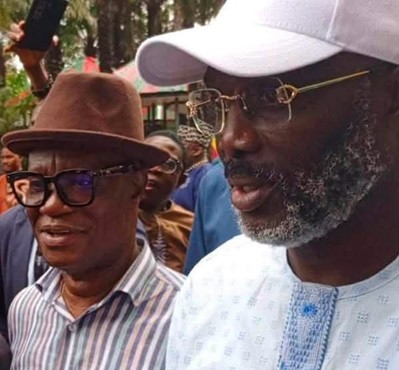
MONROVIA – In Nimba, the vote-rich county that has made and unmade Liberian presidents, a single senator’s quarrel has swelled into a contest that could redraw the map of 2029. The indefinite expulsion of Senator Samuel G. Kogar from the Movement for Democracy and Reconstruction — the party of the late Prince Johnson — has set him against Vice President Jeremiah Kpan Koung, the party’s leader and President Boakai’s presumed heir, in a struggle over who inherits Nimba after its old godfather. Kogar calls the expulsion a government-backed plot; the party calls it due process. And his hand-in-hand appearance beside George Weah has turned a county feud into a national question. Analysis By THE ANALYST
A County That Makes Kings
No county carries a Liberian election the way Nimba does. Its bloc of votes has proven decisive cycle after cycle, and for two decades that bloc moved, more or less, at the word of one man — the late Senator Prince Yormie Johnson, the “godfather” whose blessing was a currency all its own. His death left a throne, and the scramble to fill it is now the central drama of Nimba politics, drawing in Vice President Koung, Senator Kogar, and former Mines Minister Wilmot Paye, each with a claim to speak for the county.
Into that vacuum the Kogar affair has fallen like a spark into dry brush. What began as friction between a senator and his party leadership has become a test of who commands Nimba — and, through Nimba, who can credibly promise to deliver it in 2029.
The Expulsion, and the Hand Behind It
On Saturday, August 29, the MDR Executive Committee voted to expel Kogar indefinitely, with Chairman Cllr. Cooper W. Kruah citing violations of the party’s constitution and “divisive statements,” and insisting the senator had every chance to defend himself before the party moved. The offense, in plain terms, was Kogar’s public opposition to the Unity Party government with which the MDR is allied, and Kruah has framed the expulsion as necessary to protect that alliance.
Kogar tells a different story. He has rejected the action outright, branding it a “government-backed effort” engineered to silence him, refusing to surrender party assets in his keeping, and vowing to fight it in court.
The rupture had been building: in early August, Kogar told a Monrovia radio audience that he would not automatically refuse a vice-presidential offer from another political leader — a remark widely read as a shot across Koung’s bow, and one the MDR did not forget.
The Elders’ Alarm
The quarrel has frightened the very people who hold Nimba together. Chiefs, elders, and county icons — many of them devoted to Kogar for his closeness to the late Johnson, and alarmed at the prospect of a divided county — moved to broker peace between the senator and the Vice President before the breach hardened into something permanent. Their mediation has so far ended in deadlock.
Their fear is easily read. A Nimba split between Koung and Kogar does not merely wound two men; it endangers the Unity Party’s grip on the county that helped carry Boakai and Koung to power in 2023. The elders know what the arithmetic says: a house divided in Nimba is a gift to whoever waits on the other side of the aisle.
Blood, Belonging, and the Weight of Sympathy
To grasp why a party expulsion can shake a whole county, one must understand how Nimba votes — for here, as so often in our politics, blood and belonging can move more ballots than any manifesto.
Senator Kogar’s strength flows in no small part from his closeness to the late Prince Johnson; in the county’s reckoning he is widely counted a kinsman and political son of the godfather, and the old man’s loyalists — the chiefs, the elders, the war-generation faithful — have transferred to Kogar much of the reverence they once reserved for Johnson himself.
In a culture where a wronged son draws sympathy the way dry ground draws rain, the expulsion has only deepened that bond. The more Kogar is seen as persecuted, the closer the old guard gathers around him.
Vice President Koung’s standing rests on different ground, and carries a different vulnerability. Born in Yekepa and of the Gio stock that dominates the county, Koung is by every public measure a son of Nimba, and he has laboured, more than most, to reach across its ethnic lines — winning endorsements even from the county’s Mandingo association and publicly condemning tribal incitement.
Yet a whisper trails him that his rivals are ever ready to exploit: that his people trace, on his father’s side, to Sinoe in the southeast, and that he is therefore not wholly a “son of the soil.”
It is an insinuation that ought to have no place in a modern republic, and responsible Nimbaians warn openly against voting by tribe. But no honest observer of the county can pretend such currents do not run beneath the surface, or that they will lie still as 2029 nears.
The Photograph at Jamaica Resort
Then came the image that spoke louder than any statement. On Saturday, September 5, Kogar was seen among the prominent figures at former President Weah’s closed-door opposition roundtable at the Jamaica Resort in Paynesville — not sulking at the margins of his party, but standing in the ranks of the opposition, in full view of the cameras.
The MDR pounced, declaring that his presence “vindicated” the expulsion and proved the very disloyalty it had charged. But the deeper message was for Nimba and for the nation: the man the ruling alliance had cast out had not gone home to nurse his wounds. He had walked, hand in hand, toward George Weah.
The Vice-Presidential Whisper
For months a single rumor has trailed Kogar through the political corridors — that he is a presumed running mate for Weah on a 2029 opposition ticket.
His own words in August, that he would weigh such an offer, gave the whisper legs; the Jamaica Resort photographs have now given it a face.
Nothing is confirmed, and much could still change. But in Liberian politics, a picture of the right two men standing together is often the first draft of a ticket.
Should that whisper harden into fact, it would be a heavy blow to Koung and the Unity Party — for it would mean the opposition had reached into the ruling alliance’s own stronghold and drawn out one of its most bankable Nimba names to strengthen a rival bid.
Weighing the Two Men
Set the rivals side by side, and each carries a ledger of strengths and exposures.
Kogar’s assets are those of legitimacy and sentiment. He holds a fresh and emphatic personal mandate, having crossed fifty percent and gathered more than sixty-two thousand votes in his countywide race — a figure that makes him no man’s appendage.
He carries the Johnson mystique and the sympathy of the old guard, now sharpened by his portrayal as a victim of government heavy-handedness. And in drifting toward the opposition, he offers the CDC something rare: a genuine, sympathetic Nimba name with which to pry at the ruling party’s firmest wall. His liabilities are just as plain.
He has been severed from the very party machinery Johnson built, left in organizational limbo and legal dispute; he is wagering his future on an opposition that remains, for now, the underdog; and he courts the charge of dividing his own county for personal ambition.
Koung’s advantages are those of power. He is the sitting Vice President, with the reach, the resources, and the patronage of the state at his disposal, and the standing of President Boakai’s presumed heir with the Unity Party machine behind him.
He now controls the MDR’s leadership, holds real grassroots affection built on years of visible philanthropy — clinics, hand pumps, scholarships — and enjoys a breadth of cross-ethnic goodwill that Kogar, for all his sentiment, may struggle to match.
But incumbency cuts both ways. Koung is chained to a government weathering a drug scandal, hard times, and charges of selective justice, and he must carry that baggage into any contest.
Worse, should the county come to believe that his hand guided Kogar’s expulsion — that the establishment reached out to crush the godfather’s son — the sympathy now wrapping itself around Kogar could curdle into resentment against Koung. In Nimba, the appearance of bullying a favored son can cost more votes than any policy ever will.
Koung’s Succession, Under Test
This is why the feud reaches far beyond one senator’s membership card. Jeremiah Koung is not merely Vice President; he is widely regarded as the Unity Party’s heir-apparent, the man expected to carry its banner when Boakai’s time is done. But an heir’s claim rests on the votes he can guarantee, and Koung’s guarantee has always been Nimba.
The county’s historic swing to the Boakai-Koung ticket in 2023 was among the sturdiest pillars of that victory.
Should Koung prove unable to keep his own county whole — unable even to hold the party of his late mentor together — the question will follow him onto the national stage: if he cannot deliver Nimba, on what does his succession stand?
The Kogar affair has quietly laid that question on the table.
The Bong Complication
There is a further calculation the opposition itself must weigh, and it runs through the neighboring vote-basket of Bong.
A ticket that pairs Weah with a Nimba running mate such as Kogar answers one county’s ambition while unsettling another’s.
Bong is the home county of former Vice President Jewel Howard-Taylor, now in detention on drug-related charges, and a daughter the county has not forgotten.
Elevating a Nimba man to the number-two slot could leave Bong feeling passed over at the very moment its most prominent figure sits in a cell — a resentment capable of complicating the CDC’s arithmetic in a county it can ill afford to alienate.
Balancing Nimba and Bong, ambition and grievance, is precisely the running-mate mathematics that has broken tickets before.
The Kogar photograph solves one problem for the opposition even as it opens another.
An Uphill Road, Redrawn
Pundits have long held that so long as Nimba’s two most iconic post-Johnson figures — Koung and Kogar — both anchored the Unity Party, the opposition faced an uphill climb to the presidency in 2029. The events of the past fortnight have begun to loosen that certainty. One of the two has been pushed out, has cried foul, and has been photographed in the opposition’s embrace.
Whether Kogar’s drift becomes a full defection, whether the elders’ mediation can still draw him back, and whether the whispered ticket ever materializes — these are the questions now hanging over both camps.
What is already certain is that Nimba, the county that makes kings, has once more become the ground on which the next presidency may be won or lost.
Comments are closed.