

Leading Beyond Barriers -Ellen Johnson Sirleaf on values and women in power
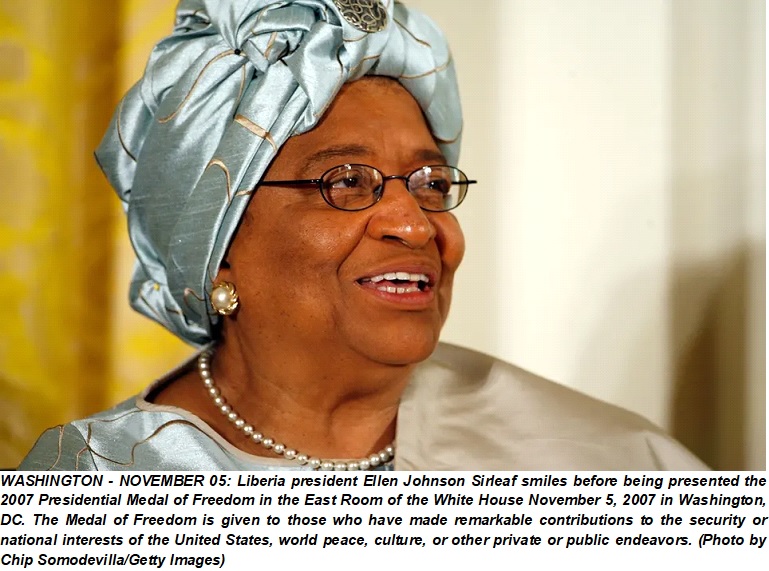
MONROVIA – At a time when women’s political leadership remains constrained by structural bias and cultural resistance, former Liberian President Ellen Johnson Sirleaf continues to advance a values-based case for gender equity grounded in empathy, resilience, and performance. Speaking at the Clinton Global Initiative in 2025, Sirleaf situates women’s leadership not as symbolic inclusion but as a practical necessity for social cohesion, peacebuilding, and development—particularly in post-conflict societies. Her reflections, drawn from lived experience and institutional legacy, reinforce the argument that equality is not merely a rights issue but a leadership strategy with measurable national dividends. Readers are referred to the full article, “Ellen Johnson Sirleaf on Leading with Values and the Power of Women,” by Mandeep Rai, culled from Forbes and published BELOW.
Ellen Johnson Sirleaf On Leading With Values And The Power Of Women
By Mandeep Rai, Contributor – I will be taking you around the world—looking
Published Jan 06, 2026,
Culled from Forbes
“Women have more concern for human life, empathy and the ability to work better with other people than men – they are also equal in every way when it comes to professionalism and performance.”
It was during the Clinton Global Initiative’s 2025 conference that I had the privilege of hearing these words first-hand from Ellen Johnson Sirleaf – the world’s first elected Black female president, former leader of Liberia, and Africa’s first elected female head of state.
I was deeply honoured to sit down with Madam Johnson Sirleaf in person after the conference. At 87, she remains radiant with purpose and energy. In our humbling conversation, she spoke with conviction about her beloved Liberia and her lifelong mission to build a generation of African women leaders who will stand tall and lead with strength, empathy and integrity.
The Value of Equality
Though the glass ceiling for women remains a global reality, Madam Sirleaf’s words resonate powerfully across the developing world, where generations of women have struggled for freedom, recognition, and equal opportunity. She stands uniquely positioned as a trailblazer who shattered barriers and continues to use her platform to advocate for gender equity and leadership grounded in values.
Through the Ellen Johnson Sirleaf Presidential Center for Women and Development, she is now working tirelessly to nurture a pipeline of African women in public leadership – those who have already made their mark and are ready to rise even higher. “I help them stand on my shoulders just as I stood on the shoulders of women leaders who came before me,” she tells the conference audience.
Later, when I ask how we can create an equal platform for women, her answer is both practical and profound.
“Create a place where women can convene to exchange ideas, re-energise strategies, learn from one another, become educated – to show the lifestyles of women in African countries who have made a difference by what they do, what they have done,” she told me.
“This will be a learning place, an interactive one – where when they leave they are ready to take leadership at higher levels and for transformation.”
Liberia: A Land of Beauty and Resilience
MONROVIA, LIBERIA – OCTOBER 20: People enjoy the sunset on the Golden Beach in the Liberian capital of Monrovia on October 20, 2014. (Photo by Mohammed Elshamy/Anadolu Agency/Getty Images)
Getty Images
MONROVIA, LIBERIA – OCTOBER 20: People enjoy the sunset on the Golden Beach in the Liberian capital of Monrovia on October 20, 2014. (Photo by Mohammed Elshamy/Anadolu Agency/Getty Images)
Getty Images
MONROVIA, LIBERIA – OCTOBER 20: People enjoy the sunset on the Golden Beach in the Liberian capital of Monrovia on October 20, 2014. (Photo by Mohammed Elshamy/Anadolu Agency/Getty Images)
Getty Images
As we spoke, Madam Sirleaf described Liberia with unmistakable pride: its golden coastline stretching along the Atlantic, the lush green hills. “Liberia is beautiful,” she said, recalling the breathtaking ocean views.
Yet the country’s past has not always reflected that same beauty. Liberia endured 14 years of brutal civil conflict that tore through its social fabric and economy. It was this very struggle that shaped Madam Sirleaf’s calling to rebuild her nation through unity, integrity, and compassion.
At the Clinton Global Initiative event, Sirleaf celebrated 20 years since she became Liberia’s first democratically elected female president in 2005 and, indeed, Africa’s first. Two decades ago, she had stood alongside President Bill Clinton and other world leaders, pledging to rebuild the war-torn country. Today, she proudly reflects on how collaboration and perseverance have helped transform that vision into tangible progress.
Her path to the presidency, however, was neither simple nor safe.
From Monrovia to the World Stage
Born in 1938 in Monrovia to a family of Gola, Kru, and German heritage, Ellen Johnson Sirleaf grew up in a household that prized education and service. Her father, the first indigenous member of Liberia’s legislature, and her mother, a schoolteacher, instilled in her the belief that knowledge and values could shape nations.
She married young, had four sons, and later pursued her education in the United States, earning a Master of Public Administration from Harvard University. Returning to Liberia, she served as Assistant Minister of Finance under President William Tolbert, known for her intellect and unflinching honesty which ruffled some feathers.
After a 1980 coup plunged the country into turmoil, Ellen Johnson Sirleaf fled to the U.S., where she worked with Citibank and Equator Bank. Her return to Liberia marked a period of political courage: running for office despite threats, imprisonment, and persecution. Undeterred, she persisted, believing that leadership built on resilience, service, and courage could heal a nation.
In 2005, she was elected President of Liberia and re-elected in 2011. That same year, she was awarded the Nobel Peace Prize, recognised for bringing women into the peacekeeping process and championing their place in national decision-making.
Leading with empathy and conviction
In her inauguration address in 2005, she paid tribute to the women whose votes and voices carried her to victory:
“My Administration shall thus endeavour to give Liberian women prominence in all affairs of our country… We shall encourage families to educate all children, particularly the girl child.”
True to her word, Madam Sirleaf expanded education, strengthened democratic institutions, and promoted women’s participation in every sphere of life. Her leadership has been grounded in empathy — a value she believes is too often dismissed in politics but essential to lasting change.
Still, the road ahead is steep. Only two women have been directly elected as heads of state on the African continent: Johnson Sirleaf and Netumbo Nandi-Ndaitwah of Namibia in 2024. The realities for women in public life — especially in Africa — remain harsh.
“Women don’t like to be the talk of the town – they are always subjected to misinformation, criticisms,” she tells me candidly. “We must realise it is not the same anymore; times have changed. Women have prepared themselves for leadership.”
The Harsh Reality for Female Leaders in Africa
Many female leaders continue to face intimidation, online harassment, and gender-based violence simply for holding positions of authority. In a survey of women parliamentarians across 50 African countries, more than 80 percent reported experiencing psychological abuse, and two-thirds encountered sexist remarks or behaviour in their professional roles.
For Madam Sirleaf, these patterns reveal not weakness but the need for deeper cultural transformation. “When a woman goes into politics in Africa,” she reflected, “it’s not just a mental but an emotional battle — one that can also threaten her safety and that of her family.”
And when I asked how she managed to lead a country emerging from civil war whilst bring up children, her reply was as pragmatic as it was powerful: “With a tough skin and realising that criticism without knowledge is just cheap talk. You have to learn to spin it off you. I think more and more, women will not let that be the constraint to them experiencing full equity and opportunity.”
A future for African women built on values
Ellen Johnson Sirleaf’s legacy is more than historic; it is deeply values-based. Her work is driven by equality, empathy, education, and courage — principles she believes are essential for Africa’s next generation of leaders. Her call is for societies to redefine strength. To see empathy, intellect, and moral courage not as feminine traits, but as leadership essentials.
“I would like to see all opportunities open to society with women able to have full participation in every aspect of civil life,” she told me. “What I’m doing is making sure we have a wave of African women with the capacity, knowledge and courage ready for competition and any position.”
Across Africa, evidence bears this out. From Liberian to Sierra Leone to Kenya and Malawi, women leaders have played transformative roles in rebuilding societies and strengthening democracy. As she reminds me: “The record is clear, women participating fully in civil society leads to higher levels of growth and development in countries.”
The Call to Action: Ensuring Full Gender Equality
Ellen Johnson Sirleaf embodies what it means to lead with values. She has deeply inspired me and so many others. Her life and work show that leadership is not about power or privilege, but purpose, which when grounded in empathy and integrity, can transform nations.
Her journey on the world stage continues to inspire. And as she looks to the next generation of African women, her message is simple but profound:
Be part of the movement to ensure full gender equity.
Comments are closed.