

Grand Conspiracy toSell Buchanan Port-Casta Alleges as Political Firestorm Erupts Over Secret Deal
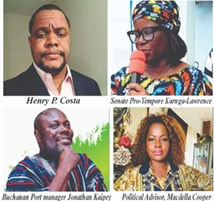
MONROVIA – In the aftermath of port decentralization law by the National Legislature, a political storm is gathering over Liberia’s port sector following explosive allegations by outspoken political commentator Henry P. Costa, who has accused Senate Pro-Tempore Nyonblee Karnga-Lawrence and several lawmakers of conspiring to fragment the country’s port system in order to secretly sell off the strategic Buchanan Port to a French-linked company. The claims, if substantiated, raise serious questions about transparency, legislative intent, and the future control of Liberia’s strategic national assets—particularly the ports, long regarded as pillars of national revenue and sovereignty. The Analyst’s Anthony Q. Jiffan, Jr reports.
In an emotionally charged statement delivered via podcast, Costa rejected the official justification behind recent legislative efforts to decentralize the National Port Authority (NPA), arguing instead that the proposed reforms represent a calculated scheme designed to pave the way for the privatization and long-term concession of the Buchanan Port to foreign interests.
“This Is Not Decentralization, This Is Deception”
Costa began by acknowledging Senator Karnga-Lawrence’s prominent role in sponsoring and lobbying for legislation aimed at decentralizing Liberia’s major ports, including the Freeport of Monrovia, Greenville Port, Harper Port, and Buchanan Port. While proponents of the bill argue that decentralization would enhance efficiency and local governance, Costa dismissed those claims outright.
“This has absolutely nothing to do with decentralization,” Costa said. “It is a lie—a malicious lie—being told to the Liberian people.”
According to Costa, the real objective of the legislative push is not reform but fragmentation—deliberately breaking up the centralized port authority to create legal and administrative conditions that would allow specific ports, particularly Buchanan, to be carved out and concessioned to foreign investors.
Allegations of Secret Meetings and Foreign Influence
Central to Costa’s accusations is the claim that Senator Karnga-Lawrence, along with family members, political allies, and fellow lawmakers, has already begun engaging in negotiations with Africa Global Logistics (AGL), a company reportedly affiliated with a French billionaire.
Costa alleged that these engagements began even before the legislation had fully passed into law, describing the actions as a blatant violation of the separation of powers.
“What right does a member of the legislative branch have to dispatch lawmakers and family members to meet with a group seeking to acquire a national asset?” Costa asked. “A law has not even been passed, and yet negotiations are already underway.”
He claimed to possess photographic and documentary evidence showing meetings between Karnga-Lawrence’s associates—including a family member and Buchanan Port Manager Jonathan Kaipey—and representatives of the French-linked company. Costa further alleged that President Joseph Boakai’s political advisor, Macdella Cooper, was also involved in the discussions.
Costa asserted that these delegations allegedly toured foreign ports managed by the same company, ostensibly to inspect infrastructure and operational models, all while the decentralization bill was still under legislative consideration.
Claims of Financial Incentives and Legislative Speed
One of the most serious allegations leveled by Costa is that foreign money is influencing the pace and outcome of the legislative process. He suggested that the rapid movement of the bills through the Legislature and onward to President Joseph Nyuma Boakai was fueled by financial backing from the foreign company in question.
“Look at how quickly these bills passed,” Costa said. “The money was pumping—pumping the process so that the moment it becomes law, they can move in.”
While Costa provided no publicly verified financial records during his statement, he insisted that evidence would be released to substantiate his claims.
Buchanan Port at the Center of the Storm
Costa repeatedly emphasized that, in his view, the Buchanan Port is the true target of the alleged scheme. He claimed that once the port is made administratively independent under the decentralization framework, it would be swiftly concessioned for 25 to 30 years, granting foreign operators near-total control.
“The moment the president signs this into law, they will move to concession the Buchanan Port,” Costa warned. “And then we will be crying again about lost revenue, lost sovereignty, and another national asset gone.”
He further alleged that political control over the port had already been consolidated through allies of Senator Karnga-Lawrence, making the transition to a concession arrangement easier.
Naming Names: Dillon, Cooper, and Political Allies
In one of the most contentious portions of his statement, Costa implicated Montserrado County Senator Abraham Darius Dillon, arguing that such a deal could not proceed without his knowledge or involvement. Costa cited his own past political support for Dillon and others as grounds for speaking out now.
“When you help make somebody, you have every right to call them out when they go wrong,” Costa said, recalling his role in mobilizing protests, exposing alleged corruption, and providing political platforms during the opposition years.
Costa expressed disbelief that Senator Dillon could be unaware of what he described as a “shady deal” involving a foreign company with a controversial history in Africa.
Appeal to President Boakai
Costa concluded his remarks with a direct appeal to President Joseph Nyuma Boakai, urging him to veto what Costa described as a “fraudulent” revised port act, just as the President had rejected an earlier version.
“To my dear uncle and president, I know you will veto this,” Costa said, warning that the law would open the door to the immediate sale or concession of the Buchanan Port.
He also questioned how members of the ruling collaboration could reconcile their political commitments with alleged dealings involving foreign companies accused of manipulating elections and exploiting African state assets.
A Nation Awaits Evidence and Official Response
As of publication, neither Senator Karnga-Lawrence, Senator Dillon, Macdella Cooper, nor Africa Global Logistics has publicly responded to Costa’s allegations. Senate leadership has also not issued an official statement addressing the claims.
Costa has promised to release what he describes as photographic and documentary evidence to support his assertions—a move that could further intensify public scrutiny and political tension.
For now, the allegations have reignited a broader national debate over transparency, foreign investment, and the future of Liberia’s strategic assets—particularly its ports, long regarded as vital engines of national revenue and sovereignty.
Whether Costa’s claims will be substantiated or refuted remains to be seen, but they have already cast a long shadow over the decentralization debate and placed the Buchanan Port at the center of Liberia’s unfolding political drama.
Comments are closed.