

Govt. Unveils Sweeping Security Reforms -Officials say new security strategy will drive transformation
MONROVIA – The unveiling of Liberia’s new National Security Strategy signals more than a recalibration of security policy; it reflects a broader effort by government to align governance, development, and institutional reform within a unified national framework. As modern threats increasingly blur the lines between security, migration, economic stability, technology, public health, and social cohesion, policymakers are embracing a more integrated approach to state management. During the government’s latest public briefing, officials linked the strategy to ongoing reforms in education, anti-money laundering efforts, land governance, migration management, infrastructure development, and international engagement. The message was clear: national security can no longer be separated from the wider conditions that shape stability and prosperity. As THE ANALYST reports.
GOVERNMENT UNVEILS NEW SECURITY STRATEGY
The Government of Liberia has officially unveiled a new National Security Strategy designed to transform the country’s security architecture from a reactive model into a proactive, people-centered framework capable of addressing evolving threats while strengthening national resilience.
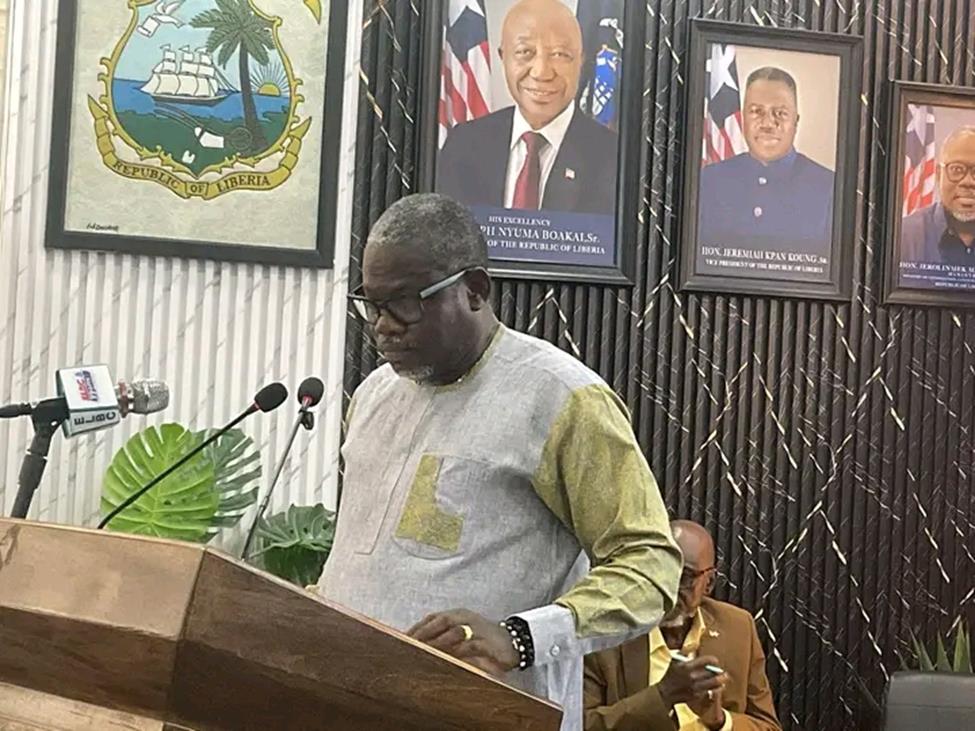
The announcement was made during the Ministry of Information’s regular press briefing in Monrovia, where Information Minister Jerolinmek Matthew Piah described the strategy as one of the most comprehensive security frameworks developed in recent years.
According to Minister Piah, the strategy was officially launched by President Joseph Nyuma Boakai following an extensive two-year consultative process involving security institutions, government agencies, local communities, civil society organizations, development partners, and technical experts.
The framework is intended to position Liberia to respond more effectively to both traditional and emerging threats while fostering stronger institutional coordination and public participation.
Officials say the strategy forms a central pillar of the administration’s broader governance and development agenda.
FROM REACTIVE TO PROACTIVE SECURITY
Minister Piah explained that the strategy represents a significant departure from traditional security approaches that focused primarily on responding to crises after they emerged.
Instead, the new framework prioritizes anticipation, prevention, preparedness, and resilience-building.
“The strategy represents a shift from reactive and sectorial responses toward an integrated, anticipatory and all-of-society security architecture,” Piah stated.
Under the new model, government institutions will place greater emphasis on identifying risks before they escalate into major threats.
The framework encourages investment in early warning systems, risk-informed planning, crisis prevention mechanisms, and community-based interventions.
According to officials, prevention remains less costly and more effective than responding to full-scale emergencies after they occur.
The strategy therefore seeks to strengthen Liberia’s capacity to anticipate and manage threats before they undermine stability.
EMERGING THREATS SHAPE NEW APPROACH
Government officials noted that Liberia’s security environment has changed considerably over the past decade.
Among the challenges identified are climate change, cyber threats, transnational organized crime, economic vulnerabilities, public health emergencies, and social instability.
These issues increasingly transcend the traditional responsibilities of military and law enforcement agencies.
Minister Piah emphasized that modern security challenges require coordinated responses involving multiple sectors of government.
As a result, the strategy promotes closer collaboration among security institutions, public health authorities, educational institutions, justice agencies, local governments, and economic planners.
Officials believe this integrated approach better reflects the interconnected nature of contemporary threats.
The framework is designed to ensure that security considerations are incorporated into broader national development planning.
PEOPLE-CENTERED SECURITY AT THE CORE
One of the defining features of the strategy is its emphasis on human security and citizen participation.
According to Minister Piah, the framework recognizes that lasting security depends on public trust, effective institutions, social inclusion, and economic opportunity.
“Security is not achieved through instruments of force alone. It is achieved when citizens trust institutions, communities participate in safety planning and the rule of law protects rights and opportunities,” he stated.
Government officials argue that communities must become active partners in maintaining security rather than passive recipients of state protection.
Consequently, the strategy seeks to strengthen engagement between citizens and government institutions.
Officials believe this approach will improve accountability, responsiveness, and public confidence in the security sector.
REFORMS TARGET COMMUNITY PARTICIPATION
To translate the strategy into practical action, government plans to strengthen county and district-level security committees throughout the country.
These structures are expected to serve as important channels for identifying local concerns and informing national security priorities.
The framework also promotes enhanced community engagement, expanded public awareness campaigns, and stronger collaboration between local authorities and security institutions.
According to officials, local participation remains essential to building resilient communities capable of responding effectively to emerging threats.
Government representatives say community ownership of security initiatives will contribute significantly to long-term stability.
The reforms are intended to ensure that local voices are incorporated into national decision-making processes.
HUMAN RIGHTS AND ACCOUNTABILITY EMPHASIZED
Minister Piah disclosed that the strategy includes measures aimed at strengthening accountability and human rights protections within the security sector.
Planned reforms include expanded human rights training programs, stronger oversight mechanisms, and improved accountability systems.
Government officials argue that effective security institutions must also be trusted institutions.
As part of this effort, authorities intend to improve transparency and encourage greater citizen engagement in security governance.
The strategy recognizes that public confidence is a critical component of national security.
Officials believe stronger accountability frameworks will improve operational effectiveness while reinforcing democratic principles.
YOUTH AND GENDER INCLUSION PRIORITIZED
The strategy also places considerable emphasis on addressing the social drivers of insecurity.
Government officials indicated that youth empowerment, education, skills development, and economic opportunities will play important roles in preventing crime and social instability.
Special attention will also be given to gender inclusion.
The framework seeks to ensure that women and girls are fully integrated into security planning, implementation, and leadership processes.
According to the government, promoting inclusive participation strengthens social cohesion and improves policy outcomes.
Community-based early warning systems will also be expanded to help citizens identify and report threats promptly.
Officials view these initiatives as essential tools for strengthening resilience at the local level.
IMPLEMENTATION ROADMAP ESTABLISHED
To ensure the strategy produces measurable results, the government has developed a detailed implementation roadmap.
The roadmap includes performance indicators, financing arrangements, institutional reforms, and monitoring mechanisms.
Minister Piah stressed that implementation will be guided by measurable targets and periodic assessments.
Regular reporting systems will be established to promote transparency and accountability.
Government officials maintain that successful implementation will require sustained commitment across multiple institutions.
The roadmap is expected to serve as the primary framework for coordinating security reforms over the coming years.
INDIA TRAGEDY DRAWS GOVERNMENT RESPONSE
Beyond the security strategy, Minister Piah addressed recent international developments affecting Liberian citizens.
He disclosed that the government had received official information from India’s Ministry of External Affairs regarding the death of a Liberian national during a recent fire incident in India.
The Liberian government extended condolences to the affected family and acknowledged expressions of sympathy from Indian Prime Minister Narendra Modi.
Piah further revealed that another Liberian woman who had traveled to India seeking medical treatment for her husband was among those injured.
Government officials indicated that they remain engaged with relevant authorities regarding the welfare of affected Liberian citizens.
SOUTH AFRICA SITUATION UNDER MONITORING
Addressing reports of anti-foreigner violence in South Africa, Minister Piah said Liberia’s Embassy in Pretoria has informed the government that no Liberian citizen has thus far been affected.
According to information received from the diplomatic mission, fewer than 200 Liberians currently reside in South Africa, many of whom hold refugee status.
The South African government has reportedly condemned the attacks and directed law enforcement agencies to protect all residents regardless of nationality.
Liberian authorities say they will continue monitoring developments closely and provide updates as necessary.
The government emphasized its commitment to ensuring the safety and well-being of Liberian citizens abroad.
EDUCATION SECTOR RECEIVES BOOST
The Ministry of Education also announced several initiatives aimed at strengthening educational delivery across the country.
Among the measures highlighted was the placement of an additional 1,000 qualified volunteer teachers on the government payroll through allocations contained in the national budget.
Government officials believe the initiative will improve classroom instruction and reduce staffing shortages.
Additionally, plans are underway to recruit 150 monitoring and evaluation interns to support county education officers.
The interns will assist in strengthening school supervision and ensuring compliance with educational standards nationwide.
These measures form part of broader efforts to improve educational quality and accessibility.
SCHOOL FEEDING PROGRAM EXPANDS
Minister Piah further disclosed that government intends to significantly expand the national school feeding program.
Coverage is expected to increase from 18 percent to 45 percent of primary school students by 2027.
Officials believe the expansion will improve student attendance, retention, and academic performance.
The Ministry of Education has also completed school geo-mapping exercises in five counties as part of efforts to improve planning and resource allocation.
Meanwhile, reforms in the school permitting process have reportedly resulted in an increase in the number of licensed educational institutions.
Government officials view these developments as important steps toward strengthening the education sector.
BURKINABÉ MIGRATION RAISES CONCERNS
Another issue highlighted during the briefing involved a growing influx of migrants from Burkina Faso into southeastern Liberia.
Minister Piah revealed that a joint assessment conducted by the Liberia Refugee Repatriation and Resettlement Commission and development partners estimates that approximately 140,000 Burkinabé nationals are residing in Grand Gedeh and River Gee Counties.
Many are reportedly engaged in mining and agricultural activities.
Officials described the situation as an emerging national security concern requiring careful policy attention.
The influx is placing pressure on local resources while creating both humanitarian and security challenges.
President Boakai has reportedly directed that the issue be elevated to Cabinet level for broader discussion and policy consideration.
LAND GOVERNANCE REFORMS ADVANCE
The government also announced strengthened cooperation between the Liberia Land Authority and the Judiciary.
The partnership seeks to improve land governance, reduce disputes, and strengthen legal certainty regarding land ownership and administration.
Chief Justice Sie-A-Nyene Gyapay Yuoh reportedly welcomed the collaboration and emphasized the importance of addressing land-related conflicts.
Land disputes remain among the most common sources of community tensions across Liberia.
Officials believe stronger institutional cooperation will improve transparency and conflict resolution.
ANTI-MONEY LAUNDERING CAMPAIGN LAUNCHED
The Financial Intelligence Agency has meanwhile launched a nationwide anti-money laundering and counter-terrorism financing awareness campaign.
The initiative is being implemented in collaboration with other government institutions.
Authorities say the campaign seeks to address weaknesses identified during Liberia’s second-round mutual evaluation conducted by GIABA.
Officials maintain that combating illicit financial flows remains essential to national security and economic stability.
The campaign forms part of Liberia’s broader efforts to strengthen regulatory compliance and improve international standing.
POLICE AND MEDIA STRENGTHEN RELATIONS
The Liberia National Police has also commenced a two-day media-police relations workshop aimed at improving cooperation between journalists and law enforcement officers.
The training focuses on media ethics, crisis communication, public information management, transparency, and strategic engagement.
Officials believe stronger relationships between the media and police can improve public confidence while promoting responsible information sharing.
The workshop reflects broader efforts to strengthen institutional communication and accountability.
INFRASTRUCTURE REMAINS DEVELOPMENT PRIORITY
Concluding the briefing, Minister Piah highlighted ongoing road construction and rehabilitation projects across the country.
He described road connectivity as a central pillar of President Boakai’s ARREST Agenda for Inclusive Development.
According to him, significant progress has been recorded on several road corridors, with additional projects continuing nationwide.
Improved road infrastructure, he emphasized, remains critical for economic growth, agricultural development, market access, and national integration.
“Roads help to revive the economy, connect communities, and make it easier for farmers to transport their produce to markets,” Piah stated.
He reaffirmed government’s commitment to ensuring that ongoing projects are completed within established timelines and continue contributing to national development objectives.
Comments are closed.